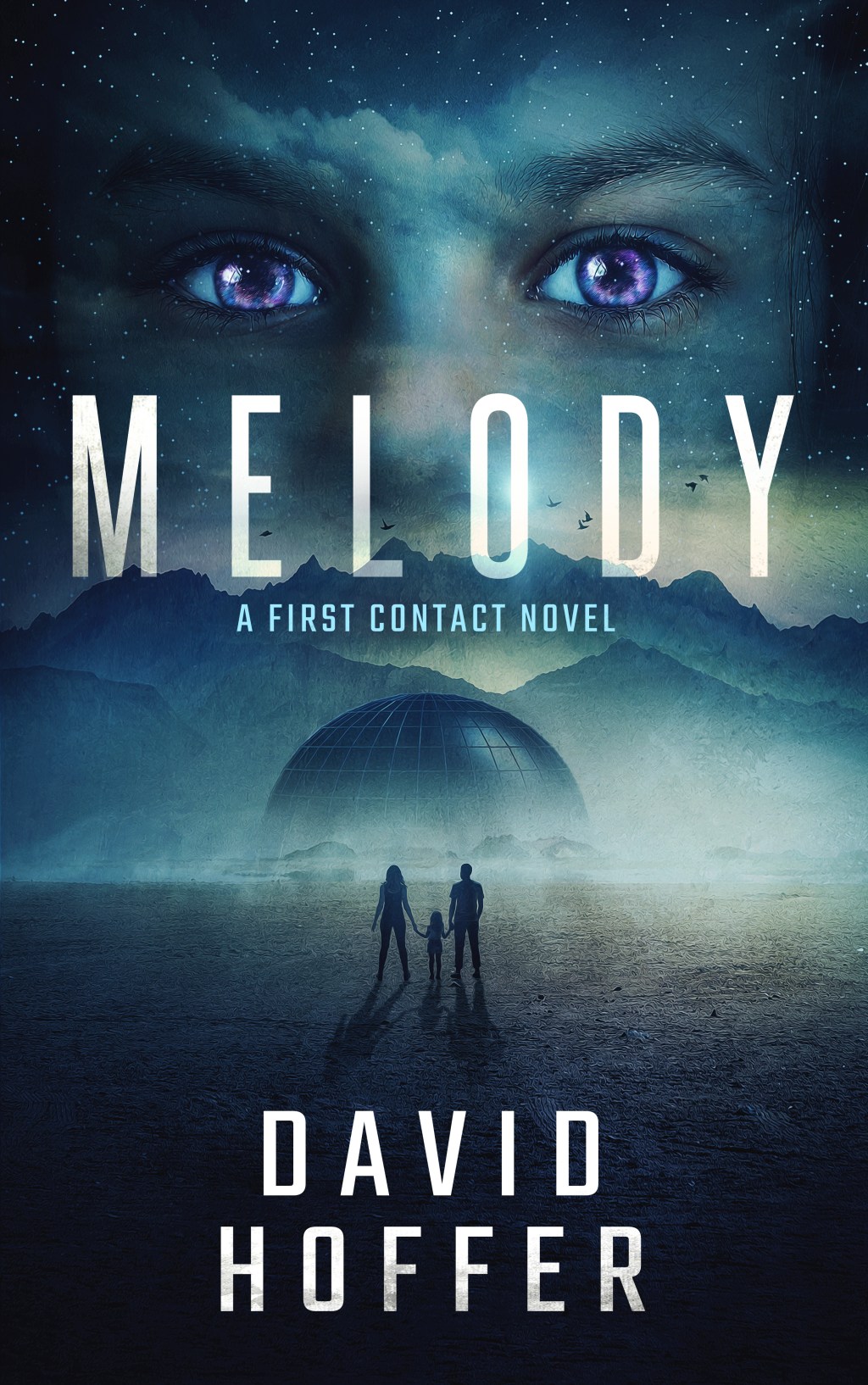
Ladies and gentlemen, welcome to the SPSFC2 finals. We have whittled our entrants down to a mere seven, all clamouring for the title of SPSFC Champion. So without further ado, here is my take on Melody, by David Hoffer.
This is my second go at reading Melody. Last year, it was in my team’s slushpile. It didn’t progress further than that, largely due to the team’s reaction to the handling of mental illness in the opening chapters, followed immediately by the death of a child. That’s a heavy opening. This year, it appears the book landed with a more favourable team, as it has now ended up in the final seven. Having now read the book in its entirety, I can report that it deserved to leave the slushpile. Though whether it should go on to win, I’m less certain.
The book does get off to a rough start. it dumps a whole load of trauma on the main character and just expects the reader to go along with it. Which I didn’t. Stephen is an absolute wet blanket of a character, and his personal struggles were by far the weakest part of the book for me. Early on, there’s a great mystery surrounding the fact that as a child he heard voices, and now his daughter suffers a similar affliction. Now, I will hold my hand up and admit to not being a mental health professional. But if I were a character in this book, i don’t think I’d be as baffled by all this as Stephen. I’d just assume it was something hereditary and move on as best I could. Of course, this being science fiction, this mental illness is in fact the work of aliens. Kind of.
It’s when we leave Stephen that the novel is at its strongest. First off, Dolores is a more interesting character, with a more plausible conflict to face. The scenes we spend in NASA and the halls of power are reminiscent of Cosmos (the film adapted from Carl Sagan’s novel) as humans communicate with an alien race that appears to be testing us. There’s even the construction of a mysterious machine. I have quibbles with Hoffer’s choice to vary between first and third person, but the prose is generally very strong, and the NASA scenes are uniformly great for almost all of the book. It’s a realistic first contact scenario, in so far as such a thing exists. There’s a refreshingly hard SFness to these chapters that elevates the whole novel.
I was thoroughly confused by the ending, however. The science goes out of the window in favour of some very odd ideas around reincarnation and ancestral memory. I’m still not entirely sure went on there, and I can’t really talk about it without spoiling the novel. Suffice to say that the ending did not live up to the strengths of the middle.
At Boundary’s Edge will not be revealing our team scores until all judges have read all books. Stay tuned for my final review, which is coming very soon.


 At Boundary's Edge