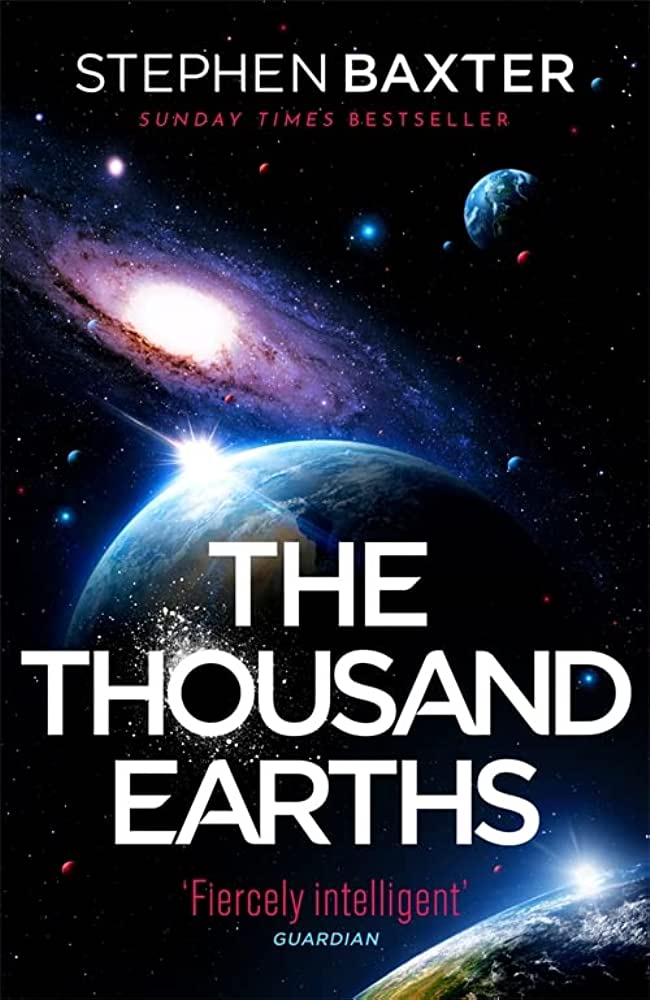
Teaser
John Hackett will go further than any man before. His is a voyage that will take millions of years. But what manner of world will he return to? And what manner of people will dwell upon it . . .
Review
One of my pet peeves with blogging is the incessant hyperbole. It seems like every book is touted as an instant classic, or the best thing ever. ‘A strong contender for book of the year’ is a phrase that gets trotted out in just about every positive review. Now, at some point you will read the best book of the year, but I do my best to keep a level head an not get to carried away. Nevertheless, The Thousand Earths gives me the confidence to say that Stephen Baxter is one of my favourite active science fiction authors. Adrian Tchaikovsky and Christopher Ruocchio are in the mix too, but Baxter has had only one misstep in all the books of his I’ve read. That’s got to be worth something. And with seven of his novels under my belt, I’m only just getting started.
The Thousand Earths shocked me with its structure. There are two narratives at work. First, we have Hackett and his infinite voyage. We revisit Earth at various points, each time seeing how civilisation has changed over millions of years. At the same time, separated only by chapters, we have the story of Mela, a young girl who lives on a flat world that is slowly eroding, and has only thirty years left before annihilation. Either one of those is a great story in its own right, but there’s no immediate connection between the two. Indeed, they don’t cross over until there are only a few chapters left in the book. Normally, this would frustrate me. However, there are two caveats. the first is that I have great faith in Baxter as a writer, so I’m inclined to give him some leeway even with my most hated tropes. The second is that the two stories have great thematic parallels. As this is primarily a novel about ideas, and the discovery of new worlds, this ties them together strongly enough for me to overlook the fact that one does not affect the other for five hundred pages.
The John Hackett sections remind me a lot of H.G. Wells, which is not surprising given Baxter’s influences. Hackett spends his time travelling between Earth and far-flung locations, and discovers a very different Earth each time. A lot of science fiction goes decades or centuries into the future, but Baxter takes us billions of years from today. Each new Earth society is brought to vivid life in an impressively short time. By the end of Hackett’s journey, humans are barely recognisable as such.
Which dovetails nicely with Mela’s half of the book. Life on a shrinking Earth is not a utopia, and as the land shrinks, the number of refugees increases, all streaming towards the centre of the flat Earth. In these chapters we see the worst of what humanity can stoop to. It’s a rare enjoyable (from a reading perspective) apocalyptic scenario, and the treatment of the refugees is chillingly plausible. There’s not a whole lot of joy going around in these chapters, but it stands as a star counterpoint to the utopian ideals encountered by Hackett in his many return trips.
Stephen Baxter writes the sort of science fiction I’ve always wanted to read, and I can’t believe it’s taken me this long to get into his lengthy catalogue of work. This is fiction where the science matters, where ideas reign as champion, and where your mind is opened up by the end of the book. I cannot recommend it highly enough.
Deeper Dive: Many Books, One Story
All authors have themes they keep coming back to. Isaac Asimov could never escape his robots. Frank Herbert couldn’t help but include mysticism in everything he touched. After seven books, I’m starting to understand the themes that keep Stephen Baxter up at night.
Deep Time is a concept I’m still coming to grips with. Basically, it’s the idea that the universe is very big and very old, and that humans are largely insignificant in the grand scheme of things. heady stuff. Proxima and Ultima lost me a little bit with the idea that cosmic bacteria are intertwined. But Galaxias was a more compelling idea of a living planet. That much I can buy into. And with The Thousand Earths we face the idea that the universe is made for stars rather than for humans, and we’re just parasites that stumbled into existence. This is exactly the kind of existential dread I can appreciate. it’s a cold universe out there folks, so be good to one another. Maybe we’re all we’ve got.
Book Stats
- A Standalone Novel
- Published by Gollancz
- First published in 2022
- Hard SF
- 579 pages


 At Boundary's Edge