Teaser
Mourning the loss of the Red Company, Hadrian Marlowe returns to a Sollan Empire wracked by strife. With Cielcin attacking on every front, it seems that Hadrian’s days of fighting are far from over . . .
Review
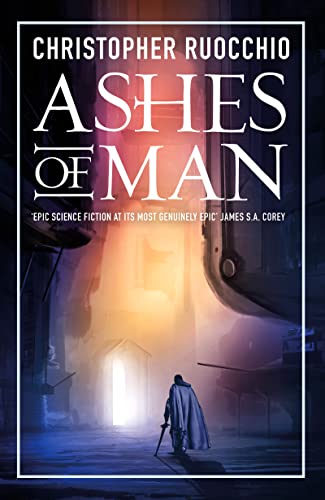
It’s always a good day when a new instalment of your favourite series is released. When I’m really into a current series, I try and read the book close to release date. Partly to avoid having it spoiled, partly because I want to be able to talk about it right away, but mostly because I’m just really excited to get to the book in question. Yet with The Sun Eater series, I often find myself reading them a little while after release. In the case of Ashes of Man, it was released in December last year, I received my copy in January, and only now in July have I actually read it. Now, these are weighty books. High in page count and also rich in the writing, so I wanted to make sure I had the time to properly commit to reading it. After my miserable start to the reading year, this was probably a wise choice. But I was also hesitant. Kingdoms of Death took the series in a direction that, the more I thought about it, the less I liked. Would Ashes of Man sour me on the entire series? Or would it reclaim its place on the science fiction podium?
Given that Kingdoms of Death and Ashes of Man were originally envisaged as one book, it’s no surprise that this volume essentially picks up right where the last one left off. The Red Company is dead, and Hadrian is in self-imposed mourning. This had me concerned at first. Hadrian’s tale is already a melancholy one. I don’t think I could stand any Robin Hobb-esque moping around, no matter how dramatic it may be. Thankfully, Hadrian soon returns to society, and from there on the book is a headlong rush towards inevitable further tragedy.
Ashes of Man can broadly be split into two major sections. The first is Hadrian regaining the confidence of the Emperor (and his own self) while the second is a siege. In the first half, we get more details on the Extrasolarians, who are among the more fascinating cultures in what is a very rich world. Seeing how the Extras plot and scheme against the Sollan Empire using technology is perhaps the most science fictional part of the entire series. In these earlier sections we are also introduced to a man named Oliva, who is surely deserving of a spin-off novella at the very least. One thing this series does very well is build a sense of the universe existing beyond its main character.
Then comes the siege, which was always going to score highly with me. Along the way, there is a misstep which I’ll detail in my Deeper Dive below, but the siege itself is as good as anything Ruocchio has written. And let me tell you, Ruocchio can write. His is that rare prose that stands out from the page, but in a way that forms the story rather than obscuring it. Through the lens of Hadrian’s memoirs, Ruocchio has to be one of the best writers of elaborate prose active in the field. As someone who prefers prose to be almost invisible, I am constantly floored by how well he writes. Ask me what good writing looks like, and I’ll point you to this series.
In short, Ashes of Man is another phenomenal arc in the grand tragedy of Hadrian Marlowe. Surely one of the best ongoing science fiction series.
Deeper Dive: Putting the Fantasy in Science Fiction
Ruocchio advertises his series as science fantasy, with the stated aim of snaring both fantasy and science fiction readers. Personally, I categorise them as space opera. However, Kingdoms of Death swung things in a far more fantastical direction, and Ashes of Man doubles down on that. In earlier books, the Quiet were depicted as an unknown alien species, reaching back through time. In recent volumes, however, they have become deified by both characters and the text itself. Hadrian Marlowe and Syriani Dorayaica are no longer simply great leaders, they are appointed champions of their gods.
In terms of narrative, there is no problem here. It serves as one more upping of the stakes as the series heads towards its conclusion. On a thematic level, however, I find the involvement of gods to be fundamentally underwhelming. In earlier books, the conflict between humanity and cielcin was one of irreconcilable differences. the ultimate culture clash. Now, however, the fight for survival has taken on a new existential level. It is not simply a race of alien locusts who must be stopped, but a malevolent god bent on humanity’s erasure. It’s perilously close the good/evil binary that, while great for storytelling, is of little interest to me on a philosophical level. It’s an unfortunate misfire from a series that is otherwise philosophically engaging at every turn.
Book Stats
- The Sun Eater Sequence (#5)
- Published by Head of Zeus
- First published in 2022
- Space Opera
- 498 pages


 At Boundary's Edge