Teaser
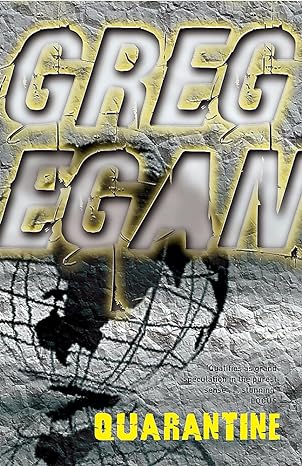
In the middle of the twenty-first century, our solar system is shrouded in an impenetrable barrier, forever cutting us off from the stars. A generation later, a missing persons case leads a detective into a most unusual conspiracy . . .
Review
I first learned about Greg Egan through the YouTube channel Media Death Cult. The two key things to know about the man are a) he is an incredibly qualified mathematician and scientist, and b) his books take the term ‘hard SF’ to the extreme. This is a man who writes what he knows, which I always enjoy seeing in this genre. Unfortunately, such books also have a tendency to reveal my own stupidity. Because while I started off enjoying this book, I pretty much lost the ability to focus after the first act.
The first act uses the isolation of the human race largely as background for a run-of-the-mill police procedural. A woman has been abducted from a mental asylum, but no one can figure out how. Classic locked room mystery. Egan only takes us forty years into the future (seventy at the time he wrote it) so all of the developments feel plausible. I suppose living on the cutting edge of science lets you predict the future with some degree of accuracy. Egan depicts a society where you can download modifications at will. For example, police officers modify themselves to remain calm under pressure, while our protagonist spends time with the data ghost of his dead wife. It’s an expanded, and quite frankly better, version of an idea that I encountered recently in Philip K. Dick’s Do Androids Dream of Electric Sheep?
The second act is where quantum physics comes into play. Now, I am familiar with the paradox of Schrodinger’s Cat, which is simultaneously alive and dead until concrete proof either way is observed. that, I can just about wrap my head around. Egan goes further. Too far for my puny brain to handle. What if, he posits, the entire universe is the Cat? What if we define the universe through the simple act of observing it? Okay, I think I can get behind that idea. But again, Egan is several steps beyond me. What if those possible universes all exist, and are trying to influence the observer, ensuring that they become real? At least, I think that’s what was happening. It all got very technical, and very confusing.
I walk away from Quarantine in awe of Egan’s imagination, but frustrated by my own inability to follow his lines of thought. Maybe it’s a communication issue, but it’s just as likely I’m too thick for this sort of literature. Maybe even a hard SF nut like myself has set limits. Curiously, if this same mind-blowing idea had been presented in a tenth of the pages, I think I would have been all over it. There’s something to be said for the short story, and that’s the format any future encounters between myself and Egan are likely to take.
Like the meeting that could have been an email, Quarantine is a novel that could have been a short story. I’m sure there are those who will praise Egan for the lengthy exploration of the idea, but for me it was simply overwhelming.
Book Stats
- A Standalone Novel
- Published by Gollancz
- First published in 1992
- Hard SF
- 249 pages

 At Boundary's Edge