
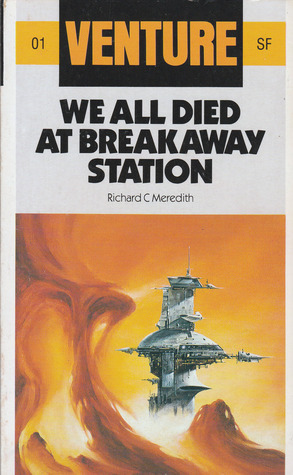
Teaser
Humanity is at ware with the Jillies – a war that seemingly has no end. Among the casualties of this war are Absolom Bracer and his crew, revived from the brink of death and tasked with escorting a hospital ship back to Earth. Yet the Jillies are relentless, and at Breakaway Station, Bracer and his crew must make a valiant final stand . . .
Review
I love a good last stand almost as much as I like a long retreat. Thermopylae, Rorke’s Drift, you name it. Give me a small defensive force against overwhelming odds, and my blood is pumping with excitement. On that basis alone, you’d think We All Died At Breakaway Station would be a good fit for me. As it happens, however, it was a book I was only vaguely aware of. Having read a few of the Venture SF collection (and enjoyed them) I’d seen it listed as the first of the range and made a mental note to pick it up if I happened across it. Unfortunately, it turns out that this book is monstrously hard to get hold off, sometimes commanding three figures on eBay. Now, I managed to snag a far, far cheaper copy than that, but I probably wouldn’t have kept looking online if I hadn’t been buying it as a gift. A gift that, as a devourer of all things sci-fi, I naturally read before handing over. And let me tell you, I’m glad I did. This book is absolutely brilliant.
Military SF from a time before that term really existed, We All Died At Breakaway Station is not only concerned with the fate of the soldiers, but with the civilians they give their lives to defend. For such a short book, there is an impressively broad scope. It didn’t surprise me to learn that this was expanded from a shorter piece. But while some expansions pad a story out with additional scenes following the main narrative, Meredith’s novel uses the increased page count to show us other stories running alongside the central arc. Thus, alongside Bracer’s preparations for his final stand, and the desperate flight of Earth’s forces from a more powerful force, we are also treated to scenes of young lovers as their world is destroyed, a preacher trying in vain to bring peace between humans and Jillies, and all the daily affairs of countless men and women living in the shadow of the war. Though detached from the main narrative, these scenes serve as a stark reminder that war is not all about heroes and monsters.
And those heroes are a far cry from the square-jawed heroes that other stories of the period boasted on their covers. Meredith’s soldiers have been brutalised by war. Bracer himself is little more than a head and an arm, wired into a life-support cylinder. I can’t help but envisage Doctor Who‘s Davros, but even that grim image does not do justice to the character. Others have faces rebuilt with plastic, missing eyes and limbs and organs. Even the ship’s computer was once a human, now only a brain hooked up to a warship. This is a war that is truly dehumanising. The exact methods by which the dead soldiers are revived are left vague, and the book was obviously written before modern innovations in prosthetics and plastic surgery. Nevertheless, it’s a hard-hitting depiction of just how much of a toll war takes on those who wage it.
Beyond the military aspects, there is some great science fiction in here. The Jillies are an interesting alien species. Telepathic (the alien go-to of the sixties) and with mobile stomachs, the most interesting aspect for me is their motivation. It’s never spelled out, but it is noted that Jillies have engaged with humans in a less than absolutely hostile manner before. Of course, they have also abducted humans for science projects. Their language and entire frame of reference is so incomprehensible to the human mind that meaningful communication is all but impossible. That sense of ambiguity is a strong point, especially as we only get the perspective of fairly low-ranking individuals. Even the admiral we spend some time with is more concerned with winning the war than understanding its origins. That same ambiguity hangs heavily over the book’s climax. The ending is definitive, but it is only the end of this story, not the end of the war.
This being over fifty years old, there are course some dated elements, but nothing that will disturb a reader’s journey. Characters do a lot of smoking, and just about everyone is planning to get it off with the opposite sex at some point. It was the sixties, it was a wild time. Or so I’m told. But none of this drags the book down. Because the other elements, the better elements, are timeless. This is a book about war and suffering, yes. But it’s also about the importance of doing the right thing, of standing by your convictions, and not giving in to despair.
Book Stats
- Part of the Venture SF Range
- Published by Hamlyn, 1985 (originally published 1969)
- Military SF
- 244 pages


 At Boundary's Edge