
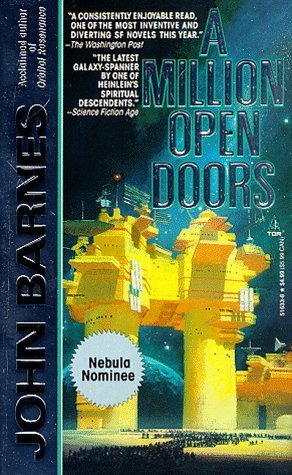
Teaser
Humanity has spread far among the stars, and every world has developed its own culture, its own traditions. When a new technology brings the scattered worlds of humanity back into communication, those cultures encounter each other for the first time, and the clashes are as dangerous as they are inevitable . . .
Review
John Barnes is the author of one of my favourite books. Technically, Encounter with Tiber is co-written with famed astronaut Buzz Aldrin, but I don’t think I’m alone in suspecting that much of the actual prose is the work of Barnes in that case. The level of detail is the sort that only an astronaut could provide, however, so Buzz was definitely pulling his weight. Despite Encounter with Tiber‘s place on my favourites list, however, I’ve never felt the urge to seek out more novels by John Barnes as a solo author. That changed when I happened across a copy of A Million Open Doors. The John Harris cover art is always a draw, and the blurb sounded fascinated, so I plunged in headfirst. Emerging damply on the other side, I have one overriding question: Where is the man who wrote Encounter with Tiber? It’s a question I ask in despair, as this book has so little of what I loved in that other Barnes work.
My main issue with this book was the writing itself. I admit, it seems like an obvious thing to dislike a book over. After all, what is a book if not the writing? I can’t quite pin my finger on why it didn’t work for me, but I found the whole book to be very stilted. This is not helped by the amount of French (at least I think it’s French) peppered throughout the book. In theory, it’s a great idea to have unique fusions of different Earth cultures. In practice, though, it interrupts the flow of the prose when I frequently stumble into unfamiliar terms. And if I’m having problems at a sentence level, you can imagine how that accumulates over the course of the novel.
A lot of the cover quotes and reviews for A Million Open Doors claim Barnes to be the rightful successor to Robert A. Heinlein. I can see why. There are similarities in the style, but also in the ideas. This is effectively a space opera told without spaceships. Instead we have teleporting doorways known as ‘springers’ that send people between worlds. As in Heinlein’s works, here we see a young man thrown into a foreign culture. And, as in so much Heinlein, there’s an unfortunate reliance on sexual morality to illustrate how foreign those cultures are. Thankfully Barnes doesn’t go too into detail, but I’m not all that convinced by acts of public BDSM as a counterculture. The duelling culture, though. That has some merit to it, even if the delivery isn’t all that it could have been.
A Million Open Doors is over thirty years old, but it feels twice that. Tell me this was a work of the sixties, and I’d have believed you. Oftentimes, that’s a period I love to see books hearken back to in their styles, but not this time. This time, I am fundamentally underwhelmed by a book that I dearly hoped to enjoy.
Book Stats
- Thousand Worlds (#1)
- Published by Tor
- First published in 1992
- 309 pages

 At Boundary's Edge