Teaser
The psychohistorians have ruled the galaxy for tens of thousands of years, guiding civilisation with mathematics that only they understand. It is an arrangement that not everyone agrees with, but how can you oppose those who control the future . . ?
Review
I have a lot of random thoughts, and one that crops up a few times a year is this: Why don’t books have cover versions. After all, covers and remakes are all the rage in other forms of media. Modern versions of classic songs regularly appear in the UK Top 40, and even a casual glimpse at modern TV and cinema will reveal a plethora of remakes. The closest books seem to come is adaptations (I’ve seen three live action versions of Dune alone). Yet there are vanishingly few book-to-book remakes. There is no ‘Brandon Sanderson’s The Lord of the Rings‘ or ‘Stephen King’s Oliver Twist,’ for example. You might get books that are written in response to others, but never an old title with a new author. I suppose the closest we get is updates of ancient mythology, and those are very much their own creature.
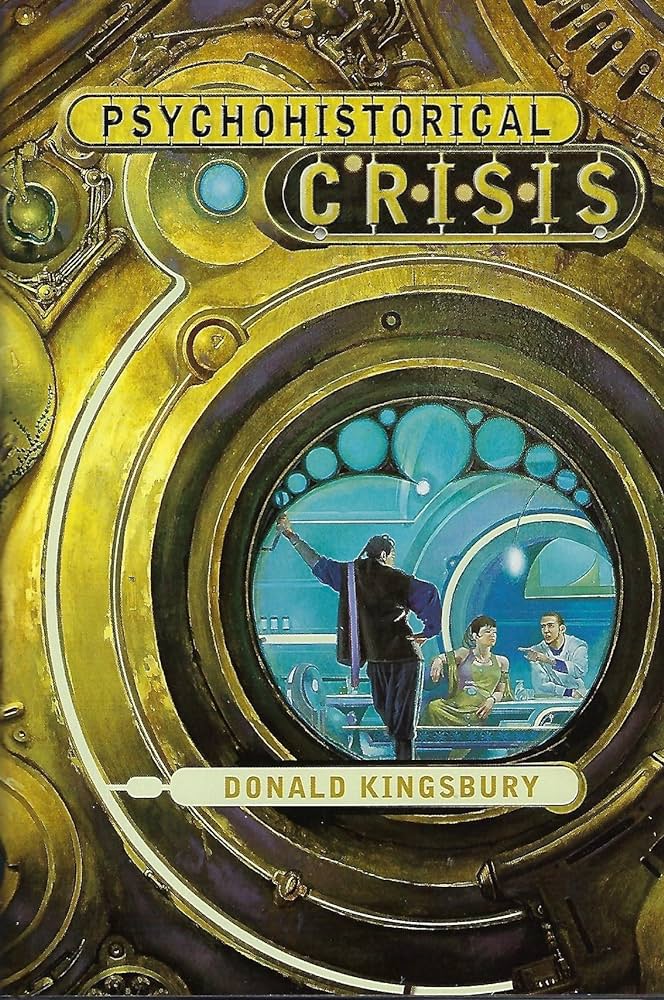
Psychohistorical Crisis, however, could easily be a remake of Isaac Asimov’s Foundation. Change some of the names around, and it could even work as a straight sequel. The blurb makes a big deal of this being the only book other than Asimov’s to include psychohistory, but this isn’t actually true. I can think of at least one Henry Kuttner story that also uses the term. I will, however, concede that Kingsbury’s work is the only other book to seriously examine the idea of using mathematics to predict the future on a galactic scale. Indeed, it goes into far more depth than Asimov ever did. Unfortunately, this proves to be a major flaw with the book.
I adore Foundation, that much everyone knows. But I also don’t think it’s half as clever as a lot of people seem to think. Psychohistory is a great idea, but ultimately it’s a gimmick. A literary tool to justify the multi-generational story that Asimov wanted to tell. It’s a really cool gimmick, but one that falls apart if you put too much thought into it. Which is exactly what Kingsbury does here. reading this book means reading through page after page of dense mathematical theory. As anyone who is familiar with the name Greg Egan will attest, mathematics is hard to make entertaining at this level. For me, Kingsbury falls flat.
It’s not just the maths either. The whole book is incredibly dense. The prose hard-going. There’s also a lot of humour that just did not work for me at all. A lot of the time, the mangling of ancient history is something I enjoy in science fiction. Phillip Reeve’s Mortal Engines was especially good at that, but I found Kingsbury’s misinterpretation of Earth’s (or Rith’s, as the book has it) past to be more annoying than endearing. For some insane reason, he also decided it would be a good idea to rename and/or alter every measurement of time and distance. Oh yes, and he’s also that rare author who is worse at writing romance than Asimov, so there’s that.
Strip away all of that, however, and there is good in here. Psychohistorical Crisis is that rare book that truly engages with the science fiction canon. It takes the ideas of stories sixty years older than itself seriously. It critiques were necessary, is not overly reverential, but nor does it topple headlong into deconstructionism. It is a book written in the grand tradition of science fiction: Taking outlandish ideas and seeing where they might be taken. It might fall short in many areas, but at least it is reaching for something.
Book Stats
- A Standalone Novel
- Published by Tor
- First published in 2001
- 567 pages

 At Boundary's Edge