
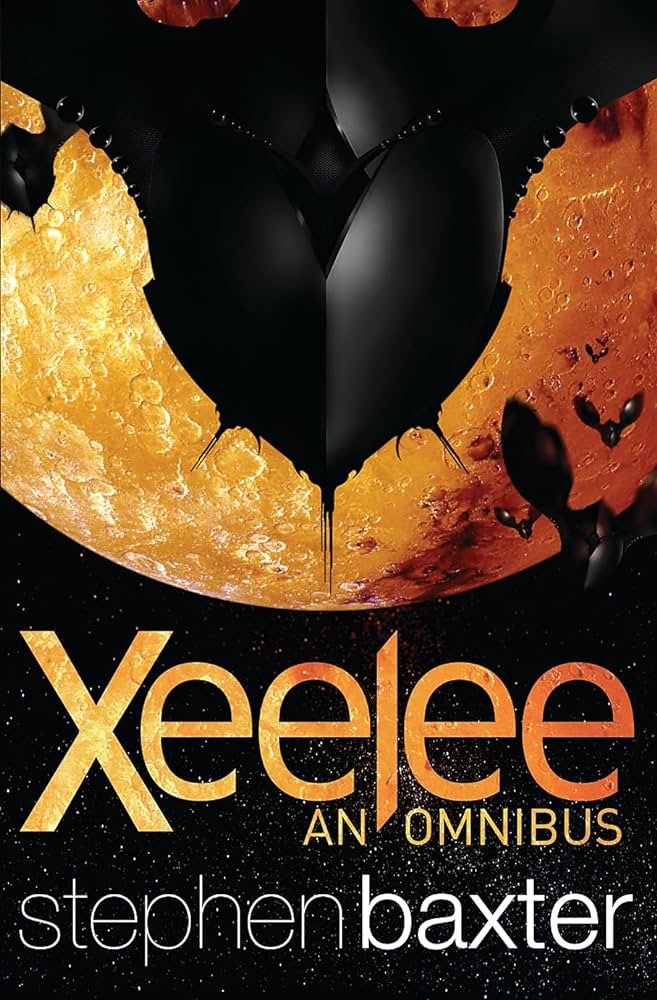
Teaser
Life can survive almost anywhere, even within a neutron star. With their origins a mystery, the star’s human inhabitants must fight to survive. For there are monsters out there. Monsters that care not for human life . . .
Review
Once again I am diving into Xeelee: An Omnibus, for a look at Stephen Baxter’s early novels. These four novels all take place in the same canon, but each offers something unique. Flux may just be the strangest Baxter book I’ve read to date.
One of the best things about science fiction is the way authors build new worlds. Worlds filled with wonder and horror in equal measure, worlds that set them apart from other stories. Baxter’s adherence to the physics of the real-universe is one of my favourite things about his work. Flux, though, is different. It’s a world built from the ground up, in ways that don’t always work. Some of the ideas come across as ludicrous, such as ‘pigs’ that propel themselves about via flatulence, or the idea that humans are miniaturised to survive in their new surroundings. Others didn’t make sense to me. I’m still not a hundred percent sure what Baxter means by ‘waving.’
Novelty of the setting aside, however, Flux is perhaps the most traditional narrative found in this collection. We follow a young woman and her brother as they leave their familiar life behind in the wake of disaster, only to find that the world they emerge into is even more dangerous. What comes next is a positively Dickensian tale of child labour, benevolent farmers, and an ailing elderly relative. I’ve never had much time for Dickens, so it’s unsurprising that Baxter’s emulation similarly fails to thrill me.
These two halves of the book also slot together unevenly. The razor-sharp, hard SF clashes with the fantasy of manners that makes up the bulk of the narrative. In the latter stages of the book, when the broader Xeelee universe imposes itself upon the world, things become incredibly confused. I’m honestly not sure I can say what happened, or at least not in any way that makes sense. It’s an unfortunate muddle that sends Flux towards the bottom of my Stephen Baxter rankings.
Even so, there’s quite a bit to enjoy here. Especially if you like the narrative stylings of one Charles Dickens. Personally, though, I was here for the aliens. In that regard, I can’t help but walk away a little frustrated.
Book Stats
- Part of the Xeelee Universe
- First Published in 1993


 At Boundary's Edge