Teaser
Jake Cardigan used to be a cop, but after being framed for a crime he did not commit, he was sentenced to prison. So when he’s offered early release, and a chance to take on the real criminals, he can hardly say no . . .
Review
Celebrities fancying themselves as writers is nothing now. They say that everyone has a novel in them, so it’s only natural that those who already have fame, money, and influence wield those assets in the battle for publication. Sometimes this creates genuinely brilliant works of fiction (for example, Chris Hadfield’s The Apollo Murders), but often enough the results are less than stellar. William Shatner’s work sadly falls into that latter category.
As an aside here, Shatner is open about the collaborative nature of his writing. We’ll probably never know for sure how much of this book was written by Shatner himself, and how much was the work of ghost-writers, so for the purposes of this review, I’m treating Shatner as the author. After all, he approved of every word that goes onto the page, and it is his name that appears on the cover.
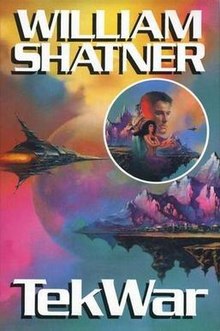
The Tek series marks Shatner’s first experiments with literature, and isn’t as well known as the Star Trek novels he later worked on. Nevertheless, there was a TV spin-off, and the prose feels a lot like tie-in media of the eighties and nineties. This book is short, punchy, and direct. Sometimes to an absurd degree, but it really fits the mass market at which it was directed. This is not a mindboggling epic of incredible scientific discoveries. It’s a cop novel with technological flourishes. One in which it’s easy to picture Shatner himself playing the protagonist. More TJ Hooker than Star Trek.
Leaving aside the bluntness of the prose, there are some good ideas in here. The main one is, of course, tek itself. It’s basically addictive virtual reality – an idea that’s even more plausible now than it was thirty-five years ago. Then there’s the library that prints books on request, but has run afoul of censorship. This forward-thinking is balanced by the dated notion that the twenty-second century will still see the use of fax machines. In that, I suppose, Shatner is in keeping with a lot of classic science fiction. It’s easy to imagine vast sweeping changes, but the smaller, day-to-day alterations are usually overlooked.
Tek War is far from terrible, but also a long way from brilliant. It’s fun and frantic, but with all the depth of a puddle. More interesting for who wrote it, rather than what was written. Which, I suppose, is the point of having Shatner’s name so bold on the cover.
Book Stats
- A Tek Novel (#1)
- First Published in 1989 by Bantam
- 300 Pages

 At Boundary's Edge