Teaser
When a war rages across all of time, nowhere is truly safe. Not even in the hospitals far from the frontline. For in this place beyond places, dangers comes not only from the enemy, but from those you should see as friends . . .
Review
Over on the Fantasy & Beyond forum this past month, there’s been a read-along of Amal El-Mohtar and Max Gladstone’s novella This is How You Lose the Time War. I listened to that book several years ago and found it an enjoyable, if inconsequential, story of lovers caught on opposite sides of a temporal conflict. This got me thinking about time wars in general, which crop up every now and then in science fiction (most notably in Doctor Who), but rarely attain mainstream success as a narrative element. Likely this is due to how confusing they rapidly become, with timelines splitting and being overwritten. This is all a roundabout way of saying that I looked into the history of the trope a little, and found that one of the earliest examples was available through the Audible Plus catalogue.
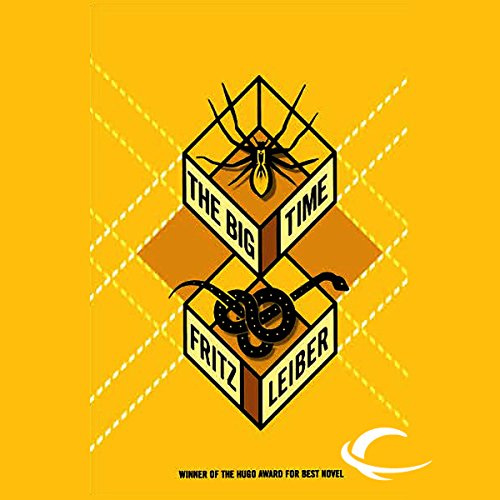
Fritz Lieber is a name I know primarily through his sword and sorcery series Fafhrd & the Gray Mouser. Like many early pioneers of pulp fiction, however, he wrote just as much science fiction as fantasy, and much of it met with acclaim. In the case of The Big Time, it won a Hugo Award. It’s on the shorter end of the novel scale, with this audio version clocking in at a little under five hours. Those five hours, though, are well worth it.
The Big Time drops us right into the middle of The Change War, a conflict of unknown purposes waged between groups known only as the Snakes and the Spiders. The broader conflict is seen only in snatches, but includes such battlefields as Ancient Greece, the First World War, Classical Rome, and more. The combatants, meanwhile, have all been pulled out of their respective timelines prior to death, and include American flappers, German soldiers, Amazonian warriors, and aliens from the Moon. There is far too much there to unpack in a short novel, and Lieber makes no attempt to do so. These things simply are. The war exists, and that is enough.
Where Lieber draws our attention is a hospital. One that exists outside of the time-space continuum, and is known only as the Place. Here the staff are entertainers as much as medics, with a duty to heal both the body and the mind of the soldiers dropped through their door. Naturally, friendships, romances, and rivalries all spring up from the unlikely gathering of characters, and it all comes to a head when they are cut off from the outside world by an act of sabotage. Even within the Place, most of the action takes place in a single room, with characters occasionally dashing off to search a back room. This gives the book the feel of a play, a feeling only enhanced by how much dialogue there is. Seriously, you could put this thing on a stage and lose none of the effect.
Narrating it all is Greta, wonderfully played by Suzanne Toren. Toren captures the voice of a character who ranges between charming and insufferable as the punches start to roll in. It’s incredibly easy to listen to, and absolutely the right voice for the character, staying firmly on the correct side of annoying throughout. You start to think she really has come out of the early twentieth century.
The Big Time may be one of the first books to explore the ramifications of a time war, but it dies so through a small group of characters rather than the epic sweep of temporal battlefields. It’s tight and twisty, with enough mystery to leave you hanging on for more. A worthy winner of science fiction’s most prestigious award.
Audio Stats
- Narrated by Suzanne Toren
- First Published in 1958
- Runtime: 4hrs 42mins

 At Boundary's Edge