Teaser
We have discovered something on the moon. A labyrinth of sorts. The only problem is it kills any man who enters. That means the only logical person to send is a man who doesn’t fear death . . .
Review
Once again I’m dipping back into the Audible Plus catalogue, this time because I’ve finally stumbled across a science fiction novel originally published in 1960. The fact that I haven’t come across one before suggests that it wasn’t a particularly good year for the genre. Having now read such a book, I still don’t rate the year all that highly.
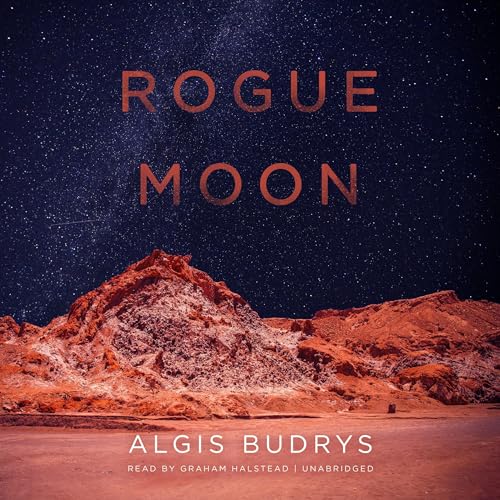
Rogue Moon has a classic setup. Humanity has stumbled upon some inexplicable artefact and doesn’t really know what to do with it. This being the sixties, there’s also the panic that those pesky Russians might crack the riddle before our all American heroes. In this particular instance, the mysterious object is a location. A maze embedded in the surface of the moon. Anyone who goes dies, but for a different reason each time. As such, humanity send sin one person at a time, who exactly copies the actions of the previous explorer to learn what killed them, and hopefully progress a little further.
The most interesting bit of the book is how those explorers get up there. To digress for a moment, one of my favourite SF TV shows was Dark Matter, which featured among all the usual space opera tropes a company called Transfer Transit. It was essentially a more plausible form of teleporting, that involved quickly cloning the traveller at a distant location, and then uploading their memories. It was an idea I had never seen elsewhere until listening to Rogue Moon. Here, more than fifty years before that show broadcast, is perhaps the genesis of that idea. A clone is created on the lunar surface, and the mind linked to the original explorer. The explorer has the memories of exploring, and of dying, but remains physically unharmed. of course, the splitting of minds across two bodies drives people mad.
That bit of the book is interesting, but Budrys doesn’t seem particularly interested in getting into the ethics of it all. He’s also not all that keen on mapping the maze, as we are simply told how long each explorer lasts, and perhaps given a sketchy impression of what it’s like in there. Instead, he keeps his focus more local, highlighting the personal relationships of the explorers and their loved ones. This is a shame, because the characters are all spectacularly dull. Seriously, everyone in this book is a misanthrope at best, and the book itself comes off as misogynistic at times. Clearly, exploring a deadly moon maze would put a strain on any relationship, but the maze is infinitely more interesting than any philandering sceintists.
The worst part is that we never get any answers about what’s going on up there. Not even in a vague, cosmic philosophy way. It’s simply brushed aside in favour of the interpersonal stuff. Which, I think I may have mentioned, is painfully boring. Just my personal opinion, but a book about searching for answers should at least try to give an answer.
There’s a good idea here, and I enjoyed the narration, but Rogue Moon falls well short of the mark. The best thing about it is that it ticks another year off my reading chart. I can only hope that the currently absent 1978 has something better to offer.
Audio Stats
- Narrated by Graham Halstead
- A Standalone Novel
- Originally Published 1960
- Runtime 6hrs 11 mins


 At Boundary's Edge