Teaser
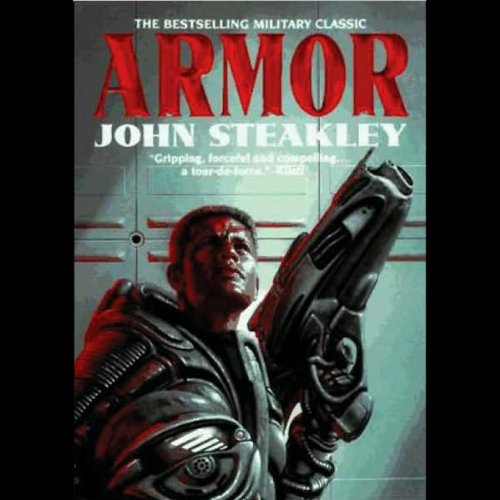
In a war between humans and the hideous aliens known as Ants, there can be no heroes. Only soldiers willing to throw away everything, even their own humanity, in order to win the day . . .
Review
Armor has something of a cult reputation among science fiction fans, particularly those with an enthusiasm for military SF. For some, it’s an overlooked classic worthy to stand alongside Robert Heinlein’s Starship Troopers. For others, it’s a solid adventure narrative, notable for it’s innovative use of power armour. For a military SF reader like myself, it was an enigma I couldn’t help but invest time in.
I think the comparisons to Starship Troopers are as well-deserved as they are obvious. There’s a deeply militarised society, a grinding war against insectoid aliens, and a deep affection for the common soldier. In that, it’s quite a bit like Heinelin’s famous novel. In execution, however, it feels closer to Paul Verhoeven’s equally famous adaptation of said book, with the caveat that all the self-aware humour has been stripped out. It’s that lack of awareness that proves to be Armor‘s Achilles’ Heel.
Written in 1984 and focused exclusively on the business of war, it’s only natural that Armor is dominated by male characters. Even so, this is a relentlessly macho novel. There’s enough testosterone flowing through these pages to put hairs on any reader’s chest. The book is split between the experiences of two characters. Felix, and Jack Crow. Felix is a trained solider, the one who wears the armour of the book’s title. Thoroughly manly, he survives battles by adopting a new personality which he calls the Engine, a merciless killer who exists to prevent Felix caving under the weight of PTSD. There was an opportunity here for a deep dive into a soldier’s psyche, but instead we get a rather tired story of a macho superman mowing down enemies, while himself on the run from a terrible loss. Oh yes, and there’s the small matter of a noble family missing an heir to remember as well. I’m sure that won’t lead to any predictable revelations.
Crow’s story is equally manly. He infiltrates a scientific research outpost using his masculine charms, even managing to seduce a woman through charismatic brute force on his very first day. that woman, by the way, is described as either beautiful or frigid, depending on Crow’s mood in the given scene. It’s a trait she shares with every other woman Crow sets eyes on. A trait that grows tiresome very quickly. I wish things were better when women weren’t on the page, but Crow spends every mano-a-mano interaction growling and chest-thumping to prove himself the bigger man. Which of course means being the bluntest and most violent.
While I don’t have any issues with Tom Weiner’s narration, I do think this book suffers in the audio format. As is so often the case, it’s a matter of structure. The book is divide into acts, some of which have multiple chapters, others of which have only the one. Generally speaking, Felix has longer chapters than Crow. Surprisingly, the problem isn’t one of split narrative, as they are threaded together quite cleverly. However, some chapters are only a few minutes long, while another is four hours in length. I can find no discernible reason why this mammoth could not have been broken down into more distinct sections. Even worse, large parts of the narrative flow out in stream of consciousness. Steakley is good at action scenes, capturing the chaos of battle, but if I never have to experience his attempts at regular human interaction, it will be too soon.
Other than the role it played in popularising power armour, there isn’t a whole lot I can say to recommend Armor. It may be in conversation with classics like Starship Troopers, but it doesn’t have a whole lot to say.
Audio Stats
- Narrated by Tom Weiner
- A Standalone Novel
- First Published in 1984
- Runtime 13hrs 38mins

 At Boundary's Edge