Teaser
Humanity lives in fear that the alien Formics will return. To avert the possible extinction of the human race, any tactic is acceptable. Even ones that require the brutal indoctrination of young children . . .
Review
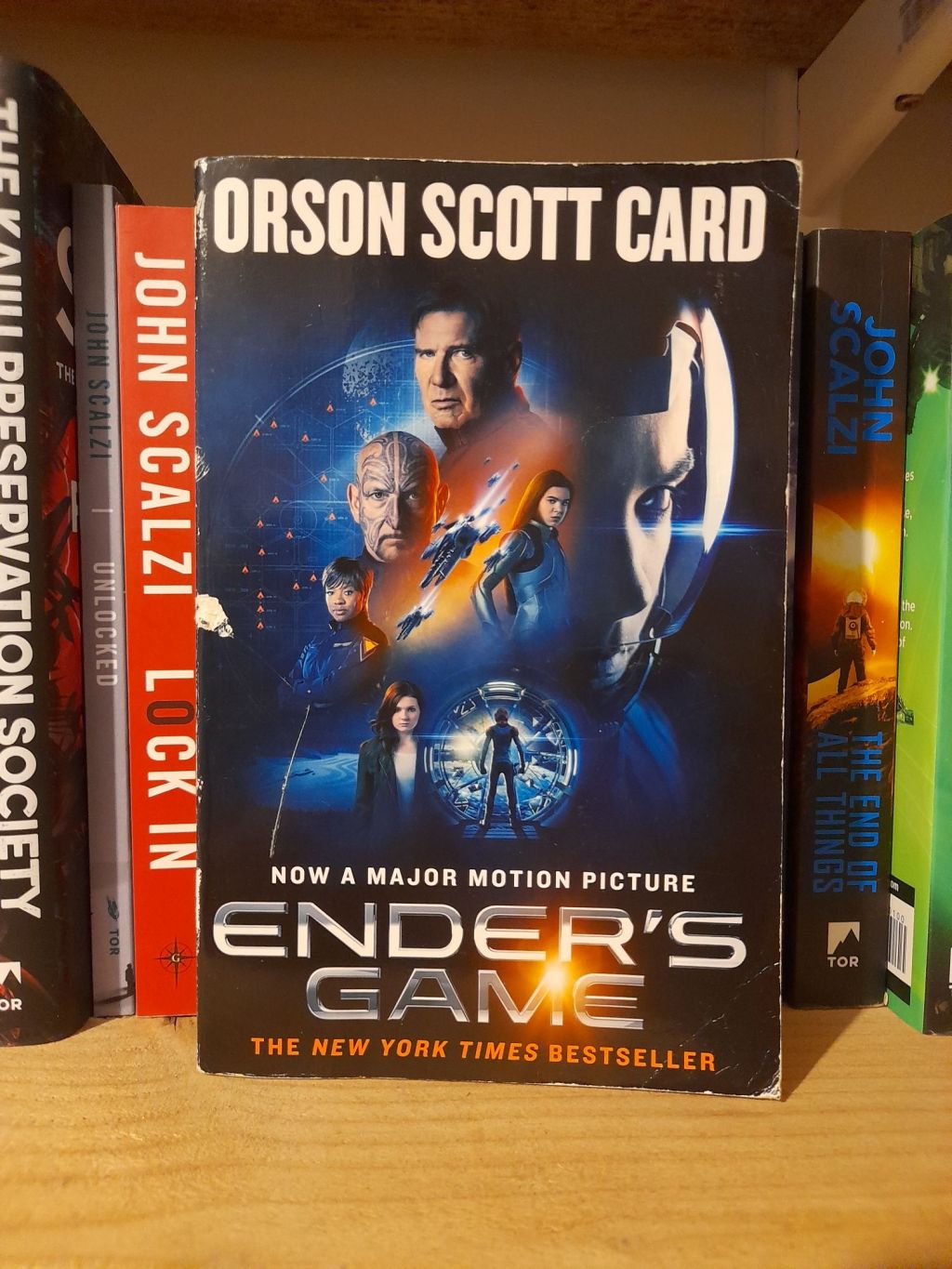
Ender’s Game is a book that comes with a formidable reputation. Winner of multiple awards, including the Hugo, massively influential in the military SF scene, and regarded as one of the foundational texts of modern science fiction. It has a fame that stretches beyond the genre. Most anglophone readers will have heard of the name, and will likely have absorbed some of the premise through osmosis. It’s a book built on such profound ideals that it is reportedly taught in the United States military. More than that, it’s the book that has spawned a franchise, with multiple sequels, prequels, and spin-offs. In 2013 it received the big-screen treatment, with a film that was my first conscious interaction with the story. Only natural then, that my first encounter with the prose version should be the film tie-in edition.
Immersed in science fiction as I am, Ender’s story holds few surprises for me. Indeed, my main response for much of the novel was that I was correct to steer away from the book for so long. You see, there are two tropes I truly have no time for. Child protagonists, and schools for gifted children. Naturally, the two go hand in hand more often than not. Ender’s Game plays these tropes straight. Even in a school for gifted children, Ender is a superman. A chosen one, for want of a better term. At the tender age of six, he overpowers quite literally everyone in his path. if not through direct violence, then by outplaying them at their own game, with little or no training. To an extent, this is the point of the novel. Ender is exceptional. Only he can end the war. However, that doesn’t make it any easier to accept. At no point does Ender feel like a six year old boy, and the interactions between the other children feel more pubescent than pre-pubescent. You can argue this away by saying that these are explicitly not ordinary children, but if we’re to make that argument, what was the point in making them so young? The only reason for the youth is to have Ender remain innocent and impressionable. Neither of which traits are the sole purview of the very young.
Unsurprisingly, it’s the time we spend away from the combat school that prove the most interesting. The double lives of Ender’s siblings back on Earth are far stronger than Ender’s story. Startlingly prescient of the double lives we all lead online these days, not to mention the spread of disinformation and propaganda, the elder Wiggins’ affairs are a strong example of showing the effects that a war has on the people who remain far from the front line.
Ender’s role in the story only becomes interesting once he graduates, and here is more interesting knowing that the next step is not further training, but the real deal. And yes, I have just spoiled a the twist of a nearly forty year old book. I think the statute of limitations has expired on this one. Regardless, this closing stage is where Ender’s Game comes into its own. This is a book with weak characters and flat writing. What keeps it afloat is theme, and that theme is delivered most powerfully in this final act. We have seen Ender overcome adversity, and we know he is being propped up by the military high command. This is where we find out why. Where we learn that to them he is not a child, but a weapon. This is where their manipulation of an innocent is finally driven home with force.
The question that lingers in all of this is the extent of Ender’s guilt. He is a willing participant throughout, but never a witting one. To blame Ender for genocide is to blame a gun for murder. Yet if a gun were sentient, would it not want to fulfil its purpose? There is no answer to that – there can be no answer to that – yet the question remains. Ender’s sense of guilt over his actions is what drives the sequel. But for now, all we can do is wonder.
Ender’s Game is more than the sum of its parts. Far from perfect, and a downright slog for much of its first half, it nevertheless deserves it place in the canon of science fiction.
Book Stats
- The Ender Saga (#1)
- First Published in 1985
- 326 Pages


 At Boundary's Edge