
Teaser
The tank. The weapon that truly mechanised warfare. From the trenches of the Great War to the battlefields of the far future, the tank will always have a role to play . . .
Review
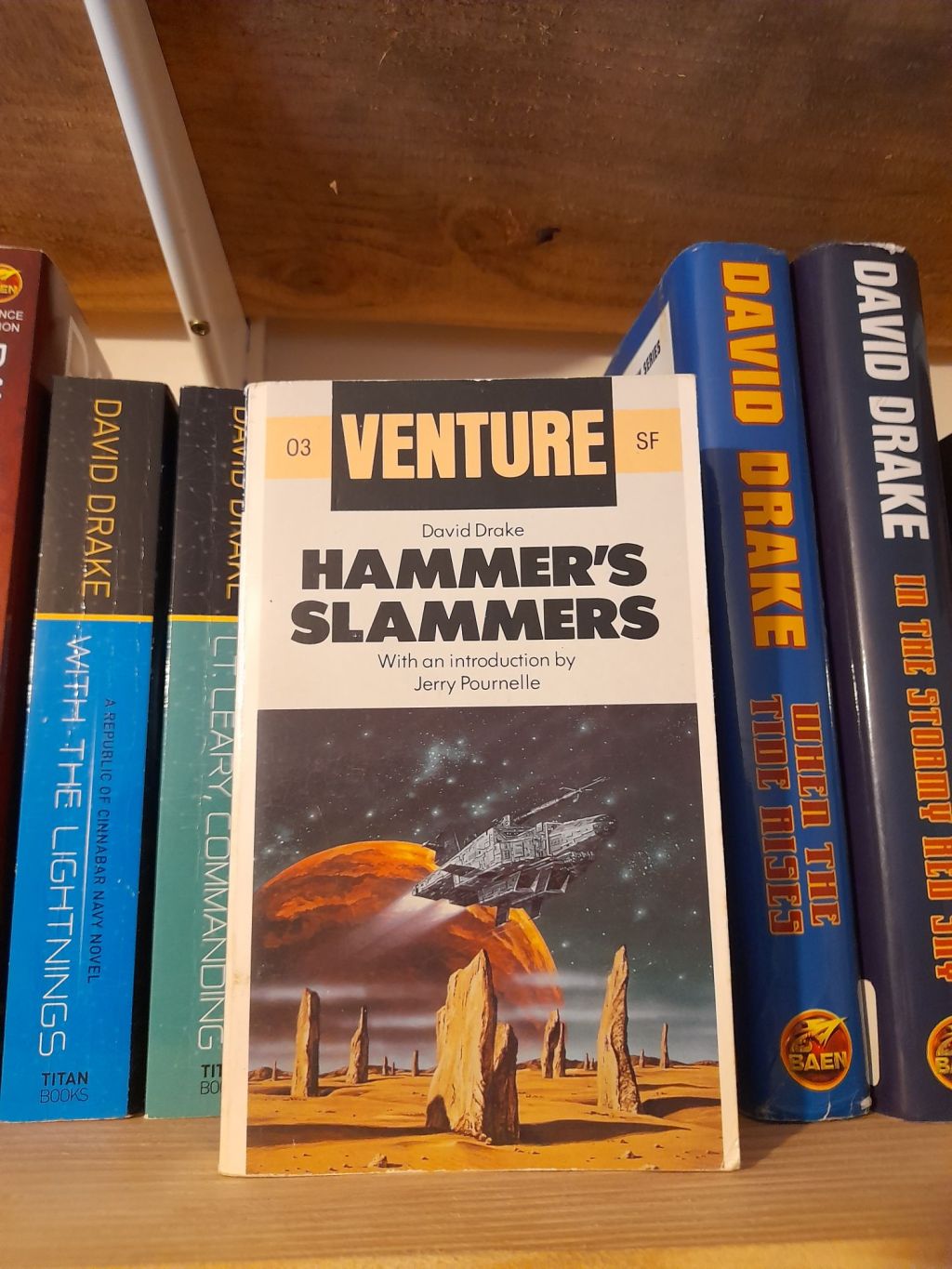
Though he has dozens of books to his name, it’s for his debut that David Drake is best known. Hammer’s Slammers is one of the cornerstones of the military SF genre. There had been stories about warfare and soldiers before, but this was among the first to focus on tank regiments. Despite this fame, however, I’m coming to this book having already read Drake’s RCN series, which is more of a space opera, and Redliners, the book he wrote as a commentary on the military experience. As such, I went in expecting a weaker novel, in prose terms if nothing else. I got what I expected.
As a quick aside, I’m pretty sure the title of this book is meant to rhyme. It does, but with my Anglo-Welsh accent, the words Hammer and Slammer are stressed differently, which really disrupts the rhyme. That’s not at all relevant, it’s just something that bugs me whenever I say the title aloud, and now you too are cursed with that knowledge.
Hammer’s Slammers comes out of the Vietnam war, a conflict in which Drake served, and which provided ample inspiration for an entire generation of military SF writers, most notably Joe Haldeman in The Forever War. Hammer’s Slammers isn’t as intimate a depiction of warfare as Redliners, which does make it easier for a non-combatant to process, but Drake’s personal background still bleeds through the text.
On a structural level, this is a fix-up of multiple shot stories, each one centred roughly on a different member of Hammer’s team. Bridging the stories are a selection of in-universe documents ranging from a future history of a united Christian church to an equipment roster for the entire regiment. These infodumps are, much to nobody’s surprise, my favourite part of the book. They lend a sense of reality to the stories they frame, as well as being perfectly interesting in their own right.
In contrast, the actual stories aren’t all that good. At this early stage in his career, Drake wasn’t close to being the writer he’d later become. There’s an undeniable rawness that adds something to the stories, but it comes at the price of a clunkiness that makes for an at times painful reading experience. In addition, the stories themselves are largely forgettable, and disparate even by the standards of a fix-up. Personally, I’d have preferred a clearer sense of the war Hammer was waging.
Stepping back from the book as an individual text, I do find it interesting that the Venture SF range chose to go all in on Hammer’s Slammers. I expect the series’ line-up was largely determined by rights availability, but only Timothy Zahn saw more publications under the Venture SF banner. The Hammer’s Slammers series is easily the most represented series within the selection on offer. I’m not sure if Jerry Pournelle’s foreword is original to this edition, but it makes for some interesting context. And also makes me want to check out Pournelle’s work, so everyone wins in this arrangement.
Had I read this book at random, I don’t think it’s strong enough on its own merits to make me continue with the series. Knowing of Drake’s growth, however, not to mention my desire to complete the Venture SF series, is enough to get me interested in the rest of the Hammer’s Slammer’s novels. I’m hopeful that the transition to full-length storytelling will mark the step-up in quality I’m looking for from one of of military SF’s founding fathers.
Book Stats
- Hammer’s Slammers #1
- First Published 1979
- Republished 1985 as part of the Venture SF range
- 274 pages

 At Boundary's Edge