In the past few years, one corner of the book world has really taken off. Not limited to any one author, publisher, or genre. A part of the book world that releases highly sought after products that inspire joy and jealousy in equal measures. It’s an industry that supports multiple businesses, and is particularly prevalent within SFF circles. I speak, of course, of special editions.
Before I go any further, I want to put out a disclaimer that none of this should be construed as an attack on the special edition industry. For the most part, these are small businesses run by people who love books, and are out there making book lovers happy. Rather, these are just some of my personal thoughts and observations on the phenomena of special editions that I’ve noticed in the past few years.
I make that disclaimer for one very important reason. While I respect the industry, I’m not wholly convinced that the current frenzy around special editions is a good thing.
The first thing I want to discuss is why special editions have taken centre stage in recent years. I think there are three main reasons for this. Two from a consumer perspective, and one from a production perspective.
On the production perspective, it is now easier to get special editions printed. There is now sufficient infrastructure to support multiple companies in the same market. Of course, it’s still small enough that there are hiccups. Brandon Sanderson’s leatherbound Words of Radiance is apparently taking up so much space at the printers that a lot of other books are being delayed. But the fact remains that technology now allows for the mass production of luxury items at a price that is, relatively speaking, affordable.
From a consumer’s perspective, there are two reasons for the uptick in interest, and they’re both the result of social media. In the first instance, parasocial relations mean that readers feel a lot closer to authors than they did twenty years ago, and are interested in seeing their favourites succeed beyond simply purchasing the latest releases. This stronger bond between fandom and creator is possibly the greatest marketing tool ever devised, whatever issues may arise from it. But it’s not just authors out there promoting their works.
I strongly dislike the term ‘influencer,’ but there’s no denying that members of the book community have great influence over their followers. There was a time that reviewers would be purely text based, perhaps with a cover photo of the book in question. With the rise of social media, notably Instagram, there’s an increased pressure for books to look pretty on camera. No longer does a battered mass market paperback cut the mustard. Instead we see sprayed edges, alternate covers, interior art, and the like. The actual story remains the same, but the presentation has taken control.
So, if businesses are booming, authors are getting the attention they deserve, and readers are getting pretty new books, you may be asking what the issue is. The simple fact is that most people seem quite happy with this arrangement. The other simple fact is that I’m a bit of a grouch. And if I don my grouchy hat, I come out with things like this.
My fundamental issue with special editions is that they are not for readers. They are for collectors. Every few weeks, I’ll see a new poll asking the same question: Do you read special editions? A lot of people say no, and all I can think is ‘It’s a book. It’s meant to be read.’ The majority of people who buy a special edition already own the book. Maybe they bought a paperback, fell in love, and want a glossy hardback to show off to the world. Good for them. But that paperback is better value for money. It’s the story in its purest form. No additional content, just the story.
Ah, you say, but what of the art? Well, I respond, what of it? The art of a story is in the prose. I could write an entirely different article about book covers, but the honest truth is that I don’t look at them all that much. Many special editions now have exclusive art. Perhaps a notable scene from the book, or the main character standing proud. I don’t want to see these. My imagination is better than any artwork. At least, it’s better for me. Just as yours is better for you.
As an aside on artwork, decorated edges have been a part of books for a very long time. The reason for that is that books used to shelved spine inwards, and often chained to the shelf. In modern times, when spine outwards is the tradition, sprayed edges are essentially useless. All they do is make the pages slightly more adhesive to one another.
The reason to have a special edition is not for your own enjoyment, it’s to sow off to other people. If you’re trying to get clicks for your site, or even if you just want visitors to your home to know what you’re into, then it’s great. But how often do people actually take their special editions off the shelves and read them as a book should be read? Probably not all that often.
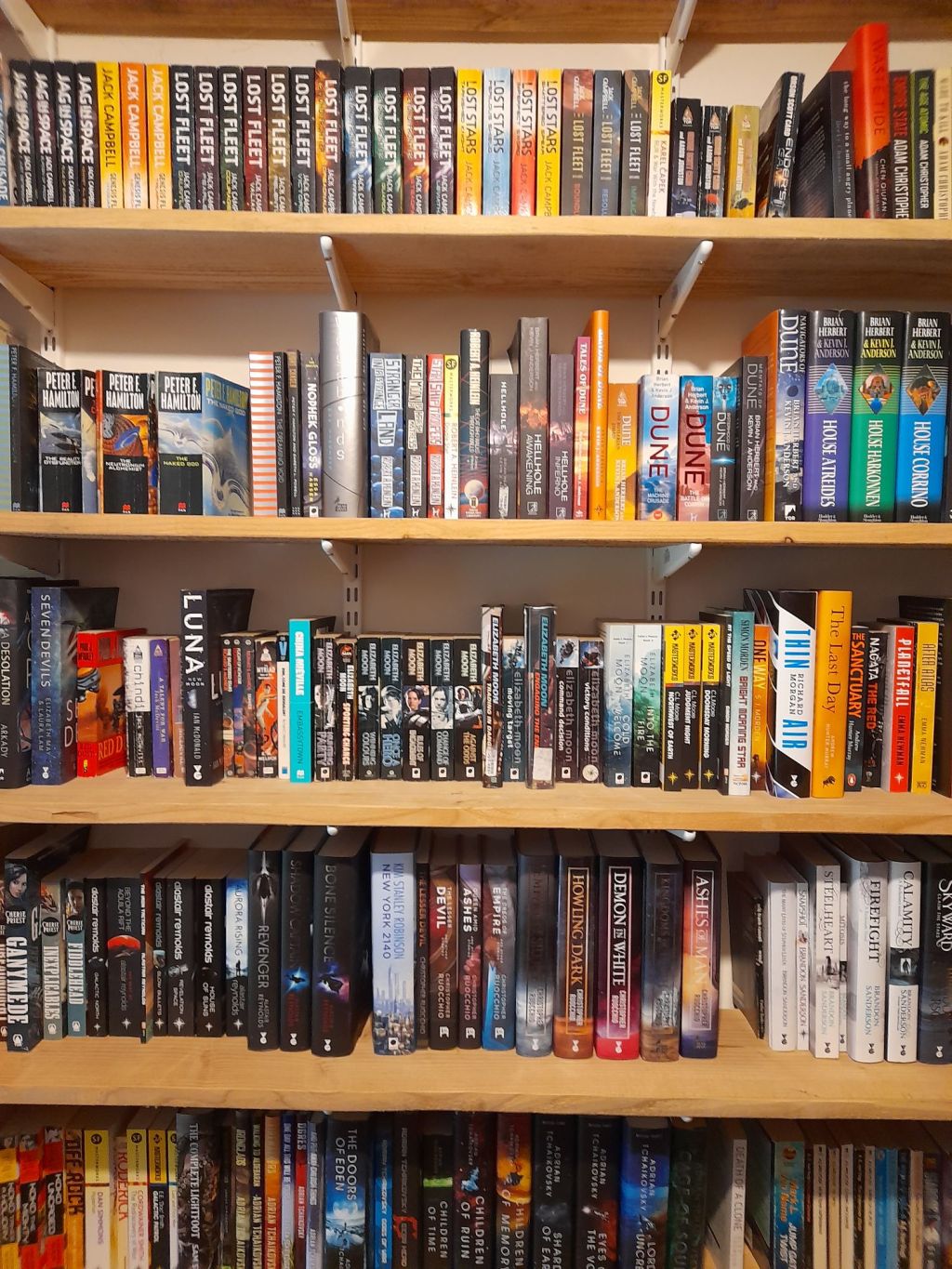
Lest I come off as too much of a curmudgeon, I will freely admit to having some special editions in my collection. Christopher Ruocchio’s short story collections are currently only available in deluxe editions, and I’ll buy them and read them because I love his work. But am I interested in Diamond Edition leatherbounds or a published edition of his alternative first draft? No. Not remotely. I like having one version of the story, reading it, and then shelving it. If I want to read it again, I take the book off the shelf. I don’t shell out a hundred pounds on a shiny updated version. On which note, while a new special edition of Dune seems to be released every year, I don’t really understand who is buying them.
I also take issue with one particular practice that has recently come to my attention. Subscription services. Apparently there are companies who will send you a new special edition every month, but you have to sign up without knowing what books you’re going to get. This just boggles my mind. if anything proves my argument, it’s these subscription models. People aren’t getting their favourite stories repackaged, they’re getting random books that look pretty in the background. It’s a commodification of luxury that is just utterly bizarre. I can understand paying a lot of money to support your favourite author, I really can, but to throw money at a mystery box is a hideous practice to partake in. I expect many of the people buying these will later unbox them on BookTube, which is of course accompanied by a link to their Patreon account. Again, that’s an article for another time.
Another note here. I should probably address the elephant in the room. Special editions are special because they are few in number. People want to buy them because they want to stand out from the crowd. They want to make their favourite books more popular. Paradoxically, the more popular a book becomes, the harder it becomes to obtain a special edition. Until everyone hops aboard the hype train, that is. Returning to Sun Eater, there are no fewer than three different special editions of Empire of Silence in the works this year. Does that make each edition less special? Perhaps. But it’s a sign of the inflated hype around what remains one of my favourite series. As anyone who’s tried getting their hands on a Black Library special edition will attest, however, increased hype also increases the number of disappointed fans when the books sell out.
I’ve waffled on for a long time now, and I suspect I’m not changing any minds. And maybe I don’t want to. People are enjoying special editions. People are making money off them. The books are bringing more attention to some great and deserving authors. These are all wonderful things. But for myself?
Sometimes you just can’t beaten a second-hand mass market paperback.


 At Boundary's Edge