
Teaser
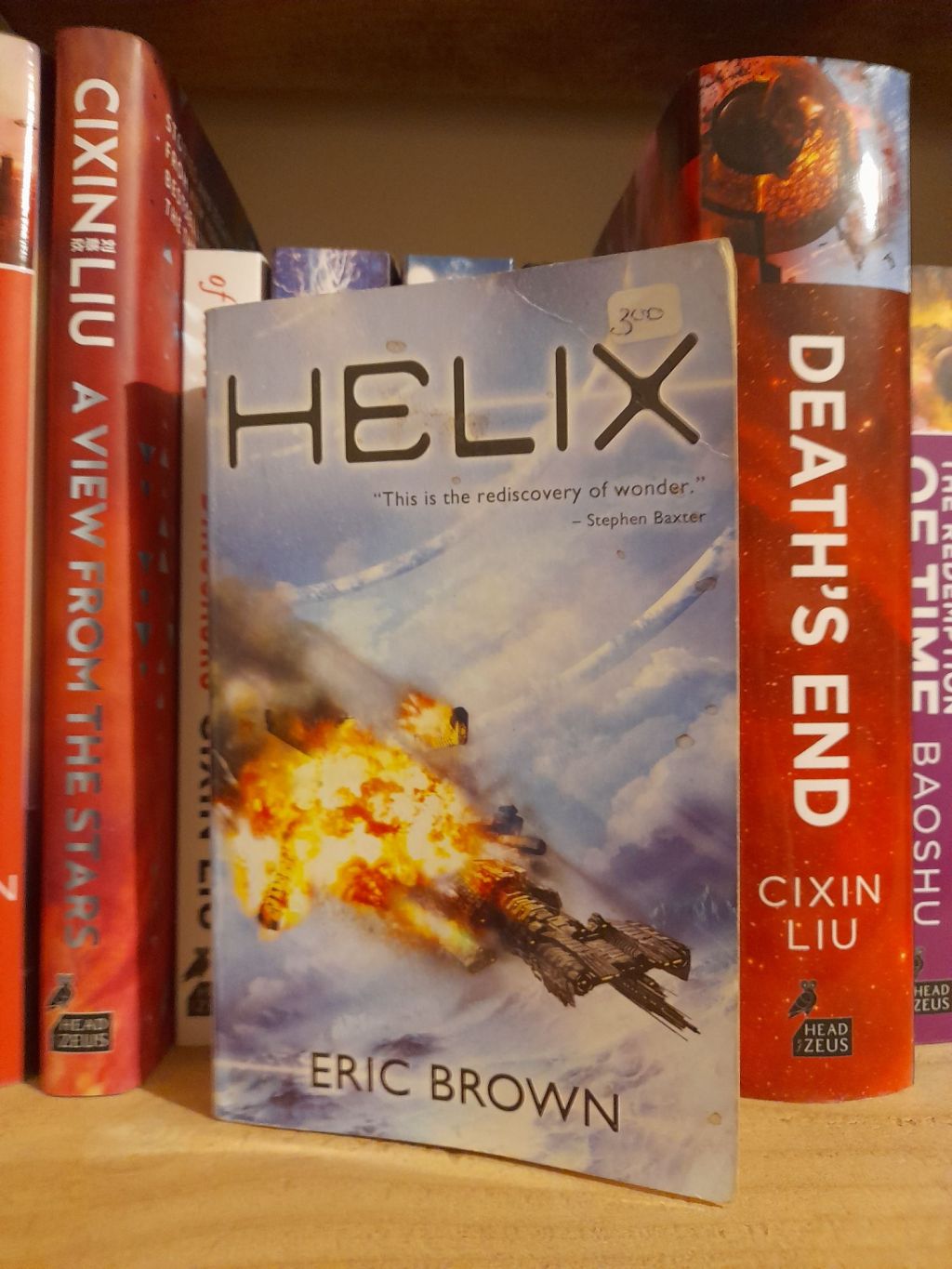
Earth is dying, but humanity has plans to survive. Crashing on a remote world, the crew of Earth’s last ark face a gruelling journey across an inhospitable, and inexplicable, alien structure . . .
Review
Way back at the start of the year, I bought a bundle of Eric Brown books. He came highly recommended, and they were very cheap. A winning combination. Engineman and Penumbra were both very good reads, while the first two Virex novels were a bit of a let-down. Mixed bags are to be expected of any prolific author, so I continued on to the fifth novel undeterred. That novel is Helix. Probably Brown’s best regarded novel, and exactly the sort of hard SF that I gravitate towards. Could it live up to these lofty expectations? Thankfully, the answer is yes.
I’m not a huge fan of climate fiction (largely because it has a tendency to be incredibly depressing), so the opening of Helix had me on-guard. happily, we leave Earth behind after a few chapters, and it’s all uphill from there. Part of me wonders if the book could have started with the unexpected landing on the Helix, especially as it brings as the initial protagonist is quickly left behind, but the opening sections work regardless.
Let’s talk about the Helix for a moment. I have a real soft spot for megastructures, from ringworlds to Dyson spheres and everything in between. Brown’s Helix is a wonderfully new megastructure. Something resembling a DNA strand compromised of distinct biospheres. Brown goes into some detail about how the Helix maintains cohesion, but doesn’t drown the reader in the minutiae of it. There’s a great mystery built up around the structure’s origins, its creators, and its purpose, which all pay off splendidly by the novel’s climax.
If you’ve been following my reviews for the past six years, you’ll know that split timelines are a hard sell for me. Initially, I thought this book might fall prey to that weakness. Helix is split between the stories of the cashed human crew, and the residents of one of the lower biospheres. The former is what you’d expect to find in a hard SF tale, but the latter is something special. At first I thought these would be the descendants of the crash survivors, having regressed at some stage, but this was thankfully not the case. I do wish it had been clearer form the start that the characters in this half of the narrative were not human, but that doesn’t change the fact that the worldbuilding and thematic exploration performed here are absolutely stellar. It’s one thing to depict humans encountering an alien megastructure, quite another to fully realise a society that has come of age on said structure. There are multiple first contacts as the novel progresses, but it’s the aliens we follow for the longest who inevitably are the most developed.
What does mystify me is how this book flew under the radar. It seems popular among readers, and certainly has its share of authorial endorsement, but both Helix and Brown in general seem to have been overlooked by every award ceremony going. There’s nothing wrong in not winning awards, but it’s a shame Brown isn’t better known. His works deserve better.
Helix is the book I hoped to discover when I started reading Eric Brown. The science is crunchy, the scale is epic, the characters are endearing. There is a sequel, but it stands well enough on its own. If you want to read Brown, this is the place to start. If you’re not hooked after Helix, he’s probably not the author for you, because this is Brown at his best.
Book Stats
- Helix Duology (#1)
- Published 2007 by Solaris
- 526 Pages

 At Boundary's Edge