
Teaser
Alone on an unfamiliar world, a lone traveller must contend not only with changes to his own body, but to a reality that makes no sense. His only hope is to seek out those wiser than himself, wherever and whoever they may be . . .
Review
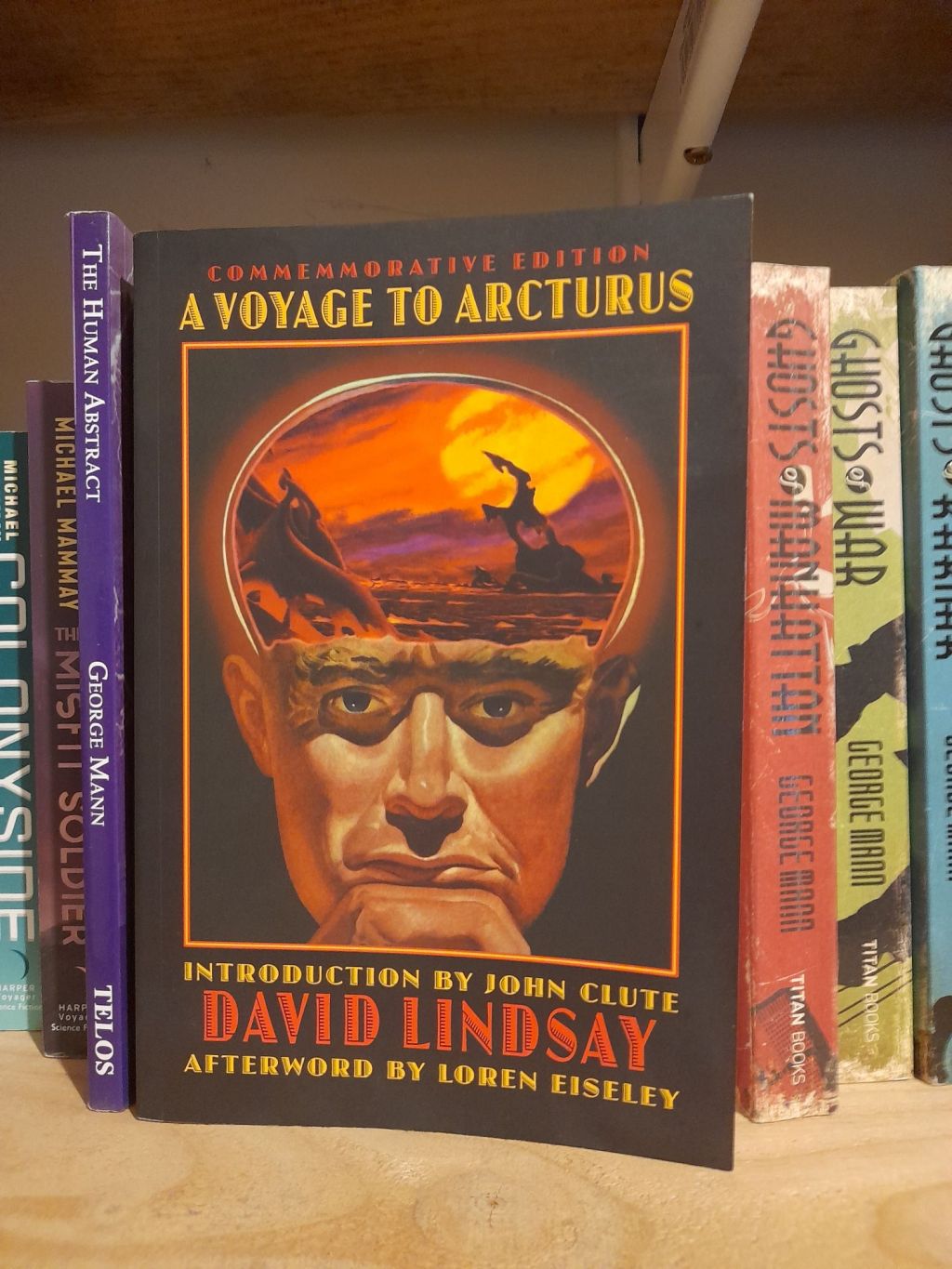
Tracing the roots of science fiction is as tricky as it is exciting. In the early days of the pulp magazines, one of the most common segments of the genre was space opera, featuring larger-than-life characters having amazing adventures on strange and alien worlds. Some of the best-known early examples are E. E. Smith’s Skylark and Jack Williamson’s Legion of Space, the latter of which I hope to read soon. Going back a little earlier than these luminaries, we find David Lindsay’s A Voyage to Arcturus.
Lindsay’s novel was published before the term ‘science fiction’ was so much as a gleam in Hugo Gernsback’s eye. It meets a lot of the criteria, however. Though it starts at a séance (a practice that was all the rage in the post-war period thanks to the prevalence of Spiritualism), the titular journey actually takes place via technological means, albeit an entirely invented technology akin to Wells’ Cavorite. As it happens, our protagonist is unconscious during the voyage, and the remainder of the book is concerned with a lengthy trek across an alien planet, named Tormance. So perhaps A Voyage Across Tormance would have been a more apt title.
I really enjoyed this book. A lot of that is thanks to its place in the canon of science fiction, but even taken alone it’s pretty good. Yes, the style is dated, but at over a century old, you have to expect that. Nevertheless, the writing is engaging, and the prose easy to follow. I have to give a special mention to Bison Books for their formatting, as this is a clearer read from the page than a lot of books half its age. These things really do help a partially-sighted reader like myself. of course, the large font and extra spacing also makes this relatively short book look more impressive on the shelf.
Where I do fault the book is in its plot, which borders on the non-existent. Every encounter follows the same basic pattern. Maskull, the oddly named protagonist, meets a stranger, discusses philosophy and the wonders of this alien world, and goes on his way. It’s about the journey rather than the destination, which is probably for the best, as the ending doesn’t make a whole lot of sense on a literal level, but could well represent some philosophical comment I’m less interested in than Lindsay seems to be.
Maskull isn’t the only one with a strange name. there’s Spadevil, Crimtyphon, Oceaxe, Joiwind, Digrung, and more. Locations include such wonders as the Sinking Sea, the Lusion Plain, Matterplay, and the Lichstorm. Honestly, it’s a D&D player’s fever dream out on Tormance. through this flurry of names, Lindsay hits us with concepts that are positively ground-breaking for a novel of 1920. There is, of course, an interplanetary voyage, but also some body horror (with body alterations that are eerily prescient of Star Trek makeup), characters employing gender-neutral pronouns, and a mix of just about every flavour fantasy, science fiction, and philosophy under the sun.
A Voyage to Arcturus is not a book I’d recommend to everyone, but if you’re interesting in the foundations of the genre, or just fancy something a little bit different, this is one you won’t want to miss.
Book Stats
- A Standalone Novel
- First published 1920
- This edition published by Bison Books
- 268 pages

 At Boundary's Edge