Teaser
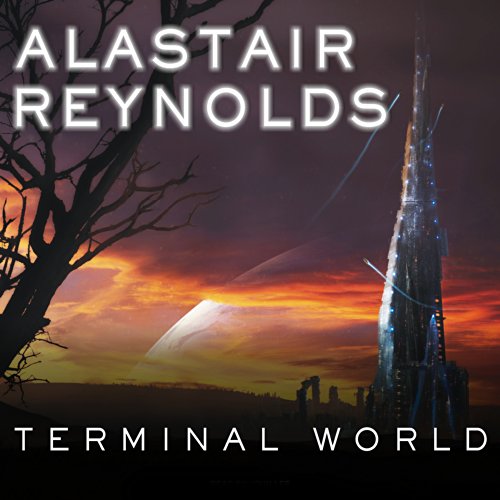
Spearpoint, the tallest structure ever built, is all that remains of civilisation. Yet the Godscraper is far from secure. Something dangerous is coming. Something that will either destroy the world, or see it reborn . . .
Review
This Vintage SF Month, almost all of my reading and listening has been dedicated to books published before 1980. I won’t lie, it’s been a pretty rough experience. Not all classics hold up, and not every book that old is a classic. Needing a bit of a detox, I hit up Alastair Reynolds. I might not be the biggest fan of his Revelation Space universe, but his other fiction has generally won me over. A safe bet, I assumed. I was utterly unprepared for how much I would actually enjoy Terminal World. It’s probably my favourite book of the month.
Make no mistake, this is a very weird novel. Most or Reynolds’ work is fairly traditional science fiction. Spaceships, robots, and all that good stuff. Terminal World, in stark contrast, opens with a group of street cleaners tasked with scraping an angel off the pavement. Spearpoint and its surroundings are as well-drawn as any of Reynold’s creation, but it’s also utterly unique.
If there’s one thing marketing departments and bloggers both love, it’s comparisons. Usually this just means saying a book is like a much more famous book of the same genre, but there’s also a vein of comparison that describes a book as ‘book a’ meets ‘book b.’ A lot of the time, these aren’t particularly helpful. These comparisons exist to make you read a book, not to help you understand what it’s all about. It is with some hesitation, therefore, that I’m going to make a comparison. In terms of Reynold’s works, there is nothing quite like Terminal World. But if you look at the genre more broadly, there are a few books that stand out. Personally, I would say Terminal World is a bit like Philip Reeve’s Mortal Engines by way of Vernor Vinge’s A Fire Upon the Deep.
What is unique about Spearpoint’s world is that technology is not constant. The world is a broken one, shattered into zones. In some, people walk about with nanites in their flesh. In others, nothing more advanced than the steam engine can function. It doesn’t quite go the full Vinge route of minds being equally affected, but disorientating ‘zone sickness’ is a real threat to health. Especially for our protagonist, Quillon, who has been bioengineered to better suit certain zones than others. Much of the early book is concerned with a trip across several zones, decreasing in technological sophistication as Quillon descends through the tiers of the Godscraper. Another book that could serve as a comparison is Josiah Bancroft’s Senlin Ascneds, only Terminal World tells the story in descending order, and is, in my personal opinion, much better.
Where does the Reeves comparison come in? I hear you ask. That’s in the second half of the book, which leaves Spearpoint behind to focus on Swarm, a community comprised of airships. This book is a heady mix of steampunk and hard SF, which sounds like it shouldn’t work, yet it absolutely does. Throw in a constantly unravelling line of mysteries, and you’ve got a book that is an absolute winner on every level.
It seems strange, in a way, to praise a book for its singularity while piling on the comparisons, but that is perhaps the best way to understand Terminal World. It is a book of a hundred different elements, none special in their own right. Yet when they all come together they form a cohesive whole that stands apart not only from the other works of its author, but the rest of the genre as a whole.
The more Reynolds I read, the more convinced I am that his standalones are some of the best in the field. Sure, some stories take a saga to tell. But there are many more that don’t. Sometimes all you need is for a book to take an idea and run with it. Sometimes a dozen ideas all at the same time. The joy of science fiction is doing that with a limited page count. I used to think that Reynolds was at his best with short stories, but now I’m not so sure. Now I think he’s better off with a few hundred pages to really see what he can do with an idea.
Book Stats
- Narrated by John Lee
- A Standalone Novel
- Published in 2010
- 19hrs 45 mins


 At Boundary's Edge