Teaser
Paris in the 1950s is no easy place to live. France may have avoided a German invasion, but there are still murders. Still conspiracies. Still murderous children roaming the streets. Still the possibility that this isn’t the way the world was meant to be . . .
Review
This review is going to get off to a slow start. Fittingly enough, that’s because I want to talk about pacing. A lot of storytelling advice holds that you should grab your readers immediately. Start in the middle of the action. In media res, as the old saying goes. Once piece of advice I’ve seen out there is that a writer should start their story as close to the end as possible. This is common in the kind of punchy space operas I enjoy. Literally opening with an explosion, these are non-stop thrill rides. If you do need to lay down some foundations, why not include a prologue that flashes forward before setting the next chapter ‘Two Days Earlier.’ This works well for stories that ape cinematic tropes, featuring all sorts of action and violence. But it’s not the only way.
At the other end of the spectrum we have the slow burn. Books that put as at the very start of the story, and take their sweet time getting to the end. This allows an author to fully immerse their readers in the setting of a novel. Establishing the ground rules means the twists hit harder. If it’s a mystery, it means we can stop and formulate our own theories instead of rushing the climactic chase sequence. It’s arguably a riskier gambit, trying to slowly ease the reader in, instead of giving them something to grab onto, but when it works, it really works.
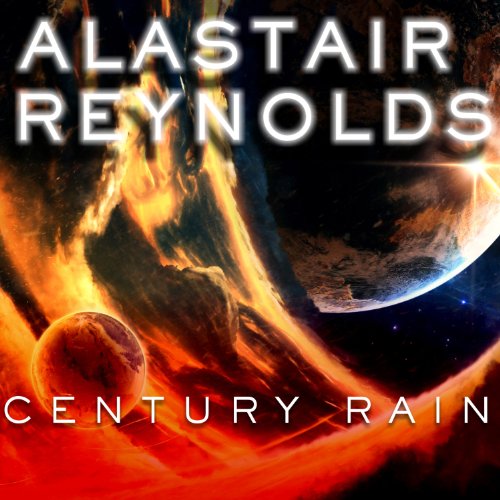
Century Rain is a slow burn. It’s an achingly slow burn. There are chapters here and there which spring from the sort of hard SF novel Reynolds is famed for, but our protagonist seldom features in these. Instead, we spend most of our time following a down-on-his-luck private detective on a case that quickly turns personal. It’s obvious from early on that this is not history as we know it, but there’s never any focus on the deviations. It’s also, to be blunt, not the most exciting mystery ever written. It’s perfectly serviceable, but so much of the investigation feels like wheel spinning while the real story is happening somewhere else. I can honestly say I spent the first three-quarters of this book thinking it was easily the weakest of Reynolds’ standalones.
And then, with no warning, it all came together.
The final acts of Century Rain feel like an intrusion from a radically different, and much better, story. Reynolds slams us headfirst into some hard SF. Here we get all the stuff I love about Reynolds’ work. There’s an interstellar civil war, megastructures, deep cosmic mysteries. If more of this had been laced through the earlier stages of the book, it would not have been anywhere near as much of a struggle. Obviously Reynolds has his reasons for telling the story the way he did, but I can’t help but think it feels like a phenomenal SF novella loosely strapped onto the back of a mediocre detective novel. There isn’t enough to mesh the two ends together. The SF comes out of next to nowhere, and the noir is rapidly left in the dust.
In spite of these disjointed halves, and largely because of the strength of the novel’s climax, I ended up enjoying Century Rain a lot more than I expected. That is in no small part due to the phenomenal narration of John Lee. He has joined the likes of Colleen Prendergast in providing my own internal narration when I pick up a physical book. I definitely don’t recommend this as a starting placer for a new Reynolds reader, but if you’re a completest, you’ll probably have a good time with it. You just have to take your time and let the book draw you in. It’s worth it in the end.
Audio Stats
- Narrated by John Lee
- A Standalone Novel
- Published 2004
- Runtime 19hrs 41mins

 At Boundary's Edge