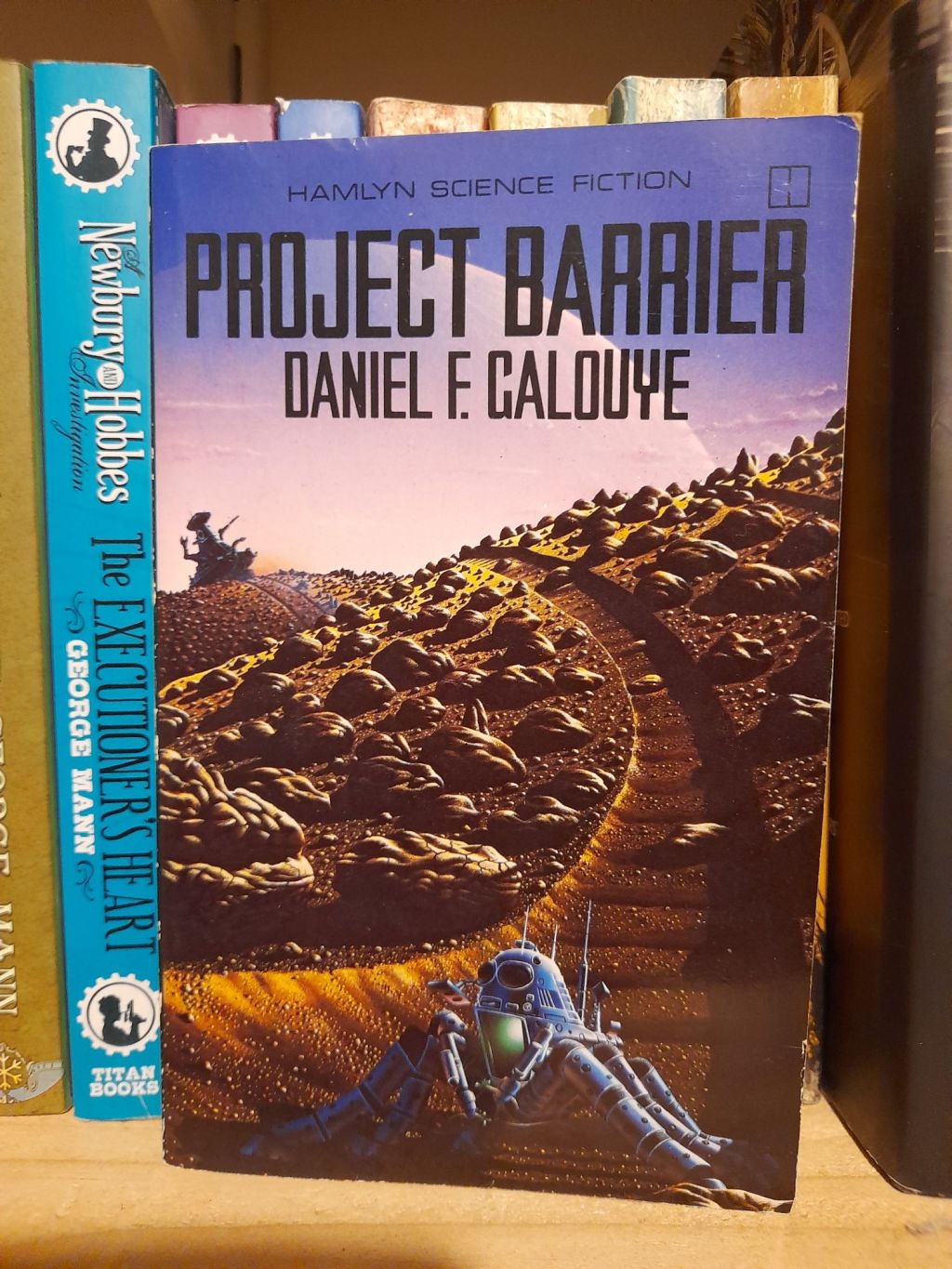
This is exactly the kind of book I blog for. One of the reasons I started At Boundary’s Edge was to discuss books that no one else seemed to be talking about. Yes, in a general sense that meant science fiction, which is almost always accompanied and drowned out by its loud cousin fantasy. Within science fiction, however, there are endless forgotten treasures. People will talk about Dune forever. The Expanse will always be popular, and deservedly so. These days you can barely move without seeing something about Sun Eater. There are timeless classics and flavours of the month in abundance, but still the great majority of science fiction books will go their entire publishing cycle unremarked. Sometimes this is due to marketing, sometimes its due to the book itself. Most frequently of all, it’s a simple matter of time’s passing. We’re long past the point when even the most ardent reader of science fiction could hope to read everything in the genre. As such, it was hardly a surprise when I found Project Barrier in a local used bookshop, and recognised neither the title nor the author.
Curiously, nowhere on the front or back covers does it mention that this is a collection rather than a novel. Indeed, only one story is teased on the blurb, and it’s not even the one from which the collection derives its title. I don’t know what the logic in that is, but it meant I had one more entry for Short Fiction February than I expected. Since there are only five stories in the book, I’m going to break with tradition and talk about each and every one of them.
‘Shuffle Board’ is an adequate story of an irradiated and polluted Earth, some point in the near future. There’s nothing remarkable about it in either content or style, and it’s hard to distinguish it from the dozens of contemporary stories I’ve read.
‘Recovery Area’ is not a good story. It’s portrayal of first contact between humanity and Venusians doesn’t do anything wrong, but it also doesn’t do anything particularly interesting. Galouye gives the Venusians their own vocabulary, which is just about understandable in context, but makes for an awkward reading experience.
‘Rub-A-Dub’ is, to put it bluntly, phenomenal. Here there is a new idea, and Galouye fully explores it. Unable to properly crew a spaceship, three adult men have their minds implanted in the body of a teenaged girl. The story covers what happens when the mission is over, and the time comes for those implanted minds to be erased. It mixes science, existential horror, and a surprisingly deep psychoanalysis of the volunteers. In the former, it’s strong. In the latter two, it hits every button I could want it to. I also have to give Galouye credit for not doing anything unintentionally creepy with the set-up. If you read any Galouye story, make it this one.
‘Reign of the Telepuppets’ is a slightly disjointed tale that opens with robotic probes going about their business while unsure of precisely why they are doing it, but then makes a shar turn into a first contact story between humans and sinister space lizards. Both halves of the story are good, but they don’t quite cohere as a whole.
‘Project Barrier’ deals with a scientist determined to explore the edge of his world. It starts off slow, but soon builds into a tight conspiracy with a sufficiently twisted ending. It’s not as descriptive as it could have been, but it remains an interesting little story nonetheless.
As ever, this short story collection is a mixed bag. ‘Rub-A-Dub’ is the best story by a country mile, while ‘Recovery Area’ left me disappointed. What these five stories prove, however, is Galouye’s range as an author. There’s little thematic crossover between the stories, and while the science is good, the characters are startling well-realised given the time period. Demonstration of range is the single most important quality in a short story collection. The second is that it should make me want to read more by the author. On both fronts, Project Barrier is a resounding success.
Book Stats
- A Collection of Five Short Stories
- Published 1968
- 238 Pages


 At Boundary's Edge