Teaser
The Culture is a utopian society. The Idirans are an all-conquering empire of religious fundamentalists. Yet when the two mighty powers clash, nothing is as clear-cut as it may seem on the surface . . .
Review
If anyone can claim to be the father of British space opera, it’s Iain M. Banks. From the thirties through to the eighties, space opera was almost exclusively an American affair, if not in its authorship then in its overall approach. Lone gunslingers, heroic criminals, and full of rebels with a cause. Banks led the charge of British space opera, alongside authors like Peter F. Hamilton, Ken MacLeod, and Paul J. McAuley. He went on to influence the likes of Gareth L. Powell, Adrian Tchaikovsky, and Michael Cobley. If you work with or or simply enjoy British science fiction, the legacy of Banks is hard to escape. The magnum opus of Banks is of course The Culture, an episodic series of space operas concerned with the Culture – a post-scarcity society beset with wonders and problems in equal measure.
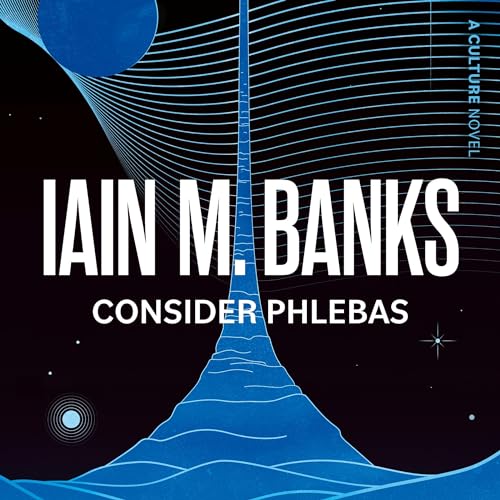
As with any series, people have differing opinions on which book is best. Excession seems to be very popular. But because the series is episodic, people also have different ideas about where to start. Back in early 2018 (when this blog was just a twinkle in my eye), the majority opinion was that I should read Player of Games first. That’s what I did, and it was such an underwhelming experience that it’s taken me several years to consider returning to Banks. And since I’m giving him a second chance, why not go back to where it all started? The very first Culture novel: Consider Phlebas.
Consider Phlebas has all the hallmarks of a debut. Bursting with ideas, but lacklustre in the execution. Banks’ imagination is vivid, with all sorts of weird aliens and artificial intelligences running around the galaxy. There’s a slightly odd approach to what constitutes ‘human’ that doesn’t really make sense to me, but among the more remarkable aspects of the worldbuilding is that Earth doesn’t feature – not even as a mythical birthplace long-since lost.
Banks also does a good job of interrogating the idea of a utopia. That, really, is the core theme of the book. Is the Culture really all it’s cracked up to be? We see perspectives of those from within the Culture and those from outside. The Culture is portrayed as a largely benign polity in which humanity is free to indulge in every whim. However, those whims include going to war. Which may in fact be a good thing, because without violent change the Culture is faced with the existential threat of cultural stagnation. I also like the idea of the Culture being insidious, warping other civilisations until they fall in line and want to sign up to the Culture’s means of doing business. Utopias rarely make for exciting storytelling, but Banks gets good mileage out of his ideas.
Unfortunately, the plot is all over the place. There’s ostensibly a race between the two powers to retrieve a valuable piece of artificial intelligence. In practice, however, much of the book is taken up by the same ship-of-ne’er-do-wells drama that takes up a lot of space opera. Not that this is a bad thing in itself, but the pacing is quite frankly appalling. The Clear Air Turbulence (Banks being a maverick when it came to spaceship naming conventions) zips from mission to the next, seemingly stalling for time while Banks thinks of a way to bring his story to a close. It’s not quite Becky Chambers, but it feels like a slice-of-life drama with a few added explosions. There are some great sci-fi ideas showcased in these middle episodes, but as a narrative it’s one mad stumble after another.
I often find that classics of the genre are more interesting as historical data points than they are enjoyable as stories in their own right. Consider Phlebas fits right into the former category. It’s influence is massive, and we should all be grateful it exists. It’s a far cry from being a bad book. But if it were released today by an unknown author, I rather think it would quickly be forgotten. Consider Phlebas walked so that British space opera could fly.
Audio Stats
- Narrated by Peter Kenny
- A Novel of the Culture
- First Published 1987
- Runtime 16hrs 25mins


 At Boundary's Edge