
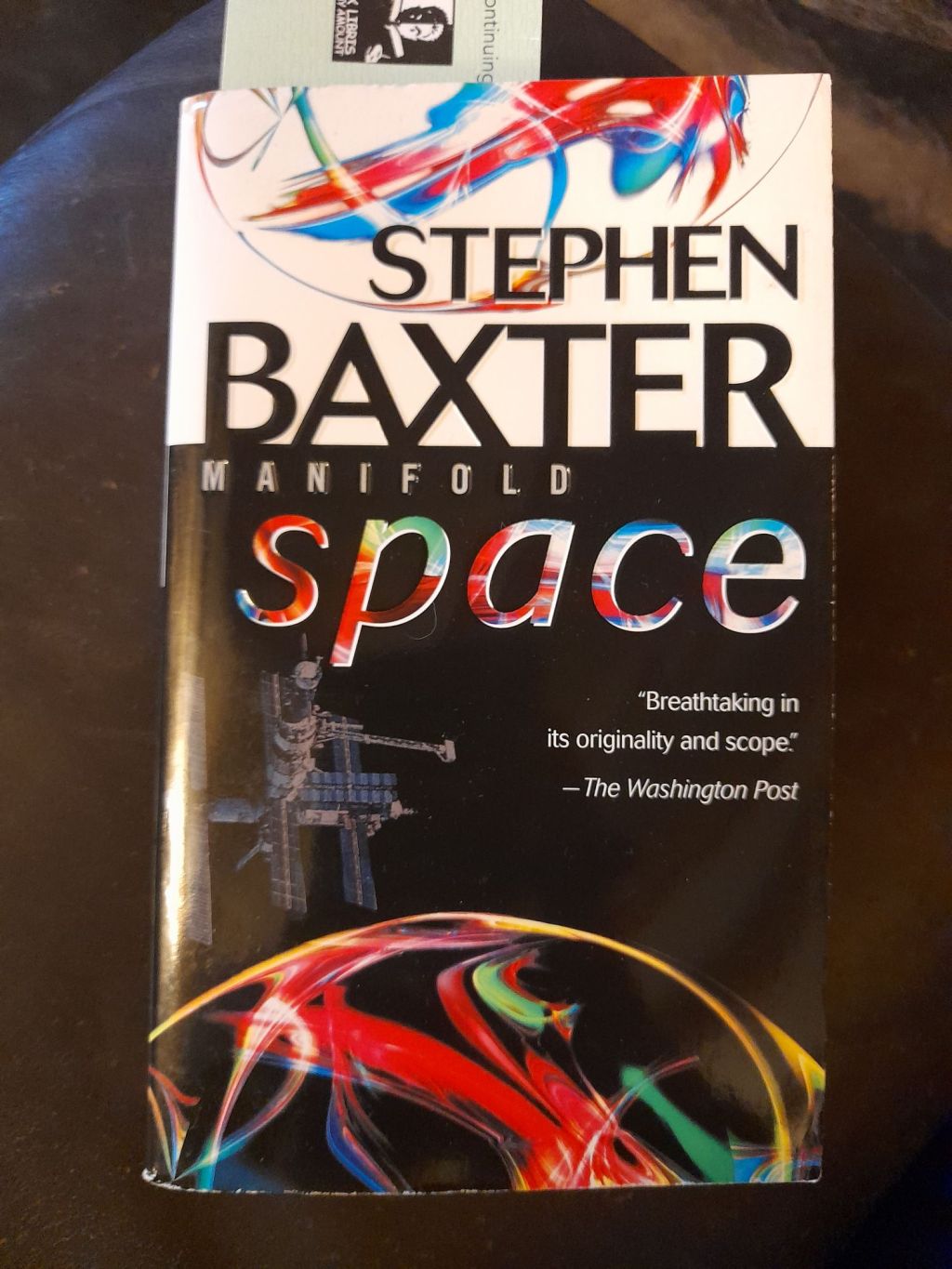
This review is going to look a little different to my usual review style, and that’s because these two books are a little different. Time and Space are, respectively, the first and second novels in Stephen Baxter’s Manifold sequence. There is a third, Origin, and a collection of short stories called Phase Spaces, which I reviewed a while ago HERE. Twenty tears later, Baxter would return to the idea of the Manifold with his World Engines duology, reviewed HERE. I’m calling this a sequence rather than a series, because the books are entirely standalone, with no connecting plot or arcs. However, they are very much tied together in ways that will soon, I hope, become clear.
Time introduces us to brilliant entrepreneur Reid Malenfant, who wants humanity to colonise the stars. To this end, he decides to send genetically modified squid to explore an asteroid. This extravagant project doesn’t go down too well with the scientific establishment, and soon enough Malenfant’s grand visions are threatened by governments and ecological collapse alike. Luckily for Malenfant, he has an unlikely source of aid: messaged from the future intended to ensure that some form of life survives the coming collapse.
Hard SF approaches to time travel always tie my head in knots, and Baxter’s endeavour is no different. I’m still not entirely sure I understand what was going on in this book, but I certainly enjoyed the journey. Sheena-5 and the other squid are some of the best uplifted animals I’ve come across in science fiction, and the whole plot hangs together very well.
Then along comes Space. Whereas Time suggested that humans are ultimately alone in the universe, Space takes the idea that life is actually incredibly common, even within our own solar system. the only problem is that everyone except humanity is dead, and has bee for a while. The best contact we can hope for is the mechanical descendants of these lost aliens species, some of whom are friendly enough, while others are on a relentless quest for galactic domination. Humanity needs a representative on the galactic stage, and who better than Reid Malenfant.
But wait. These are not the same Malenfants. Or rather, they are. You see, the Manifold is Baxter’s multiverse. There is no crossover, no switching of dimensions. It’s just a way of exploring completely different ideas using the same central character. Who isn’t really the same, because his entire life has been different. You could rename one of the Malenfants and not even know these books had a connection.
And yet there is a connection. A tenuous thread in the form of the Fermi Paradox. In short, ‘Where are all the aliens?’ Time says we are alone, and that the the future is ours alone. Space argues that we are but the latest in a long line of civilisations to rise from the primordial soup, and that we will fall along with all the others. In recycling familiar characters, Baxter lets the focus fall on the questions and assumptions at the heart of each novel. Even more so than his usual works, these are as much thought experiments as they are novels.
Now, confusing though it was, Time is the stronger novel. Space is the sort of rich and realistic future history Baxter excels at, but at this stage in his career, I feel like the writing isn’t quite strong enough to fully bear the weight of all these ideas. A weaker novel, perhaps, but a grander story. One interesting aside is that Baxter’s contemporary Alastair Reynolds published Revelation Space in the same year, with a similar notion of the direction powerful alien civilisations might take. Reynold’s work is upheld as a modern classic, whereas Baxter’s never quite reached the same audience.
Baxter is unafraid to take risks with his storytelling, and the Manifold sequence is a clear example of this. It is not his strongest work, not by some margin, but it does provoke some of the most powerful questions.

 At Boundary's Edge