
Towards the end of May, I found myself reading a lot of short stories. Three whole books full of them as it happens. Collections and anthologies are always hard to review. By their nature, they are a mixed bag. Even my favourite authors have written poor short stories, after all, and a collection of multiple authors will always have some I prefer to others. Technically, an anthology has to feature the works of multiple authors, while a collection is generally a solo work. Like most people, I’ve fallen into the messy habit of using the terms almost interchangeably. Regardless of what they’re called, they make for a tricky review. I tend to pick out a few favourite stories, maybe one that doesn’t work so well, and then give a general overview of the book as a whole. Since I read three in quick succession, I’ve decided to bundle all those short stories into one review.
The first books is the only true anthology of the lot. Nova 4 is, as the name suggests, the fourth Nova anthology edited by Harry Harrison. Most of the authors in this anthology were new to me – in fact, I’d never heard of half of them – which is really he point of the anthology. It’s abut bringing readers new stories, and championing new voices. I want to highlight two stories here, both of which are among the longer ones in the book.
I haven’t ready any of Robert Sheckley’s fiction before, at least none that I recall, but I have the gut feeling that his comedic stylings will irk me. Thus I was hardly enthusiastic about seeing his name here. However, Slaves of Time is a very good short story. It’s a time travel yarn rife with paradoxes and convoluted timeline splits. I still don’t entirely understand it, but I did have a good time reading it. My favourite story in the anthology, though, is Tom Reamy’s Beyond the Cleft. This is Reamy’s debut, and is more horror than science fiction, depicting as it does a remote village where the children turn into cannibals. It’s every bit as horrifying and grotesque as you could hope for it to be, and I’ll be adding Reamy’s name to the list of authors to keep an eye out for next time I’m browsing anthologies.
The second book is The Gabble and Other Stories, a collection of short fiction set in Neal Asher’s Poilty universe. There doesn’t appear to be any order to the stories, but a couple reference characters, locations, and events from the Polity novels. The gabble of the title is an allusion to the gabbleduck, a particularly weird and nasty alien that vaguely resembles a duck, speaks utter nonsense, and chews people for fun. Three stories are about the gabbleduck, leaving us a little older and wiser at the end of the book. Overall, however, these stories haven’t changed my already conflicted thoughts on Asher’s writing. He has a great imagination for creating monsters, but his stories tend towards gory violence, pointless and explicit sex, and a general nastiness that’s hard to stomach. A book I’d only recommend to existing Asher fans.
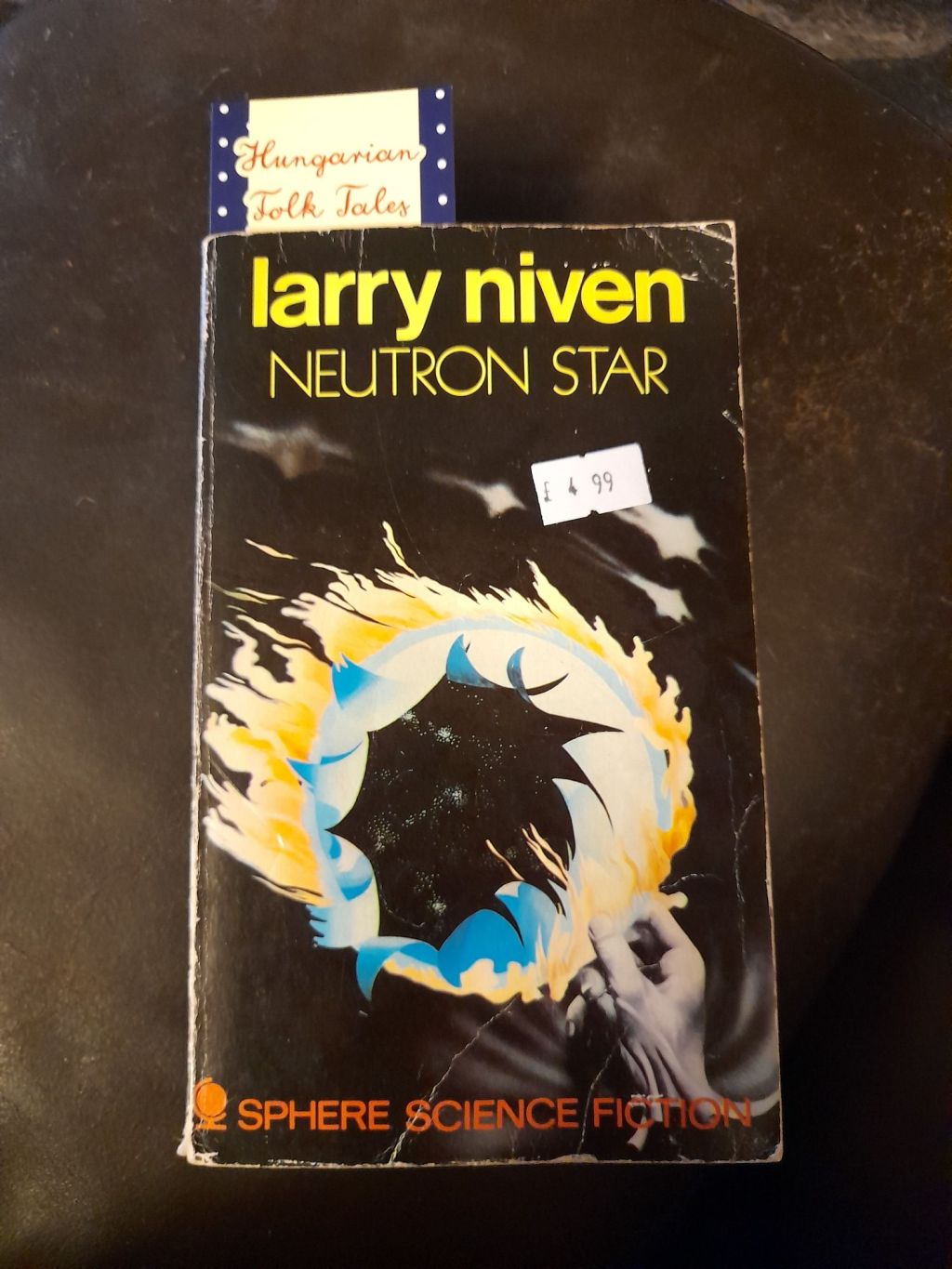
Finally, and going back in time, we have Neutron Star by Larry Niven. The title story is a Hugo winner, and sets the tone for the collection as a whole. This is some very dry hard SF, all set in (and helping to build) Niven’s Known Space universe. It’s hard to pick a favourite story, but ‘The Soft Weapon’ deserves a mention for being an original work that was later transposed almost verbatim into Star Trek: The Animated Series. About half of the stories feature wandering explorer Beowulf Shaeffer, serving to give some structure to the collection. These stories are unlikely to win over anyone who doesn’t like the more traditional style of hard SF, but I personally was fascinated by the way Niven slowly builds a universe through off-hand mentions and a few repeated ideas. I know I’ll be returning to Known Space in the near future.
If you like short stories, Neutron Star and Nova 4 are both worth checking out, but if you’re strapped for time or money and can only manage one of these three, I’d suggest you make it Nova 4. There’s bound to be something in there that you enjoy.

 At Boundary's Edge