Teaser
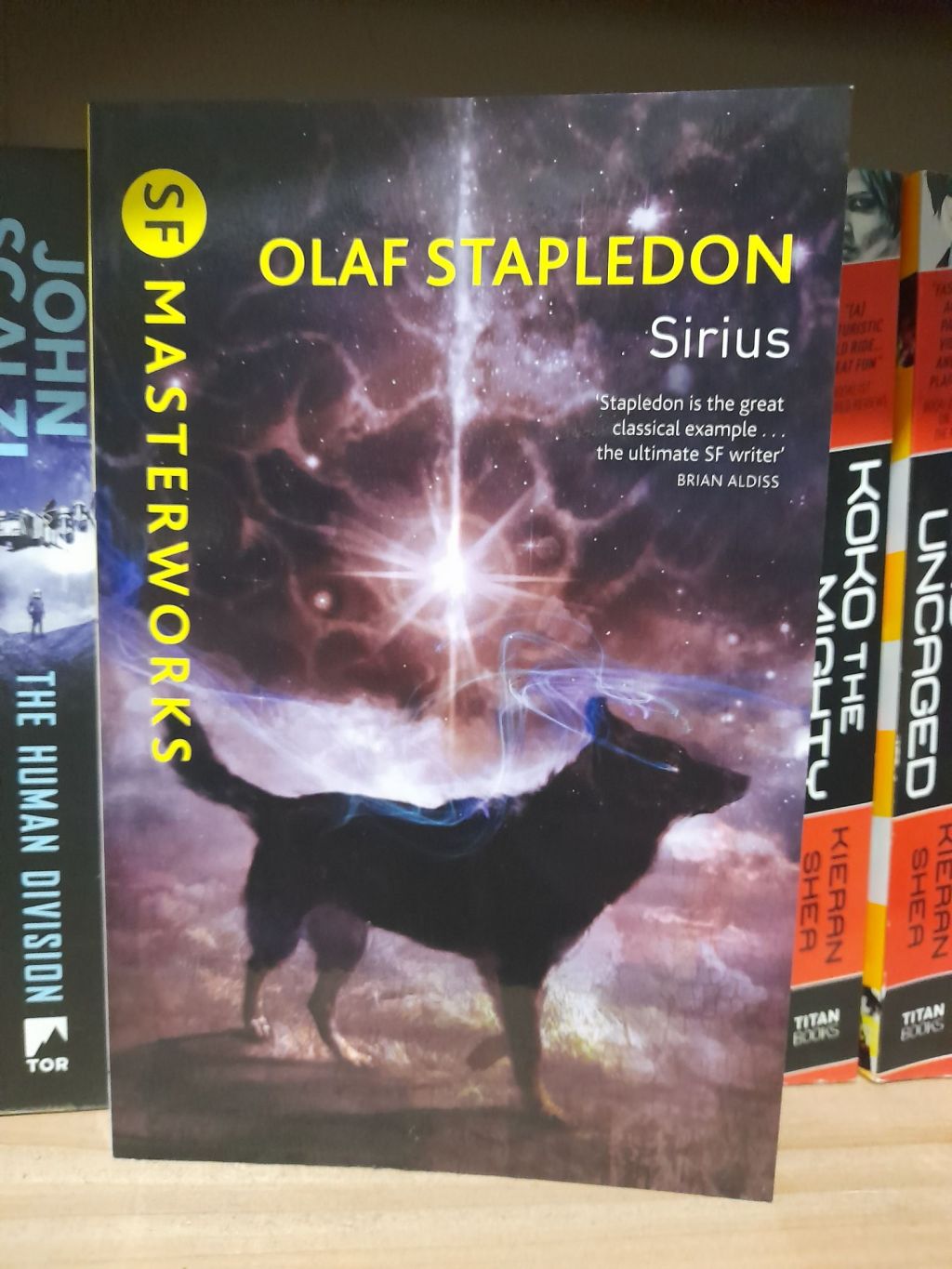
Sirius is not like other dogs. Trained as a sheepdog in the Welsh hills before being brought to university by his breeder, Sirius is the pinnacle of a revolutionary breeding project. Sirius can think, and talk, and has goals and dreams of his own . . .
Review
When I read Olaf Stapledon’s Last and First Men a few years ago, I wasn’t overly impressed. It was mindboggling scope, but also a rather tedious reading experience. You could be forgiven for thinking I’d end my relationship with Stapledon right then and there. And I did, for a while. I considered picking up Star Maker if I saw a cheap copy, but I was in no rush to do so. As it happens, Sirius was the next book of his I saw. A book about a dog? It didn’t really seem like my sort of thing. It was, however, published in 1944, filling a key gap in my history of SF. For obvious reasons, the science fiction market was a little quiet during the 1939-1945 period. This exercise in record-keeping turned out to be a blessing in disguise, because Sirius is easily one of the best books I’ve read all year.
To get one thing out of the way, it was slightly surreal reading a book written and largely set during the Second World War. Even though this isn’t a book that looks into the future, and is concerned with primarily non-military affairs, it’s fascinating to see how the spectre of war casts a shadow across events. There’s no escaping what’s happening in the wider world, even when the core of the book is set in a remote corner of Wales.
Ah yes. Wales. To the best of my knowledge, Stapledon never lived in the country I’ve called home all my life. Regardless of that, he does an excellent job of bringing it to live. Welsh hill farms have changed precious little over the past century, especially not socially, and so much of what Stapledon writes about is still true today. It’s almost unnervingly accurate in its depictions of ageing farmers, close-knit communities, and a deep mistrust of outsiders.
As to this being a book about a dog, I needn’t have worried. There’s nothing schmaltzy going on here. The dog doesn’t exist for the sole purpose of tugging at heart strings. Sirius is a fully developed character in his own right, and we see the majority of the story, albeit at some remove, through his own eyes. Sirius can talk and think, but beyond that he remains very much a dog. He is intelligent, but he thinks as a dog thinks. He is intellectually capable of understanding knots, for example, but he is physically incapable of tying them, having as he does paws rather than hands.
Of course, Stapledon was a philosopher as much as a novelist. Yes, this book is about the practical implications of being an intelligent dog, but also about the spiritual ones. Sirius takes an active interest in religion, much to his creator’s chagrin. He asks questions about the nature of the soul, his purpose in the world, and the relationship between dog and humans. Sirius styles himself as a deep thinker, even as he wages a private war against the animal instincts of his wolf ancestry.
Stapledon’s style can be dry, and his method of telling his stories second-hand is again on display here. Our primary narrator is a family friend of Sirius’ creator/owner, who recounts Sirius’ life story based primarily on Sirius’ own accounts, but also a few others. In spite of this remove, the story flows incredibly well. The tension is well-realised, and even if there are a few predictable turns, it progresses in a very natural fashion. At times, it’s a deeply tragic book, but the exploration of ideas offers a bright spot amid all the horrors of looming global conflict (not to mention the daily horrors of farming). Science fiction can be a uniquely good delivery vehicle for philosophical ideas, and Sirius is one of the best examples of a philosophical novel out there.
This book is absolutely phenomenal. A high point for both Stapledon and the SF Masterworks range. If you want to start collecting either, then this is the ideal place to start.
Book Stats
- A Standalone Novel
- First Published 1944
- 194 Pages


 At Boundary's Edge