Teaser
All Professor Ransom wants is a quiet walking tour of the English countryside. Much to his misfortune, he is soon drugged, abducted, and taken to the planet Mars, known to its inhabitants as Malacandra . . .
Review
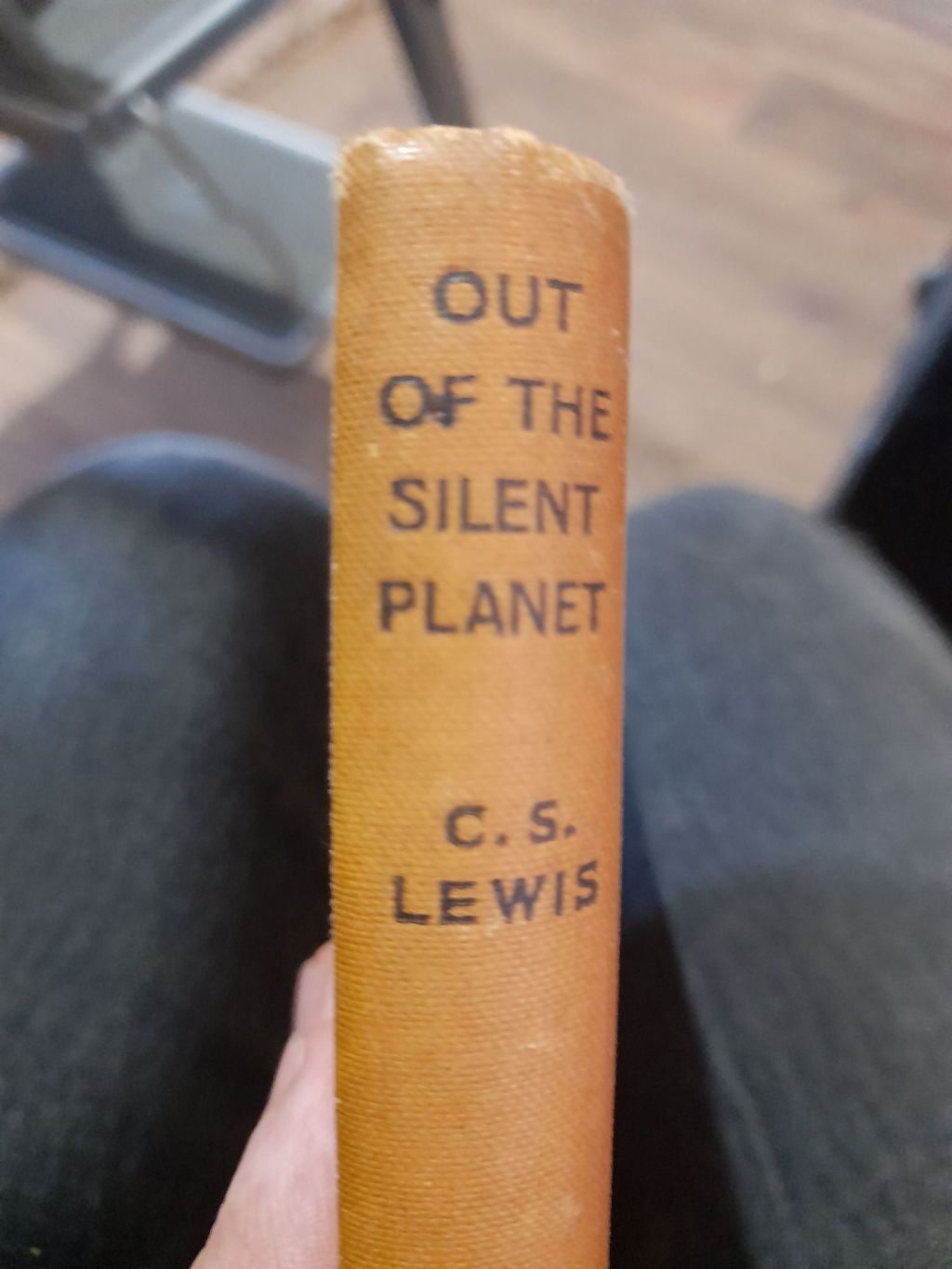
If I say to you ‘C. S. Lewis,’ the first words to pop into your mind will likely be some combination of ‘lion,’ ‘witch,’ ‘wardrobe,’ ‘lamppost’ or ‘Turkish delight.’ All things associated with his series of fantasy novels set in the magical world of Narnia, which saw publication from 1950 onwards. What you might not know is that Lewis also wrote science fiction stories. Of course, he did so before the term science fiction was as ubiquitous as it would later become. So his books are perhaps better described a s ‘space fantasies’ or ‘space-time stories.’ Regardless, the adventures of Professor Ransom are recognisably science fiction to modern eyes. Not bad for a trilogy that started in 1938, and had to compete for attention with the Second World War.
Out of the Silent Planet may have been a contemporary of the early American pulp magazines, but it derives its lineage from closer to home. H.G. Wells is a clear and acknowledged influence, while the book’s blend of adventure and philosophy is in conversation with the works of Olaf Stapledon. As such, it has a very different feel from its transatlantic cousins. It feels older, more in tune with the future histories of the late nineteenth century. In some ways, this does leave it feeling a little dated, but that is true for a lot of the period’s writing. At least in the case of Lewis, that old-fashioned feel stems more from a vintage style than for outdated scientific assumptions. This is a thoroughly charming little novel.
Now, science fiction and religion have a somewhat rocky history. Certainly a lot of Golden Age SF bows to the idea that religion is something humanity will eventually do away with. It’s something that may have been useful in the past, but surely won’t be needed as we colonise the outer reaches of space. This assumption isn’t always explicit in the text, and is rarely the centre of the narrative, but it’s an idea that pervades much of the era’s fiction. This is an assumption that Lewis, himself a devout Christian, tackles head-on. Out of the Silent Planet is just as much an argument in favour of religiosity as it is a work of fiction.
I will say this. I am not a religious person. If Lewis’ intent with this book was to convert unbelievers, then it’s a bit of a failure. I find his arguments charmingly naïve at best. And yes, I am aware of the fact that this slightly nudges me towards the camp of the book’s villain Weston, and I am uncomfortable with that. However, I do think that Lewis does a good job of weaving his arguments into the narrative. Unlike other religious SF I’ve come across, Lewis builds his own religion for the purposes of the book. In some ways it does map onto Christianity, but within the book it remains visually distinct. It doesn’t feel like Lewis wants to me to become a Christian, but simply to open my eyes to the strengths of faith. Even a stubborn old soul like myself can admit that’s a worthy goal.
I followed up my read of Out of the Silent Planet with the sequel Voyage to Venus (also known as Perelandra), and I think it suffers from being overburdened with religious imagery, transforming Ransom from a curious explorer into a devoted crusader. Lewis is hardly alone in having a sequel that can’t hold up its lofty predecessor, and thankfully a poor second outing does not diminish the brilliance of the original.
It’s always tempting to look on books this old as historical curiosities, and while Out of the Silent Planet is that, it’s also a really good story on its own terms, and one I heartily recommend reading.
Book Stats
- The Space Trilogy #1
- Fist Published 1938
- 182 Pages


 At Boundary's Edge