
Today’s review is going to be a little more experimental than usual. As you may be aware, I’m reading lots of rather short novels this month. This is one of the reasons I’m already falling behind on reviews. Another problem with short books is that, sometimes, I end up with not a whole lot to say about them. After all, nobody wants a review that’s almost as long as the book in question. Two of the books I’ve read this month have centred on people with a sixth sense, so I’ve lumped them together for a quick review.
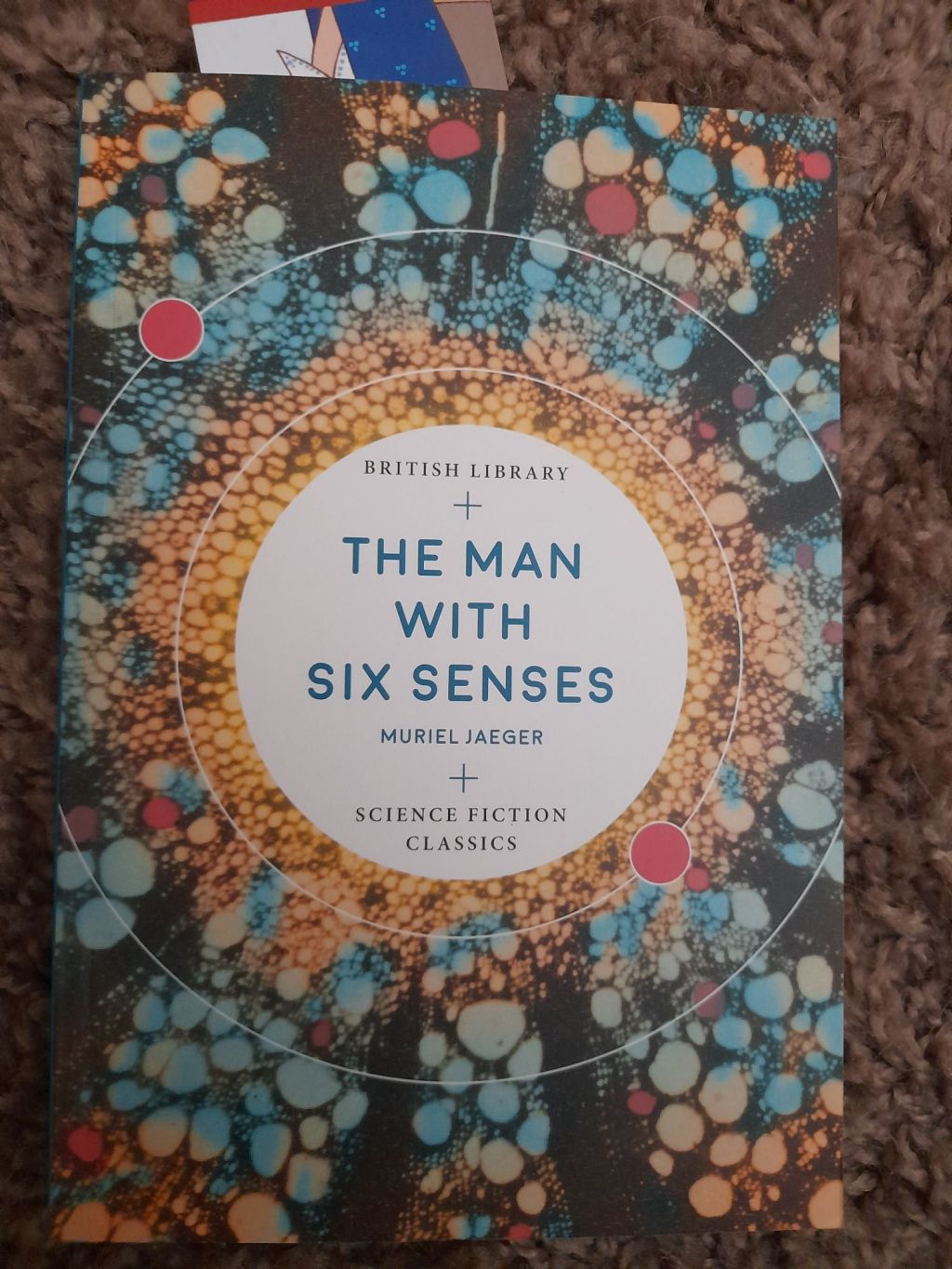
The Man With Six Senses, by Muriel Jaeger, was published in 1927. Around the same period that Hugo Gernsback was toying with the idea he called ‘scientifiction.’ Coming in at under two hundred pages, it is a surprisingly long-winded novel packed with – surprisingly, given it’s authorship – a boatload of sexism. It is a little interesting that it is told in the first person from a male perspective, and this allows Jaeger to explore ideas of male jealousy. It’s also firmly rooted in the disillusionment of the interwar period, with frequent allusions to the First World War, and the respective choices of those who did or did not fight.
The gifted individual at the centre of this book is Michael, who can identify substances by touch, and generally perceives the world around him through different means to everyone else. Notably, he is able to locate a recently buried body without any prior knowledge of the death and burial. Michael is a pathetic figure, both in the sense that he comes across as utterly unprepared for the world around him, and in the sense that he engenders pity. At least from members of the fairer sex. This culminates in his self-appointed guardian Hilda deciding to carry Michael’s child in the hopes of breeding a superior human.
The Man With Six Senses meanders through its storyline, ending in an utterly bonkers fashion. Yet it is a key stepping stone on the route to later ideas of extra-sensory perception. Ideas that the US pulp writers would take and run with in the pages of John W. Campbell’s magazines.
In 1966, Larry Niven joined the ranks of ESP literature with his debut novel The World of Ptavvs. This is a blindingly fast novel, eschewing chapters in favour of numerous short scenes that consistently propel the narrative onwards. By this point in SF history, the basic theories of ESP, telepathy, telekinesis, and other extra senses have become so well-trodden that Niven can simply mention them by name and expect the audience to understand. His protagonist, also called Larry, is a telepath, but other extra senses are casually mentioned as existing.
Larry Greenberg works with intelligent dolphins ( a startlingly common theme in science fiction) and soon becomes involved in a first contact situation. As a result, he makes telepathic contact with an alien named Kzanol. This leads to Larry being overwhelmed by Kzanol’s memories, and the telepath begins to believe that he is Kzanol. This leads to a rather confusing novel in which Greenberg (thinking he is Kzanol) and the real Kzanol must race to retrieve an alien stash in the outer solar system. I spent more time than I’m willing to admit confused as to who was who, not helped by the blistering pace and refusal to slow down.
The World of Ptavvs is perhaps most historically interesting (aside from being Niven’s debut) for including Belters who live beyond the orbit of Mars. This is an idea that would run long into the future of science fiction, perhaps most famously under the same name in James S. A. Corey’s The Expanse series. While telepathy provides the inciting incident for the novel Niven’s work is less about the wonders of extra sensory perception, and more interested in using ESP as yet another tool in the science fiction toolbox.
If this pairing of novels teaches us anything, it’s that bold new ideas rarely stay new for long. Before the dust has even had time to settle, another writer will have taken the idea off the shelf to play with. Sometimes they explore that idea in new and exciting ways, but sometimes they just give it a fresh lick of paint and use it to decorate a thrilling new story.


 At Boundary's Edge