War, huh? What is is good for? Well, this isn’t the place for any convoluted socio-economic arguments, so I’ll stick with what I know best. War can be a great narrative for science fiction. Military SF exploded into popularity in the wake of the USA’s Great War on Terror,’ while an earlier, and arguably more cynical boom in the genre came hot on the heels of the Vietnam War. There has been a military component to science fiction for longer than I can keep track of, but for now I’m going to take a quick look at three books that take war to the stars.
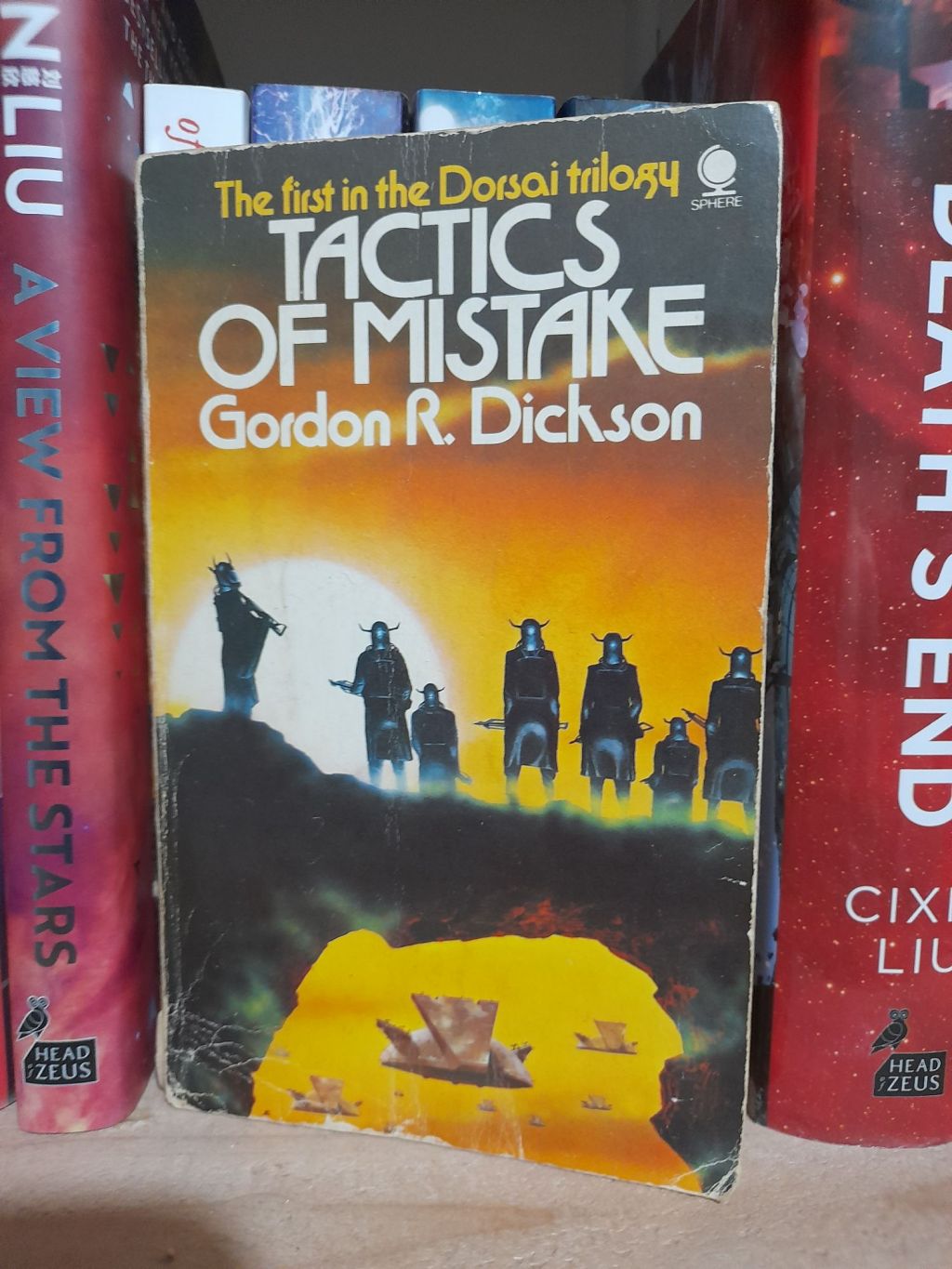
Gordon R. Dickson’s 1971 novel The Tactics of Mistake is part of his Dorsai series. The cover claims it is the first in a trilogy, but it’s also the fourth in the larger Childe Cycle. Broadly, The Tactics of Mistake follows Cletus, a military thinker with ambitious goals. The Dorsai themselves are an elite mercenary force, with the book focusing on guerrilla warfare.
It’s the tactical aspect that sets The Tactics of Mistake apart from other books of its kind. Cletus is portrayed a military genius – always a risky proposition for main character – but he really does come across as a deep thinker rather than someone who is a genius only because the book tells us he is. His calculated manipulation of those around him, especially the woman he plans to marry, leaves him an incredibly unsympathetic character, but one who could plausibly achieve the goals set for him.
In 1972, David Gerrold wrote Yesterday’s Children, which was later expanded into 1985’s Starhunt. Influenced by Gerrold’s experience writing for Star Trek, Starhunt takes place entirely on one starship, engaged in pursuit of an enemy. Unlike the Enterprise, however, the Burlingame is crewed with misfits and outcasts, most of whom are actively working to get off the ship at the first possible opportunity. This leads to a tense and claustrophobic tale as the senior staff begin to crack under the pressure, and the lower ranks never really know what’s going on.
Indeed, that lack of knowledge goes a long way to the book’s success. We are dropped right into the middle of the action. We don’t even find out who the enemy is, nor why the war is being fought, though there are plenty of indications that it going poorly for our protagonists. It feels viscerally real in a way that many of its contemporaries fail to, and even some questionable psychic pseudoscience can’t dull the sense of grit that Gerrold brings to shipboard life.
1998’s Berserkers: The Beginning, gathers almost two dozen pieces of short fiction by Fred Saberhagen, some directly linked to one another, but all set in the same continuity. In this universe, humanity has encountered a fleet of automated warships known as Berserkers. Their origins are unknown, and they exist only to eradicate life. Each short story sees some new technique being used to fight them, or some new planet falling under threat.
Inevitably, these stories do grow repetitious, but the core idea is one that has been copied by everyone from Alastair Reynolds to Stargate: Universe. One notable part of Saberhagen’s universe, almost brushed over, is the idea that humans are one of the only warlike sentient species in the galaxy, and even if their weapons were intended for use against other humans, their warlike nature makes them uniquely prepared for the arrival of the Berserkers. It’s very rare to see warlike tendencies portrayed in a positive light, yet here it is.
Whether it is a violent nature, a calculating personality, or simply the need to stay alive for as long as one can, each of these books offers a different perspective on the role of violence. Together, they prove that military SF, and science fiction warfare more broadly, is not a one-note affair.

 At Boundary's Edge