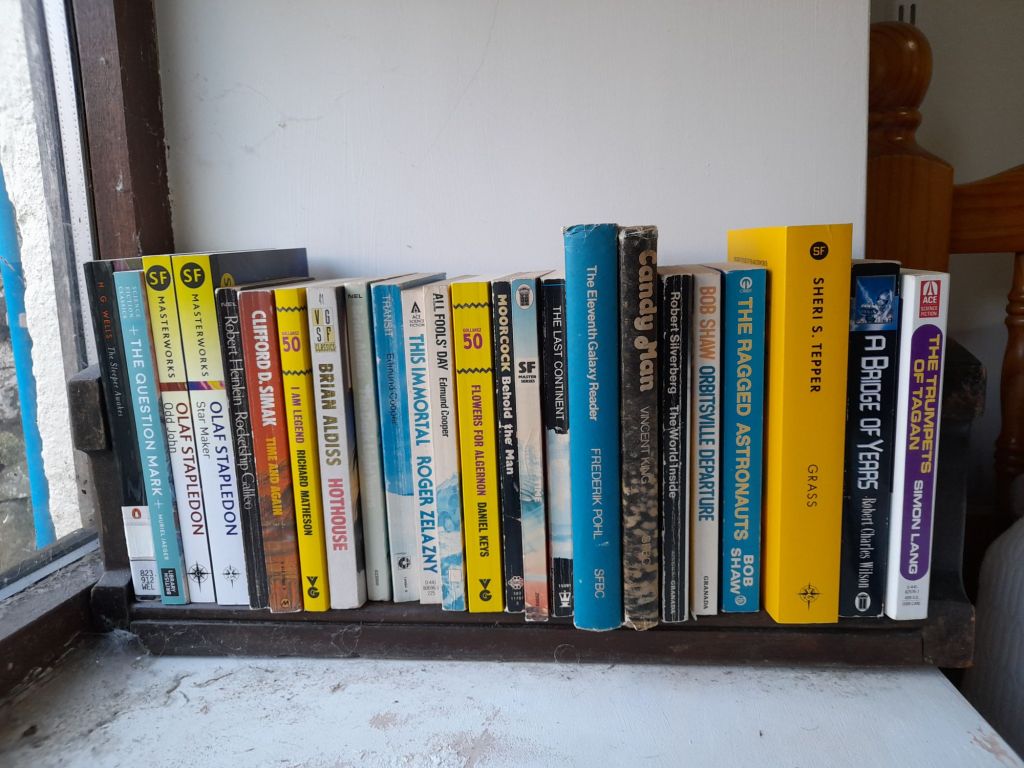
This January, I’m reading a lot of vintage science fiction. Way back in the day, it was common for books to be much shorter than they are today. Two hundred pages made a respectable novel, not just a slightly bulky novella. this means I’ve been tearing through books at a phenomenal pace. If any of these books gives me something to think about, you’d best believe it’s getting a full lengthy review. But for those that don’t leave me in a state of awe and wonder, I’ll be writing quick review. You can find the first batch of these below.
The Question Mark, by Muriel Jaeger (1926)
On the one hand, it’s interesting to see a book that is openly in conversation with the utopian fiction released only a few decades earlier. On the other hand, this book really did cement just how tedious I find both utopias and dystopias. there are some fascinating ideas here about how human nature would actually affect utopian society, but the lack of a compelling narrative uncercuts those efforts, Also, and this is not the book’s fault in any way, but my mental image of the main character was completely ruined by the fact that he was called Guy Martin. though I would pay good money to see the real, modern-day Guy Martin star in a film adaptation of this book.
Odd John, by Olaf Stapledon (1935)
Having written the rather dull Last and First Men and the utterly sublime Sirius, Olaf Stapledon continues to confound my expectations with a book that is resolutely okay. The strongest part of the book is when John ruminates on the self-inflicted destruction of human society, which is all the more poignant having been written prior to the Second World War. Stapledon was more of a philosopher than a fiction writer, and that shows here, with brilliant ideas but a stodgy plot. However, his writing clearly improved the more he wrote, so I have good hopes for my next Stapledon read, Star Maker.
This Immortal, by Roger Zelazny (1966)
Most people who follow the major sci fi awards will know that Frank Herbert’s Dune won the Hugo award. But did you know that it actually tied for the top spot? The other winner that year was Zelazny with This Immortal. This made it a good candidate for my first Zelazny read, though as it turns out it will likely also be my last. This book is only a little over two hundred pages long, but without any chapter breaks it quickly falls apart into a rambling medley of mythology and post apocalyptic landscapes. This is a book in which things happen, and places are visited, but there’s nothing holding it together. The resolution is actually quite clever, but doesn’t make up for the fact that I bounced right off Zelazny’s writing.
The Eleventh Galaxy Reader, edited by Frederik Pohl (1969)
As the title suggests, this is part of a series of ‘year’s best science fiction’ anthologies, with the catch that all of these stories first saw publication in the pages of Galaxy magazine. this one isn’t just one editor’s picks, however. Instead, it contains the results of a poll of the magazine’s readers. So if you want to know what science fiction fans in the sixties thought made for a good story, this is the place to start. For myself, I found them to be the usual mix of good and bad that you’ll find in any anthology. an early standout is Poul Anderson’s ‘The Sharing of Flesh’ which pushed all my Star Trek buttons. Unfortunately it was followed by Robert Silverberg’s ‘Nightwings’ which was far too long for a short story, and the rather dire ‘Among the Bad Baboons’ by Mack Reynolds. the rest of the anthology is comprised of stories that largely entertained, but did not inspire any more meaningful reaction. Most of the authors herein were already known to me, and while I enjoyed the stories, no new names stuck out. an unfortunate additional piece of data to suggest that 1969 was just a rough year for science fiction releases.
If you’ve read (and especially if you’ve enjoyed) any of these books, I would love to hear from you. Until then, it’s time for me to get back to reading. See you on the other side.


 At Boundary's Edge