
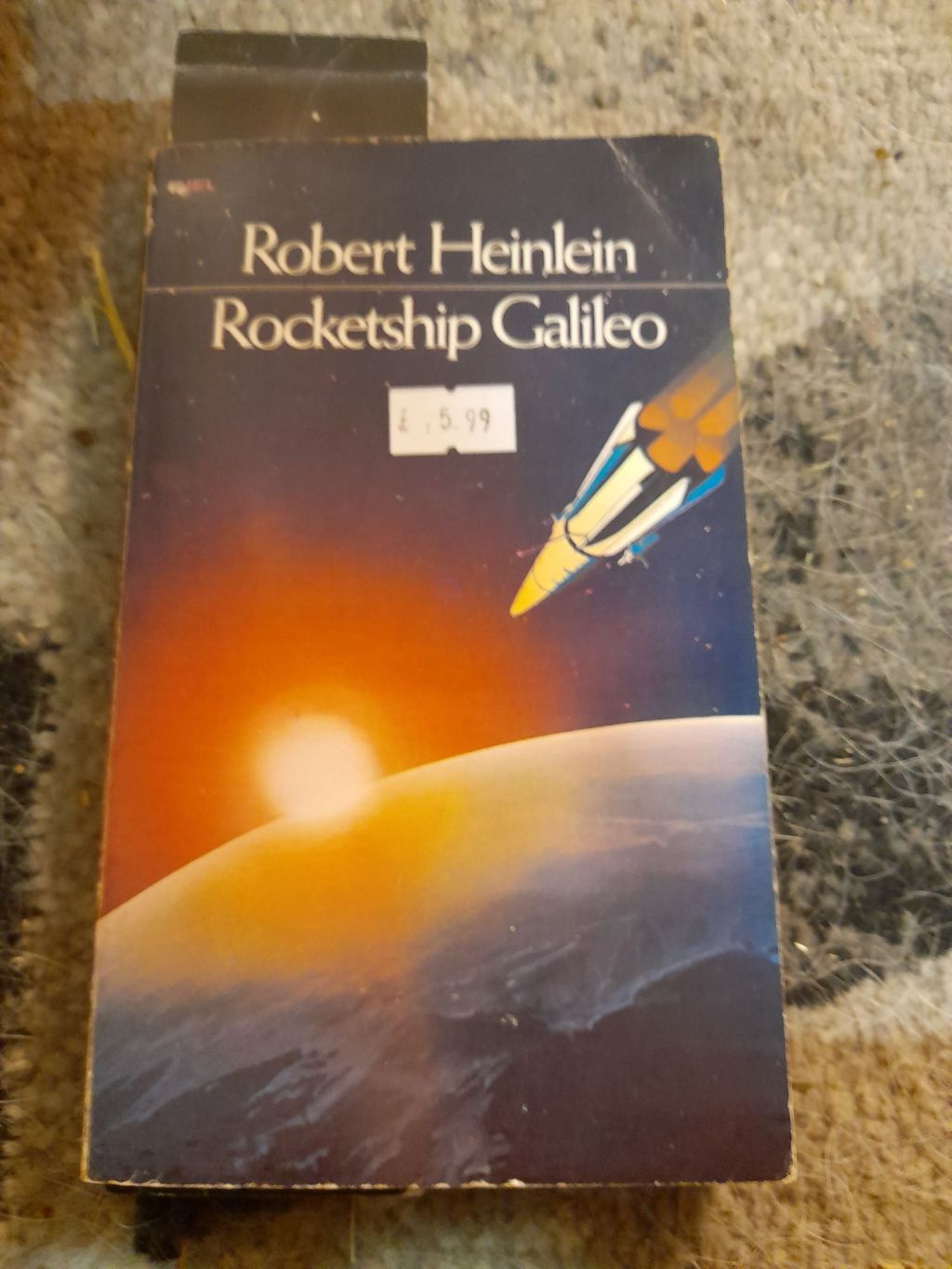
Teaser
It’s a new age of peace and scientific innovation, when three boys build a rocket that can take them to the Moon. but can it bring them back? And can these space pioneers survive what the Moon has in store for them . . ?
Review
Along with Isaac Asimov and Arthur C. Clarke, Robert A. Heinlein is one of the ‘Big Three’ writers of science fiction’s Golden Age. He’s also the one I have the least experience with. Because while I’ve read almost every piece of fiction Asimov wrote, and have made great strides over the past few years in reading through Clarke’s oeuvre, Heinlein has always eluded me. Partly this is because his books are less readily available in the UK, but it’s also because it’s not easy knowing where to start. Once you’ve read all of his Hugo Award winning novels (there are a mighty four of them), I think the logical next step is to go back to the beginning, and that means his debut novel, Rocketship Galileo, published in 1947.
Rocketship Galileo is an incredibly simple book. three teenagers build a rocket and, along with one of their uncles, fly it to the moon. Unfortunately, they have been beaten to the lunar surface by some Nazis, who have established a base up there. this leads to a confrontation, and then we all get to go home. It’s a fast and fun adventure, and even manages to avoid the tiresome space Nazis trope by virtue of having been published a mere two years after the end of World War Two. Heinlein’s style is perfect for this kind of adventure, and if it’s a little light in places, then that’s not an inherently bad thing.
One thing to bear in mind is that this was not only Heinlein’s first novel, but the first of a series of juvenile novels. Heinlein was not alone in writing for a younger audience. A few years later, Asimov would begin his Space Ranger series, and Clarke contributed novels such as Islands in the Sky to the growing youth literary genre. These are, in some ways, an early forerunner for the YA boom of the mid-2000s, but they are less rooted in a desire to make relatable characters, and more interested in getting young people into science. Not just science fiction, but science fact. In Rocketship Galileo, the mechanics of rocket-building and spaceflight is detailed and realistic, but explained in simple, no-nonsense terms.
While I don’t think that some elements of Heinlein’s works hold up today (a modern version of this book would probably include a girl among the plucky heroes, for example), I do feel like these juvenile science fiction novels filled a niche that now lies empty. Granted, I am not the target audience for young adult or teen fiction, but I am unaware of any science fiction currently being aimed at the teen audience. There is Brandon Sanderson’s Skyward, but that’s basically a fantasy series with the dragons replaced by spaceships (this is not a slight, but literally the premise). what Heinlein’s juveniles served to do was not only to tell a cracking story, but to get young people interested in science. Fiction was just the delivery method for that mission. As modern science fiction continues to lose the shelf space battle against fantasy, I can’t help but think we need a new wave of juvenile books like Heinlein’s to get readers into the genre sooner. Because no matter how much I enjoy these books, the number of children interested in scientifically outdated books from over half a century ago is probably quite small.
In the absence of newer books, the juveniles of the Big Three are still worth a look, and Rocketship Galileo is a fine place to start.
Book Stats
- A standalone Novel
- First Published in 1947
- 159 Pages


 At Boundary's Edge