
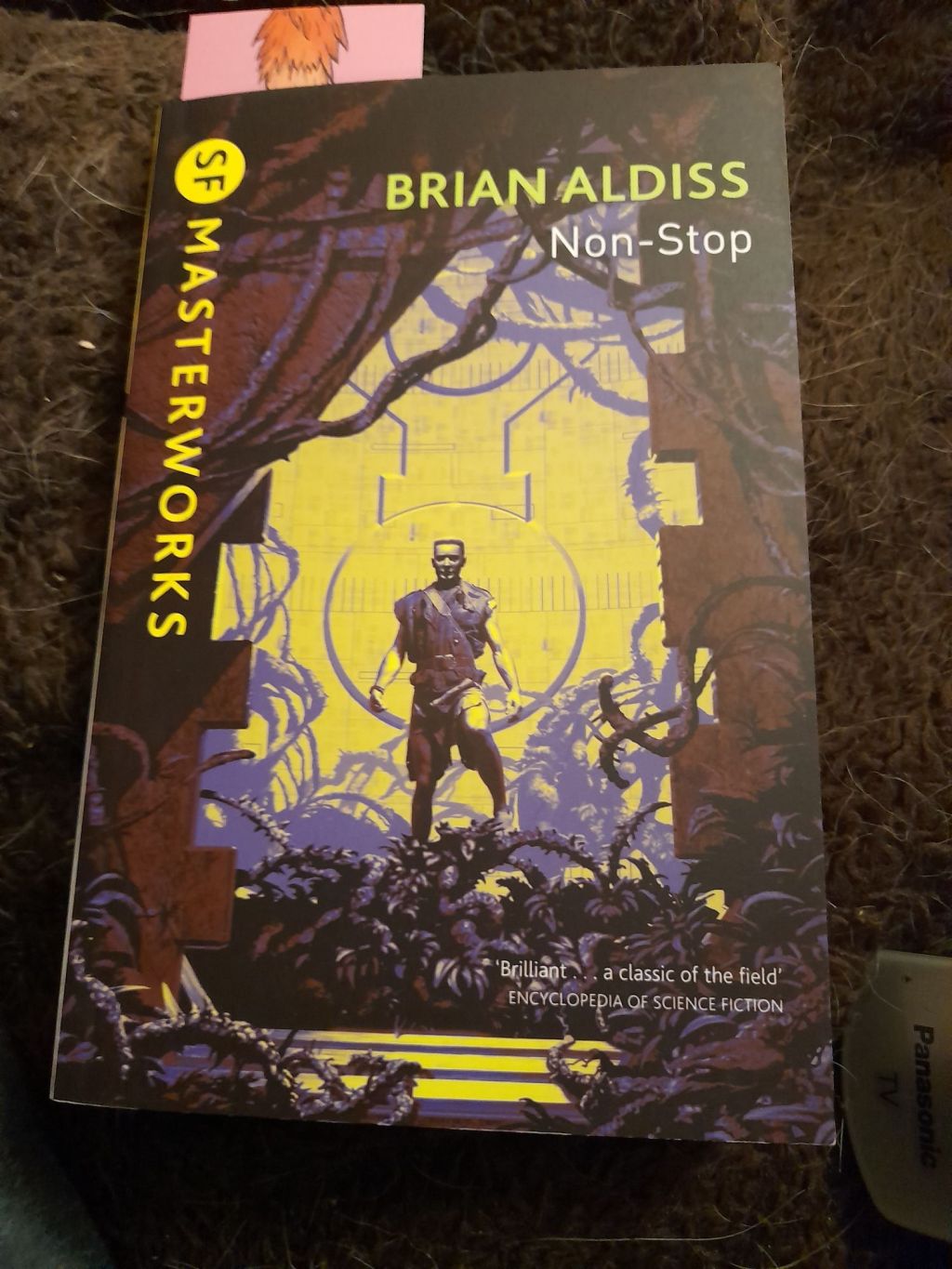
Teaser
Roy Complain has spent his entire life in Quarters. It’s a hard life, sustained only by the efforts of the hunters. But when Roy leaves home for the first time, he learns that the world is a stranger place than he ever imagined . . .
Review
It’s been a few years since I read the Heliconia trilogy and decided I didn’t get all the fuss about this Aldiss chap. But since I’m slowly poking my way through the SF Masterworks series, it was only a matter of time before I came across more of his work. Non-Stop is therefore my second Aldiss Masterwork. Let me say right now, if it had been my first, there would not have been so much time before I returned to Aldiss’ work. Non-Stop has jumped right to the top of my favourite books of the year. Granted, that’s a short list at the moment, but there’s no denying the fact that Non-Stop is my first five-star read of 2026.
Non-Stop is a book in which the protagonist starts in ignorance, and slowly learns the truth of his surroundings as the book goes on. From Quarters, Complain and his allies make their way to the near-mythical Forwards, beset along the way not only by familiar bandits, but by mysterious, seemingly alien, beings, all while speaking in hushed tones of the Giants who built the world. If you’re happy to go into the book blind, then you won’t want to read any further. Because actually talking about Non-Stop requires giving away some of the game.
As the original American title was Starship, I imagine not many people went into this book totally blind. Since it’s now almost fifty years old, cultural osmosis also let me know plenty of what goes on in this book. But the thing is, knowing what’s going on doesn’t ruin the book. Just because we know that the world Complain lives in is a starship, and that Roy and his family are the descendants of the original crew, it doesn’t change the sense of otherworldliness as Complain is gradually enlightened. and even if we know that it’s a generation ship on which something has gone catastrophically wrong, it doesn’t mean that we know what went wrong. There are some great red herrings and masterful misdirects in the latter stages of the book, and even though I knew going in what the ship’s fate was, I didn’t know how it arrived in such a state. Discovering that was a joy all of its own. Because here’s the thing, if your book only works on the surprise reveal of information – if it only works because the reader begins in ignorance – it’s not going to be a very good book. Shock reveals are fun, and this book certainly has them, but there’s a different kind of satisfaction that comes from knowing more than the characters and watching them figure out how their world works.
Aldiss’ style is different to any other I’ve encountered. There’s a gently alien quality to it that works perfectly for building Complain’s world. Each section of the ship feels utterly unique, not just physically, but culturally. The dialects change, and people keep to their traditions that, if you squint hard enough, you can make sense of no matter how strange they are. By the time society all falls apart at the end of the story, the story itself has come together perfectly.
This will not be my last Aldiss, and I’m definitely not waiting several years before getting stuck into Hothouse. Maybe it’s my renewed interest in the history of science fiction. Maybe it’s the fact that I love generation ships, and this is a masterful example of the trope. Maybe this is just a good book. All I can say for certain is that I finally see what all the fuss is about. Aldiss is great.
Book Stats
- A Standalone Novel
- First Published 1958
- 241 Pages

 At Boundary's Edge