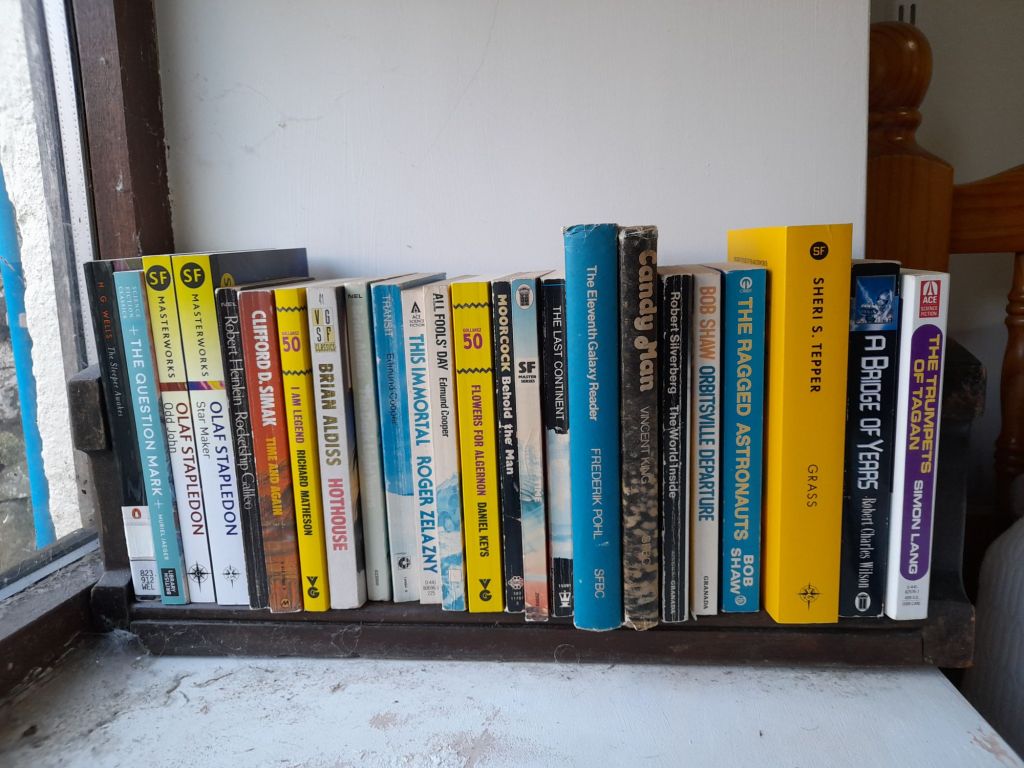
My frenzied vintage SF reading (and listening) has continued for another week. Funny what you can achieve when you put your mind to it. Although it must be said that having complete novels told in 143 pages also does wonders for one’s TBR. As before, I don’t have anything particularly enlightening to say about many of the books I’ve been reading lately, so here’s a quick look at my recent literary conquests.
The City & The Stars, by Arthur C. Clarke (1956)
Arthur C. Clarke continues his spotty track record with this, one of his more famous works, but one of my least favourite. It’s not actively bad, but getting through it did prove to something of a slog. The story chugs along at a meandering crawl, and while there’s an interesting background for the setting, the way in which it is revealed does little for me.
Who? by Algis Budrys (1958)
As much a spy thriller as it is a science fiction novel, this Cold War era mystery starts off with a genius being rebuilt as a cyborg, but his identity and loyalties remain unknown. It’s a great set-up, but ultimately the story never really goes anywhere. The constant flashbacks dry up any sense of narrative tension, but there are some good character moments.
Hothouse, by Brian Aldiss (1961)
Since this is one of Aldiss’ most famous works, I’m surprised it’s not on the SF Masterworks list. even more surprising, given my recent enjoyment of Non-Stop, was how utterly bored I was by this patched-together story. Aldiss’ usual melancholy and playful tone gives way to a rambling sentimentality that soon breaks down into full-blown mysticism. Definitely the weakest of his books that I’ve read so far.
The Dark Light Years, by Brian Aldiss (1964)
Another Aldiss, but this time much better. On the surface it’s fairly standard piece of pulp space opera, but the more you get into it, the more you realise that there’s a lot more going on beneath the surface. There’s a great examination of the complications surrounding first contact, and even if the landing doesn’t stick, the getting there is plenty of fun. It also features a spaceship covered in faeces without tipping into broad comedy, so bonus points all round.
The Caltraps of Time, by David I. Masson (1968)
This is Masson’s only SF work, and my first solo-author short story collection of the year. This book comes with a hyperactive introduction by Harry Harrison, but I can’t agree with his enthusiasm. None of the stories in here are bad, but there’s also nothing that really stands out. It’s a decent collection, but nothing to write home about.
Behold the Man, by Michael Moorcock (1969)
Well, it was bound to happen sooner or later. I have finally found a book that encapsulates everything I hate about the New Wave. Even at a mere 143 pages, it’s bloated with heavy-handed attacks on religion, needless sex scenes, and enough experimental prose to make me wonder if it’s all just one big formatting error. It’s a borderline offensive attack against the senses that I can’t find a single redeeming feature for, By far the worst book I’ve read this year, and I expect it will keep that title.
Dreamsnake, by Vonda N. McIntyre (1978)
A Hugo Award-winner that I snagged for free, this is a post-nuclear apocalypse with all the trappings of a fantasy novel. Now, I’ll be the first to admit that mid-century feminist novels aren’t my go-to reading, but I struggle to see how this won such a coveted award. The nineteen-seventies are rapidly becoming my least favourite decade for science fiction.
The Warship, by Neal Asher (2019)
After my initial excitement with The Soldier, the sequel settled back into more familiar Asher patterns. The book does very little wrong, but is perhaps a touch too long for what is essentially one long series of fight scenes. The Prador continue to be a brilliantly gory alien species, but there’s a frustrating lack of depth to the story. I’ll finish the series at some pointy, I’m sure, but I’m not going to rush to do so.


 At Boundary's Edge