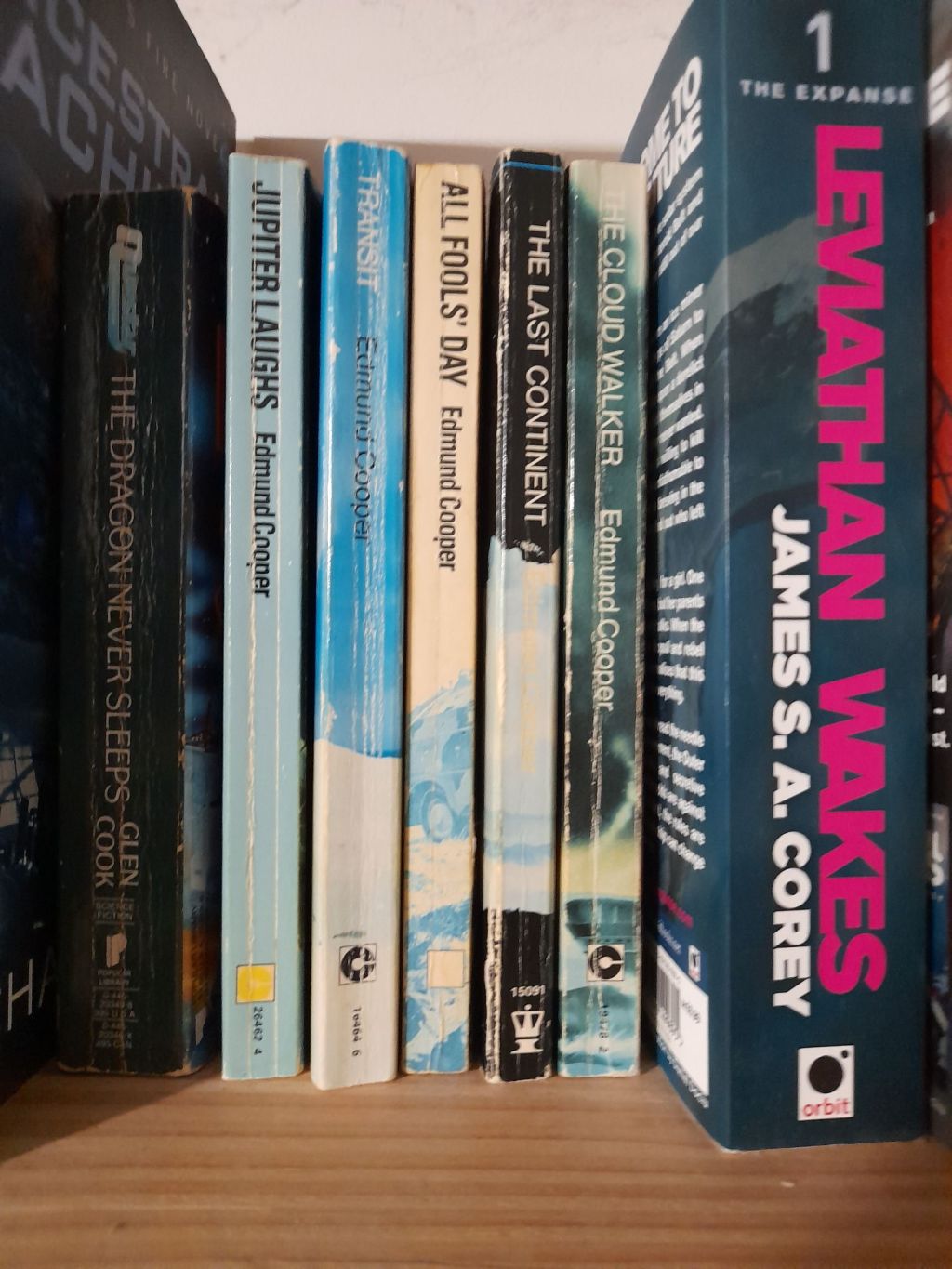
For Vintage SF Month’s final round of quick reviews, I’m going to zero in on the author I’ve read the most by this month. I’ve read two books by Olaf Stapledon, two by Brian Aldiss, and listened to two Neal Asher audiobooks. At the time of writing, I’ve also started my second Jamie Sawyer (more on that next month). But the only author to enter my hands three times this January has been Edmund Cooper.
I think it’s fair to say that Cooper has been largely forgotten today. My review last year of Cloud Walker coincided with another reviewer’s enjoyment of that book, but I have otherwise seen nobody covering the man’s work. Which is a real shame, because he las a lot going for him. ‘The Life and Death of Plunky Goo’ is my all-time favourite short story, Cloud Walker is a fantastic novel, and so I thought it was high time I get to know his work a little better.
Transit (1964) feels, in the best possible way, like an episode of Star Trek. We follow Richard Avery, a struggling artist, who is transported to a remote wasteland along with three strangers. But they’re not alone, because four aliens are also on the planet. It soon transpires that they’re caught up in some manner of test. It’s a very simple premise, and a very quick read, but there’s something about that simplicity that works. Reading about the struggle to build a new shelter, or go hunting, is just as thrilling as the bewildering first contact with the aliens running the test. As with Star Trek, some of the gender roles have aged badly, but the novel as a whole stands up remarkably well.
All Fool’s Day (1966) is another post-apocalyptic tale, with the unusual disaster of the Sun throwing out radiation that causes all normal people to commit suicide. This leaves only the weirdoes and the crazies left to inherit the world. Because of that. it’s hard to criticise the characterisation is this book, which veers from the inexplicable to the downright appalling There’s a lengthy middle section that had me doubting the book, but the final chapters, with the inevitable restructuring of society, make the torments worthwhile. If you enjoyed Survivors, Into the Badlands, or The Walking Dead, then this is the post-apocalypse for you.
The Lost Continent (1969) is the weakest of the three, because I’m not quite sure what to make of it. Again, it’s a deceptively simple premise. In the far future, Earth is assumed dead, until an advanced Martian society returns home to finds that a primitive society is emerging in Antarctica. The twist? The Martians are descended from black settlers, while the primitives are all white. As you might expect, some of the language doesn’t quite hold up, though I’m not the best place person to tell you if it’s offensive or not. Personally, I thought it was a really interesting thought experiment, albeit one that didn’t go into any real depth. Even more than the others, this is a book that would be very different if it were written today. As it stands, it’s a fascinating piece of nineteen-sixties’ race relations portrayed through the lens of science fiction.
There’s a good chance anyone reading this will be unfamiliar with the name Edmund Cooper. If that’s you, I highly recommend seeking out his work. It’s discoveries like Cooper that make reading vintage science fiction worthwhile.


 At Boundary's Edge