Teaser
The elite soldiers of Sim Ops will never set foot on a real battlefield, for they are the remote operators of genetically engineered killing machines. But when you fight and die on one battlefield after another, war takes its toll . . .
Review
It’s vert tempting to think of military SF as an American phenomenon. After all, it’s the US that gave us Robert Heinlein’s Starship Troopers and Joe Haldeman’s The Forever War. A quick look at Baen’s release schedule shows us that military SF continues to thrive across the Atlantic. And this makes sense. That literary legacy stems from a nation that takes an almost fetish-like pride in its armed forces. When works are fiction are able to provide a deeper study of the nature of war than other mass media, it’s only natural that great works of military SF emerge.
Here in the UK, there is a much milder relationship with the armed forces. We’re proud of our military, but I’ve never seen a ‘Thank you for your service’ outside of a ceremonial context. Again, this makes sense. Other than the Falklands War (which happened very far away from mainland Britain) the UK has been fairly quiet on the military front. Until the UK, along with other NATO allies, joined with US troops in what most media outlets referred to as the Iraq War. Don’t worry SF fans, this is where my historical context comes to an end. Because for the majority of UK writers (and readers), the Iraq War is the central real-world inspiration for our military SF. We didn’t have a Korean War or Vietnam, and even the Cold War was largely focused elsewhere. So when Jamie Sawyer sets his first novel’s main action set-pieces on a desert world, it evokes images that were splashed across newspapers and broadcasts during the first decade of the twenty-first century.
The Lazarus War is one of very few British works of military SF that plays it straight. It’s not a satire or parody. It’s not evoking ancient wars. There is a certain American feel to it, down to the fact that the main characters are largely US citizens or their descendants. Tell me this was written by a Yank, and I wouldn’t doubt it. Has America dominated military SF to the point that the entire genre feels Americanised? Quite possibly, yes. Or maybe it’s just that Sawyer’s inspirations are from the US, and so the conversation comes with the same accent.
Yet Sawyer is not simply aping his predecessors. Not just playing copycat with his literary heroes. This is straight-faced military SF, but it adds something new to the genre. Because unlike Heinlein and Haldeman, Sawyer is writing from the age of a new kind of warfare. Drone warfare. There are no trenches to be dug, or grinding guerrilla wars in the jungle. There are still soldiers, but the greatest battles are fought at range. For sure, there are ships and navies, but the trilogy narrows its focus to one squad, who lend their minds to specially-grown clone bodies. These sims are expendable, because you can just pop your mind into another one if you get killed. Only, you remember the experience. Dying and all.
Consciously or not, Sawyer is bringing a literary touch to those who would see war as a game. It doesn’t matter if you die, because you can reload and go again. Who cares if it’s a suicide mission? Just say yes and go in guns blazing. Conrad Harris, our narrator, has clocked up well over a hundred deaths in battle. Coupled with pre-existing issues, the trauma has left him a barley functioning alcoholic. The other members of his squad turn to religion, or cheap thrills, or simply wash out, unable to face the prospect of dying again, even if it’s not for real.
The Lazarus War is, first and foremost, an action adventure. It doesn’t dwell on the existential dread that lurks at the fringes of the story. But nor does it shy away from them. That weight is ever present, and as Harris dies and dies again, we see a man cracking under the burden of it all. Just one more man willing to die for his beliefs, and perhaps more importantly, ready to go on killing for them too.
Series Stats
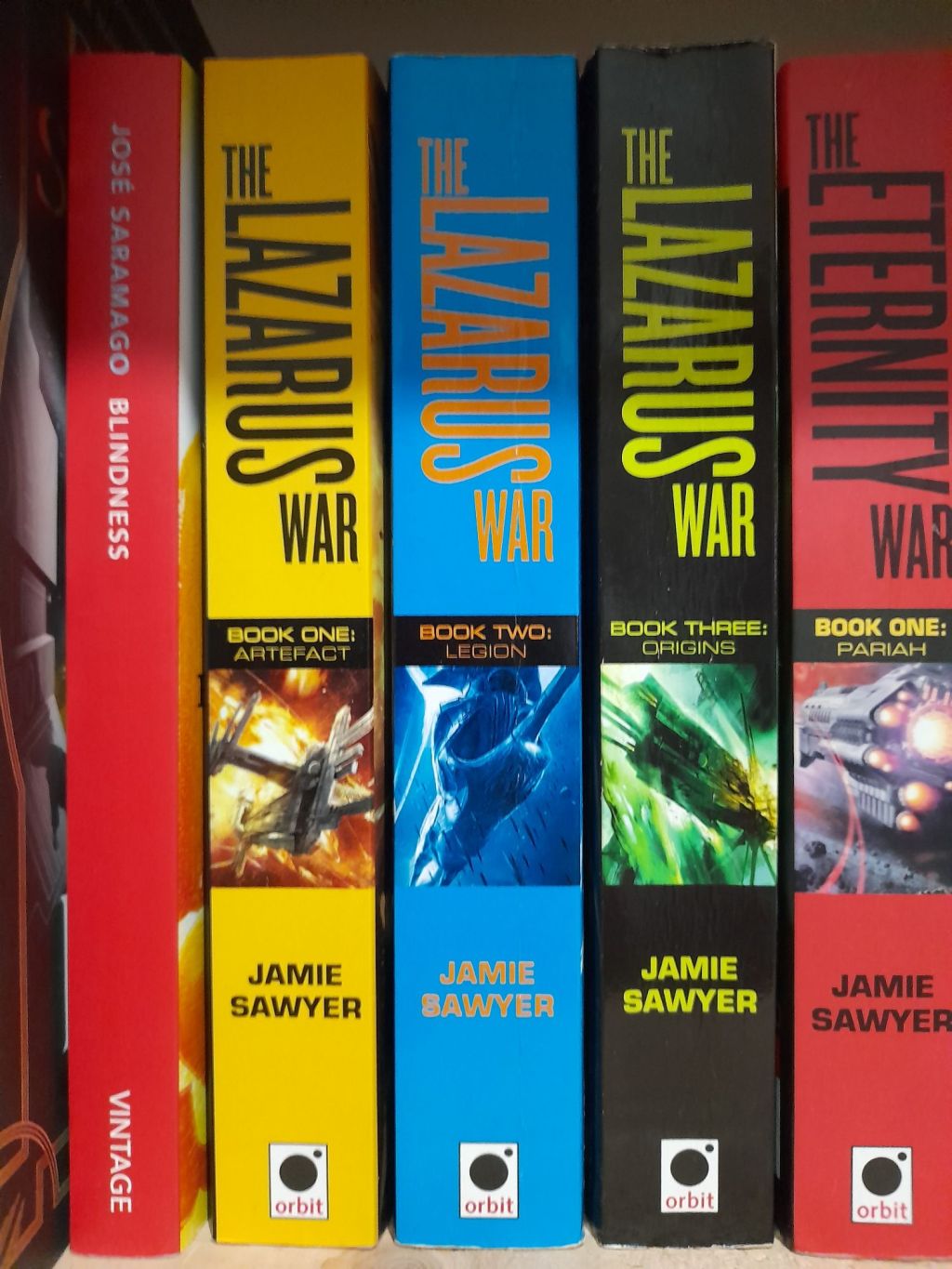
- Consists of 3 Books: Artefact, Legion, Origins
- Published from 2015-2016
- Published by Orbit


 At Boundary's Edge