Teaser
In the years following a global pandemic, a fraction of the population find themselves paralysed. These individuals have only two options for interacting with the real world: robotic threeps, or by riding the minds of other people . . .
Review
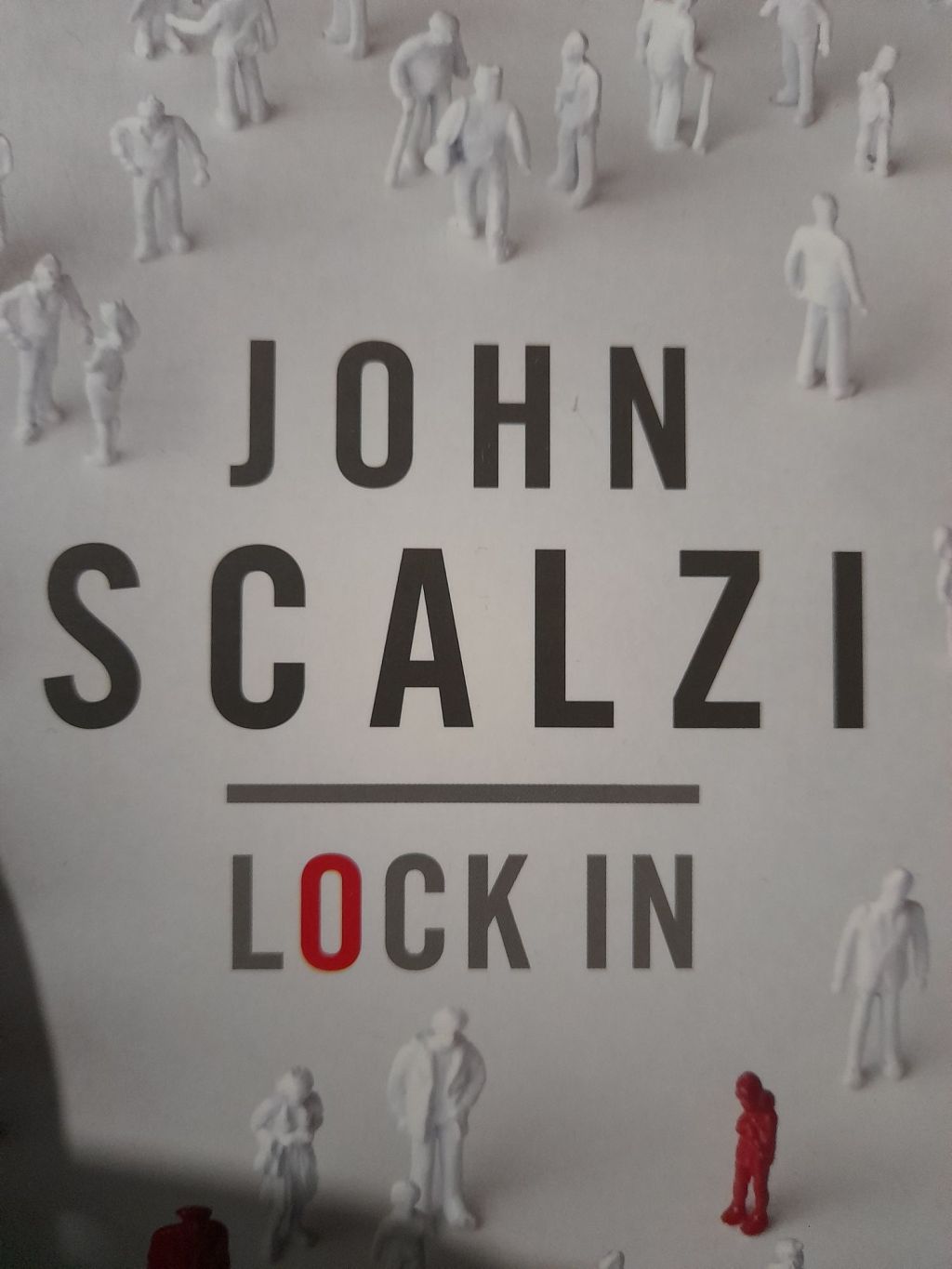
For the Boundary’s Edge Book Club’s second monthly readalong, I wanted to choose something a little lighter than our first readalong. Something fun and accessible. Something fairly modern, but that might not have had the acclaim it deserves. Since it was on my planned reread list anyway, John Scalzi’s Lock In was the logical choice. From memory, it was my favourite of his books, and the perfect gateway drug into more science fiction. As usual, the buddy read is proving to be a great experience, and now that I’m finished with the book, I’m here to bring my thoughts to the masses.
In short, my thoughts are this: Lock In is still my favourite Scalzi novel, but it’s not quite as good as I remembered it being.
Lock In’s greatest strength is also the source of its major weakness. This is a very simple book. We follow Chris Shane, an FBI agent on their first day at work. The complication is that Shane is afflicted by Haden’s syndrome, meaning that they are effectively paralysed and their body kept alive through artificial means. At work, Shane uses a threep (a robot) to interact with the world, while off-duty they also have the option of a virtual reality. Immediately, Shane is drawn into a conspiracy involving Hayden’s rights protestors, corporate cover-ups, and murder. Put simply, this would make a great TV miniseries. There’s even a curmudgeonly partner for Shane to work alongside. The plot races along briskly, with reveals falling into Shane’s lap just when they’re needed, and everyone Shane meets proving to have some very useful skills. It helps that Shane comes from general wealth. This being the near future US, all problems can be solved by throwing cash at them.
Scalzi’s prose is very direct. And I say that as someone used to reading Golden Age SF. There are pages and pages of dialogue, and while the prose itself is utterly realistic, the delivery comes across as rather clunky. Matters aren’t helped by Scalzi’s refusal to describe anything in detail. We know that threeps derive from the name of C-3PO, but what they actually look like, I couldn’t tell you. Nor could I tell you what a single character looks like. Although this does bring up one very clever rick from Scalzi. We know Chris Shane’s name, but their gender is never stated. When I first read this back in 2014, I read Chris as male. This time around, I was determined (with limited success) to view them as female when picturing the incredibly hazy world of the novel. Ultimately, there is no correct answer, and it’s a brilliant use of the first-person perspective.
Coming back to a book after more than a decade, I remembered the main ideas, but none of the plot. This reread really showed up the weaknesses of the novel. It’s all rather shallow, and the characters are paper thin. The ideas are there, but are largely background for a rather formulaic crime thriller. Reading several hundred science fiction novels in the interim has done my impression of Scalzi no favours.
That being said, I do stand my one of my initial assessments. This is a great gateway to science fiction. If there’s someone in your life who reads crime thrillers, or watches FBI dramas, then hand them a copy of Lock In and they’ll feel right at home. It’s the airport bookshop thriller of the SF world, and even if it’s far from perfect, once you get into it, it’s still a lot of fun.
Book Stats
- Lock In Series #1
- Published in 2014
- 334 Pages


 At Boundary's Edge