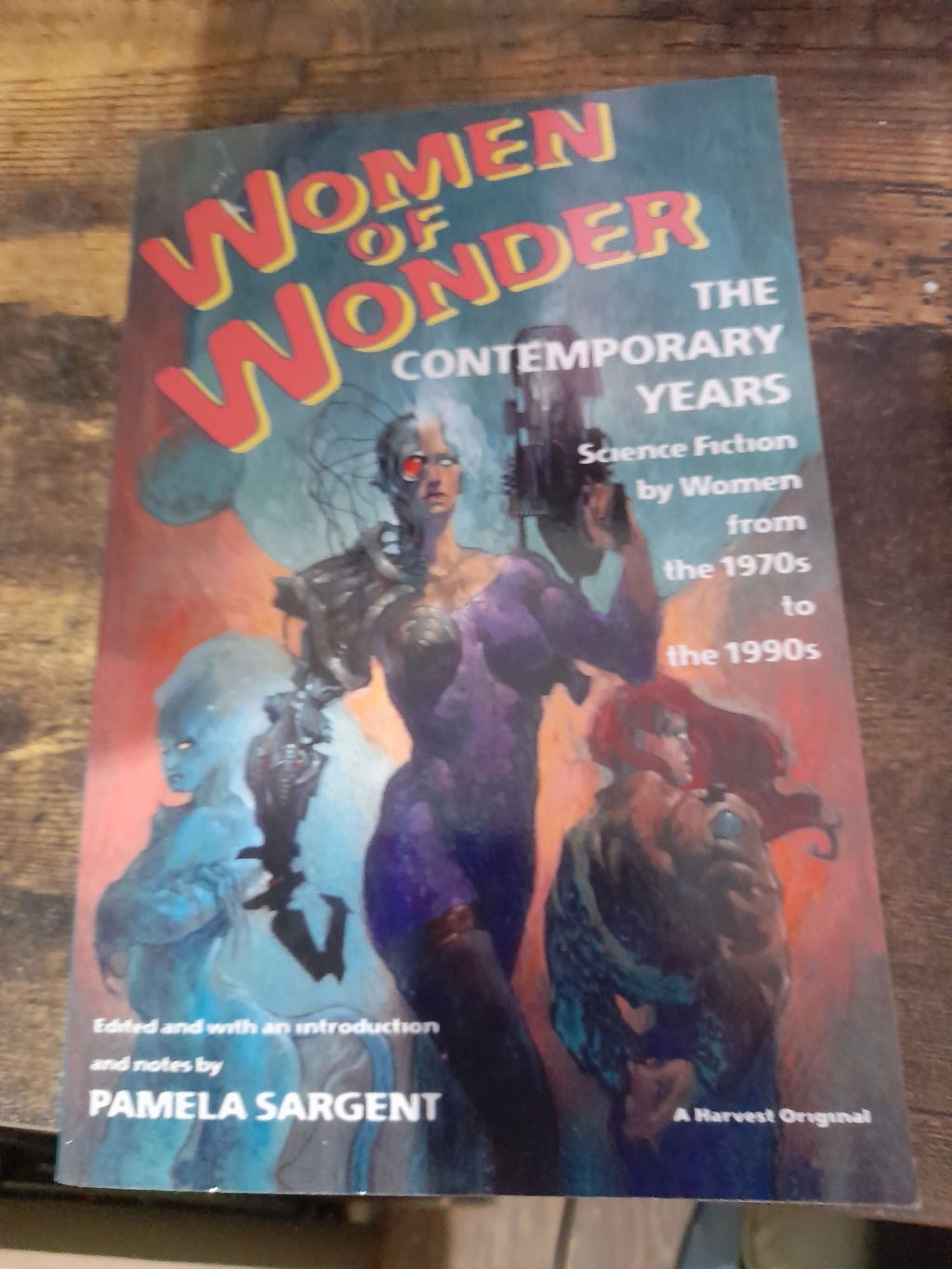
One of the main reasons I’m spending March reading books by female authors is that I want to see what I’m missing out on. A vast amount of my reading can be broken down into three sections. Golden Age of SF, Hard SF, and Military SF. For a number of reasons that I could well write a whole article on, these are corners of the SF world that have historically (and contemporarily) skewed male in their authorship. I want to fill in the gaps in my SF knowledge. As it happens, alongside that woman-shaped gap on my shelves is a lack of books from the 1970s and 1980s. Well, I have read a fair few, but I’ve struggled to find ones I enjoy. From my perspective it appears to be a bit of a weak spot for the genre as a whole.
An anthology of short stories written between the 70s-90s by women is therefore a great way to kick of the month. At least, in theory. In practice, while I enjoyed a few of the stories, overall it was a rather lacklustre anthology that mostly served as a reminder of what I don’t like about the period. However, it did help frame what exactly it is about the era that I dislike.
Starting with the stories, we have my first exposure to C. J. Cherryh. I’ve been hunting for her work for a long time, and I honestly hope her opening story here is not representative of her style, because it left me feeling precisely nothing. Thankfully, Tanith Lee soon came along with a chilling (pun intended) story of life after cryo-freezing becomes popular. Lisa Goldstein’s ‘Midnight News’ was easily my favourite story in the book, and exactly the sort of idea-based social SF that I enjoy in short form. Nancy Kress’ ‘And Wild for to Hold’ had a fascinating central idea, but the overall story didn’t do a whole lot for me. About the rest of the stories, I think the less I say is for the better. You might enjoy them. I didn’t.
What I did enjoy was Sargent’s introduction. She starts by interrogating the patently false accusation that feminism has destroyed science fiction, singling out Charles Platt as one spreader of this notion. Clearly, two things are true. Science fiction is very much alive. Ergo, feminism hasn’t killed it. However, while I don’t agree with Platt’s conclusions, I think some of the trends he noticed are worth picking up on, not least because noticed them too. Feminism as an explicit idea came into SF as part of the New Wave in the 1960s, and stuck around long after. Now, my thoughts on the New Wave are well-known at this point. If you’ve missed out on them, I’m not a fan of the movement. It heralded an era where style and combative content were prized over actual storytelling. Thankfully, as it faded away, it left in its wake a new SF field wherein good ideas and good writing existed side by side. Which brings us to the 1970s.
I do somewhat agree with Platt et al, that the 70s saw a science fiction that had lost its way. The old stuff was still there (as proved by Isaac Asimov returning to the genre) but the later big names (Iain M. Banks, for example) weren’t quite on the scene yet. As we shifted into the 1970s and 1980s – when much of Women of Wonder‘s stories were written – I think that the major shift within SF was less of a focus on big cosmic scale, and more interiority. More emotionally mature writing. Was this the result of feminism? Perhaps, but certainly not entirely. SF was by this stage old enough to assume a baseline familiarity with its own tropes, and to begin interrogating the effects that social changes would have on the individuals, both women and men. It stopped being about Jane Doe being the first woman on Mars, and more about the sense of isolation that she endures. This shift is by no means a bad thing, but it is a visible one.
Alongside that, you also had an increased gloominess. The Apollo missions stopped. Climate Change began to be seriously discussed. The fragility of the environment and humanity as a species became clear. It wasn’t all doom and gloom, but there’s an underlying sense of pessimism in a lot of stories from the period, particularly in the UK. That gloominess gave way to bleakness and eventually downright nastiness through the emergence of the cyberpunk genre in the 80s. There’s a real sense I get from the stories in this book that everyone is suffering, happiness is temporary, and the whole world will end sooner rather than later.
Am I going to grab the next book I see by any of the authors in Women of Wonder? Probably not, though I will be keeping an eye out for more by Lee and Goldstein. I’d also be very interested to read Sargent’s companion anthology focused on earlier decades of women’s SF. But between the themes and the stylistic choices in these stories, my opinion of the latter third of the twentieth century has not changed. Though I am happy to see that there is a better gender balance in my sample study.


 At Boundary's Edge