Teaser
On the world known as Grass, the nobility hunt alien foxes, the priests investigate ancient ruins, and the commoners do what they can to survive. But with a deadly plague ravaging every human world, the fragile balance of life on Grass has never been in greater danger . . .
Review
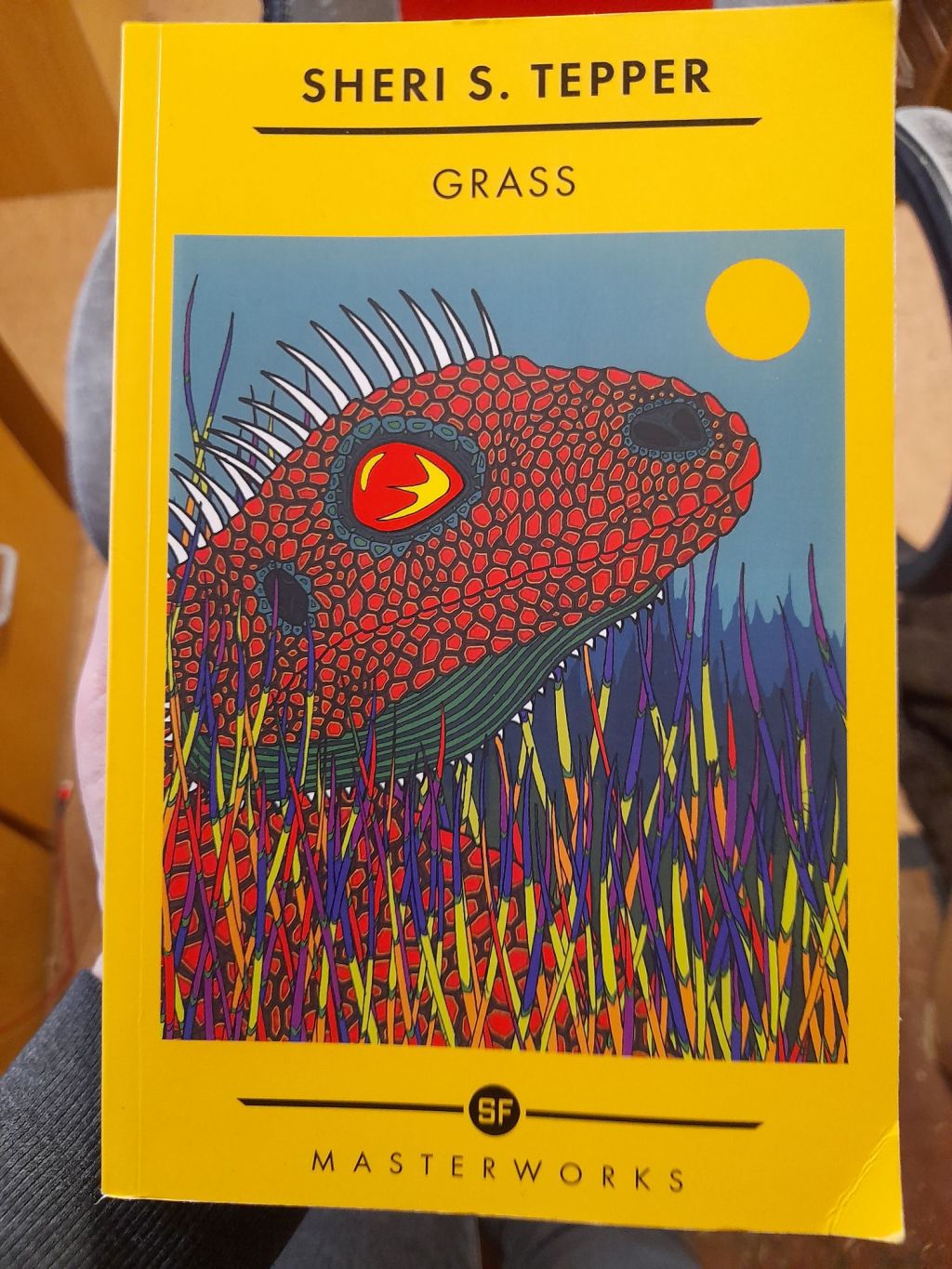
Grass was the March pick for my Book Club. Very fittingly for my Women of SF month, it’s one of the most staunchly feminist books I’ve read in a good long while. No, these two facts are not coincidence, I’m actually a devious planner. Before I get into the review proper, I’d also like to note that the version of the book I read came from the new Gollancz SF Best Of Masterworks, which are somehow even more shockingly yellow than the main range. I mention this because that regular range tends to have some shakily formatted text, looking as if it’s been scanned and printed directly from older books. Not so here, as it appears the entire book has been reset into an easily legible font. So, you know, hurray for that.
Oh, and as a quick note, you can take this review with a pinch of salt because I read this book over the peak of lambing, while my brain had all the consistency of chip shop peas.
Grass is an incredibly ambitious book, and right from the outset it’s easy to see why people might compare it to Frank Herbert’s Dune. There’s a planet named after the ecological feature that covers its entire surface, and that’s just for starters. If you like descriptions of grass, then this is the book for you. And where there are meadows, there will be noble houses on fox hunts. Or foxen, as the case may be. Because on this brave new world, everything has been named similarly to it’s nearest Earthborn analogue. the noble families are, as you might expect, incredibly patriarchal, and overwhelmingly nasty. these two facts are inseparable. The need to break free of patriarchal structures is just one of the themes the book tackles. Naturally a planet of grasses throws in some ecological issues for good measure, but then Tepper decides to throw in a deadly plague, some alien ruins, and a humanity-spanning religious organisation. It all comes down to power, at the end of the day, but getting to that end is a tricky proposition.
Taken alone, each thematic through-line could have been enough for a whole novel. There are sections set in a friary that reminded me of the best parts of A Canticle for Leibowitz. Power struggles run through all the themes, and they do eventually cohere in the struggles of Marjorie, but a large section of Grass feels disconnected from itself. The book could be twice as long and still feel overstuffed. Which makes the abrupt ending all the more curious. This is the first of a trilogy, but as I understand it, the sequel is not a direct continuation of the stories told here, instead taking place a thousand years later. certainly everything concerning Grass is tied together with a neat little bow. A few oddities aside (and most of those stem from my personal grievances with depictions of the divine in science fiction that I’ve happened upon recently), the ending is a satisfying one. I’m left wanting more, but not as the result of a cliff-hanger.
For the genre historians among you, Gras was nominated for the 1990 Best Novel Hugo, losing out to Dan Simmons’ Hyperion, and placing in the shortlist alongside The Boat of a Million Years by Poul Anderson. It was a strong year for science fiction, and Grass is easily the equal of those other novels.
Will I read more Tepper in the future? Probably. I need as break from the sheer depth and complexity of her writing, but I do intend to come back. Just as soon as I’ve whittled that TBR down to size.
Book Stats
- The Arbai Trilogy #1
- First Published 1989
- 504 Pages

 At Boundary's Edge