
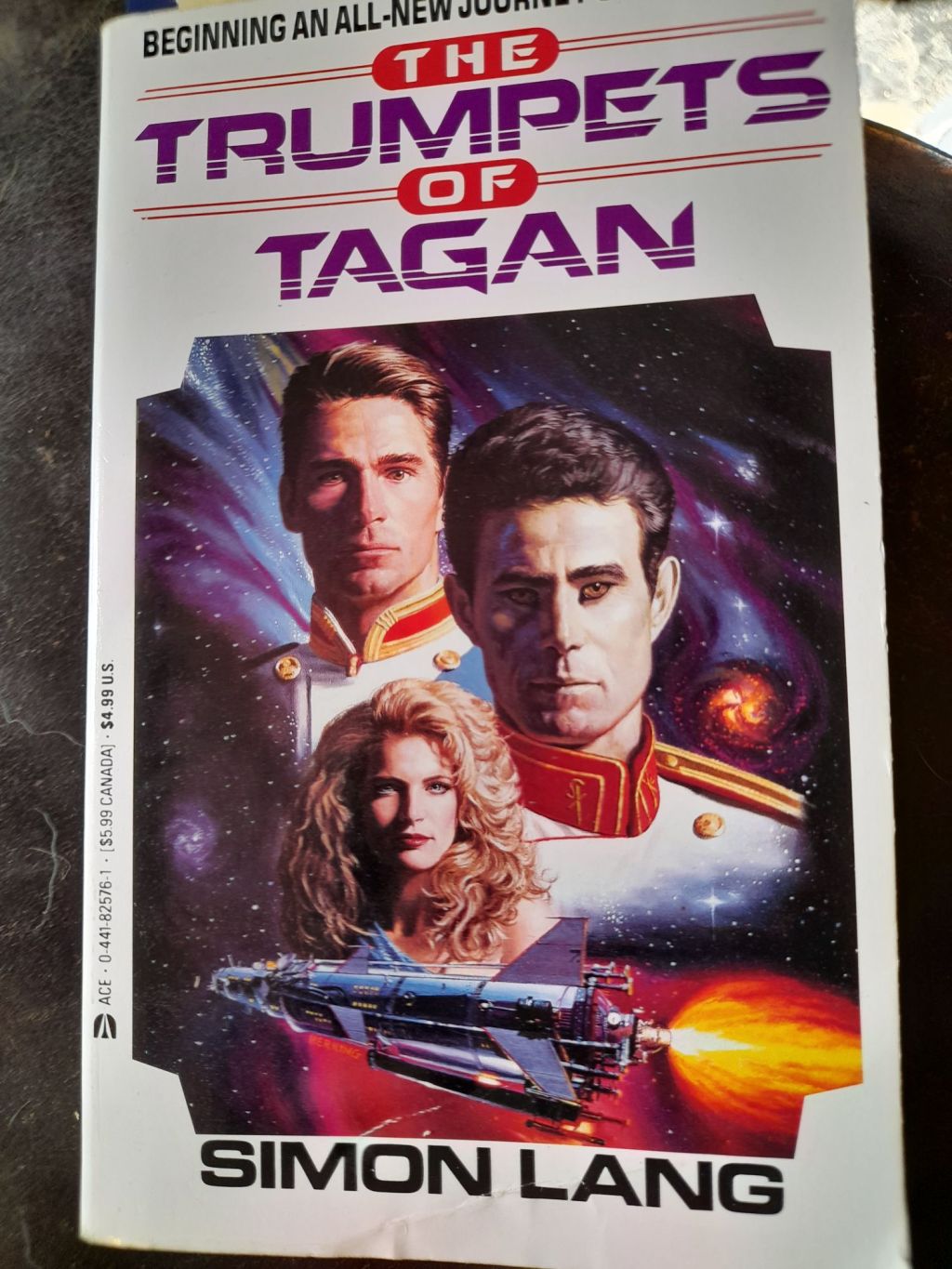
This is going to be a very short review, because it’s about a very short book that I read very quickly, and about which I have very little to say. The Trumpets of Tagan is one of those books I picked up without knowing anything about. Why? Because it had a space ship and some cool-looking guys on the cover, and the plot synopsis on the back made me think of Star Trek. Sometimes it really is that simple to make me pick up the book. Two fun facts I didn’t know about the book going in were that it was the third in a series (but ultimately offering a self-contained story) and that Simon Lang was a pseudonym used by a female author, which is why a book by someone called Simon is featuring in Women of Science Fiction month, just in case you were wondering.
I love Star Trek. You might have guessed that by now There is some really good material in every season of every series. On the other hand, there’s also a lot of stuff that’s not very good. Just mention ‘Spock’s Brain’ or ‘Profit and Lace’ and many a Trekkie will quite likely cringe at the merest reference to those episodes. Unfortunately, The Trumpets of Tagan isn’t just like Star Trek. It’s like a bad episode of Star Trek.
We have our manly, manly captain (coincidentally named Riker) charming and schmoozing his way through the women of the stars. His first officer is an alien with mind powers. There’s diplomacy and interstellar politics, but the characters mostly solve these problems by falling in love and breaking out of prisons. It’s incredibly forgettable, in all honesty. A forgettable story isn’t the worst thing in the world, especially when you have almost a thousand episodes of television to choose from, but when a forgettable story is your only exposure to an author’s work, the lack of impression speaks for itself.
I’ve watched a lot of Star Trek, and read a lot of the books. I’ve also read books that are clearly influenced by the franchise, and many more that I suspect have Trek in their DNA. Recently I’ve been reading S. L. Veihl’s StarDoc series (more on that soon) and the difference is remarkable. Veihl takes a multi-species future and tells stories of ethics and interplanetary space operatics and medical dilemma in a way that reminds me of Star Trek without actually being Star Trek. In contrast, Lang’s book, and by association her Einai series feels like little more than Star Trek with the serial numbers filed off. You could swap Riker for Kirk, substitute the supporting cast with your Original Series favourites, and not a whole lot would need changing. The problem is not that Lang has been influenced by Trek, but that it seems to be her only influence.
This would have been a lacklustre Star Trek novel, but as a book that ostensibly attempts to be something original, it’s downright disappointing.

 At Boundary's Edge