
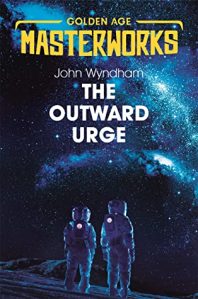
- A standalone novel
- Published in 1959
- Reprinted under the Gollancz Golden Age Masterworks Banner
- Tomorrow Fiction
- 165 pages
There is something in the blood of the Troon family. Something that calls them outwards, ever outwards. Across the skies, across other worlds, across the stars themselves. But with all such urges, there is a price to be paid . . .
John Wyndham is a name best known to readers for his more horror-infused works. The Midwich Cuckoos and The Day of the Triffids are likely the most famous, and both have shades of the science fictional about them, the latter it in its use of ambulatory plants and stellar phenomena. The Outward Urge, however, eschews horror elements in favour of a far more traditionally science fictional story. Broken up into sections taking place at fifty year intervals, it chronicles the fates of various generations of the Troon family as humanity explores space.
In theory, this is exactly my kind of book. Exploration of space? Love it. Stories that take place over a long period of time? Can’t get enough of them. Largely sticking to science as understood at the time? Always a plus. Though I’ve been aware of the name for a long time, not being much of a horror fan means this is my first experience of Wyndham. Given his reputation, I had high hopes. Unfortunately, based on my experience of The Outward Urge, this first encounter will also be my last.
There’s such a thing as cosy science fiction. Becky Chambers writes it. Ray Bradbury’s work falls into the category too. While there are plot and thematic elements that bind these stories, cosy SF is (to my mind) characterised more by writing than anything else. It’s all so laid back that even abominable horrors can be described without any real sense of peril. The Outward Urge suffers heavily from this. In the middle acts of the book, Europe, North America, and Russia destroy each other in a nuclear war (hilariously far-fetched, I know). But in spite of the death toll, the whole affair is discussed so sedately it never seems like a real threat. The same goes for the smaller-scale dangers too. When Ticker Troon is imperilled by a missile, it’s almost comical, rather than menacing, how the missile circles lazily around him for most of a chapter.
The other issue is how repetitive this book is. Clocking in at under two hundred pages, there shouldn’t be enough time for the narrative to grow stale, yet somehow Wyndham manages it. The space exploration side of things shows decent progression as humanity arrives at one celestial body after another. But the personal arcs that are clearly intended to be the focus? That’s where things fall flat. The problem is baked into the concept of the book. Each generation of the Troon family feels the urge to go further than the last. But with each feeling the same urge, and with no room for character beyond that singular identifying trait, every Troon family member feels exactly the same as the last. Whether they’re a British pilot, a Lunar explorer, or a Brazilian refugee, every single Troon (or Truno, for our Brazilian friend) speaks, thinks, and acts the same. When they meet tragic fates, it’s hard to be too upset when you know an identical copy will be along in just a few pages’ time.
So this is another classic author successfully ticked off my list, and a personal misfire from the Golden Age Masterworks. This is the banner that introduced me to the likes of Kuttner and Moore, but I’m still waiting to find another classic that I agree with.
If you enjoyed this book, you might also like:
Space Ranger, by Isaac Asimov
Moonrise, by Ben Bova
The Martian Chronicles, by Ray Bradbury


 At Boundary's Edge