Teaser
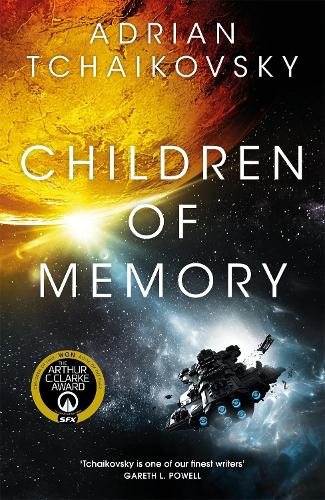
Earth is gone, and the colony of Landfall may be all that remains of humanity. Yet even here, there are strangers from out of town, birds that should not exist, and rumours of a witch who lives in the woods . . .
Review
Children of Time was about a civilisation of uplifted spiders that eventually eclipsed the humans who inadvertently created them. Children of Ruin was about a civilisation of uplifted octopuses who survive the end of their human creators and come into conflict with something truly alien. So when I tell you that Children of Memory featured uplifted crows, you probably think you have some idea of where this book is headed. But the chances are that you’d be wrong, because while there are crows in this book, they are only one tile in a much larger mosaic. Furthermore, Children of Memory puts humanity front and centre in a way that is truly surprising.
Any author writing multiple books in a series must face the same dilemma. To repeat the elements that made the earlier books such a success, or break new ground in the hope of catching lightning in a bottle for a second time. Children of Ruin played it safe in this regard, drawing easy parallels between octopus and spider civilisations, while dabbling in newness with the nameless entity on Nod. Children of Memory is a far riskier proposition, but it’s one that largely pays off.
Some time after the previous books, we now see an amalgamation of familiar names (though not necessarily familiar characters) forming an expedition to investigate a seemingly impossible human colony. That’s one half of the chapters, as Tchaikovsky once again employs alternating acts. The other half of the story is largely told from the perspective of Liff, a young girl who lives in said impossible colony. In previous books, the acts have covered great swathes of time to great effect, but here things are a bit more muddied. The two halves of the story are set very close together chronologically, with the same characters in both. Couple this with a plot relating to the loss of identity and the manipulation of memory, and it makes for an at times confusing read. It all makes sense in hindsight, but the fractured continuity of the book made it difficult to parse.
This confusion is the only mark against an otherwise excellent continuation of the series. The rigorous evolutionary speculation is still there, but Children of Memory has a very different feel to it. With the focus on humans, it feels smaller in scale, more intimate. The revelations, when at last they come, are tinged with a sense of cosmic horror. Even though I suspect the end is intended to be uplifting, I feel like this is Tchaikovsky’s bleakest work since Cage of Souls. In other books we have seen what replaces humanity. Here we see humanity dying off. It’s a slow and depressing decline that is all the more chilling for its plausibility. Happy reading, this is not, but it’s all the more compelling as a result.
It may not quite reach the heights of the previous books in the series, but Children of Memory is a fitting development of the themes present in Tchaikovsky’s work. Once again, the ending is left open for more stories, but if this is the last we see of Portia and the Children, the end is a satisfying one.
Book Stats
- Children of Time (#3)
- Published by Tor
- First published in 2022
- Hard SF
- 480 pages

 At Boundary's Edge