Teaser
The Confederation has brought a new golden age to humanity. All is not well in the dark corners of the galaxy, however, and a force unlike any other could yet spell disaster for the entire universe . . .
Review
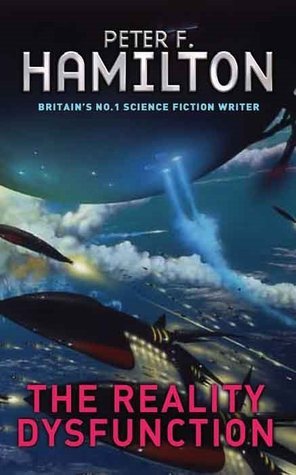
The first thing to know about Peter F. Hamilton is that he writes big books. The Reality Dysfunction clocks in at over twelve hundred pages, and is the first of a trilogy of similarly sized behemoths. It’s also one of those trilogies that is a single story broken up across three volumes, so don’t expect any closure in this opening volume. Hamilton may have introduced himself to the world with his slightly smaller sci-fi detective stories featuring Greg Mandel, but it is these epic space opera that put him on the map. At one point, he was even the best selling science fiction author in Britain. Possibly because once you bought one of his books, you didn’t have time for anyone else’s, but also because these stories captured the imagination of millions.
With that kind of reputation, approaching Hamilton’s work as an unfamiliar reading is daunting. I’ve dabbled with him in the past and found that his work often lacks a focus, but I’m now committing to the full Night’s Dawn trilogy, as part of my ongoing search for what makes British science fiction distinct from that of other nations. There’ll be more of that in April, but with these books as big as they are, I’m giving myself a headstart.
There is a lot to like here. I can’t think of many authors who write space opera on the same scale as Hamilton. Indeed, may epic fantasy novels would be envious of the page count. In these pages we find a teeming sea of ideas. There are ancient alien entities travelling the cosmos. Vast empires held together by very little. Feuding families in crumbling ruins. Brave adventurers plunging the depths of alien superstructures. Faltering first steps towards planetary colonisation. All the good stuff is here, and some of the best parts are when Hamilton goes off on a tangent about some aspect of his universe. Personally, I’d love to see more of the cosmoniks, or more detail on Ruin Ring, or a better understanding of the living spaceships known as voidhawks.
This kitchen sink approach does come with a serious downside, however. This book is seriously lacking in momentum. Not only does it meander off into tangents at any given opportunity, but Hamilton is balancing so many major plotlines that the entire novels grinds to a halt every other chapter so that a new character can be introduced. More than this, that grab bag of ideas also includes some that just didn’t work for me on any level. There’s the Satanist cult that springs up on a new colony, there’s the fact that every interaction between protagonist Joshua and a woman begins with her fawning over him and ends with exotic sex. For the record, scientific studies suggest reproductive activities would actually be much harder in zero-gee. But hey, who am I to argue with Britain’s bestselling SF author?
I also have major reservations about the nature of the existential threat, as revealed in the closing stages, but that’s something I’ll get into when I review the next book in the series.
For now, what matters is that I still get excited when I look at Peter F. Hamilton’s books. There’s a sense of overwhelming ambition about them, even if the end result isn’t quite as thrilling as I’d hoped it would be.
Book Stats
- The Night’s Dawn Trilogy (1)
- Published in 1996 by Pan
- 1221 pages


 At Boundary's Edge