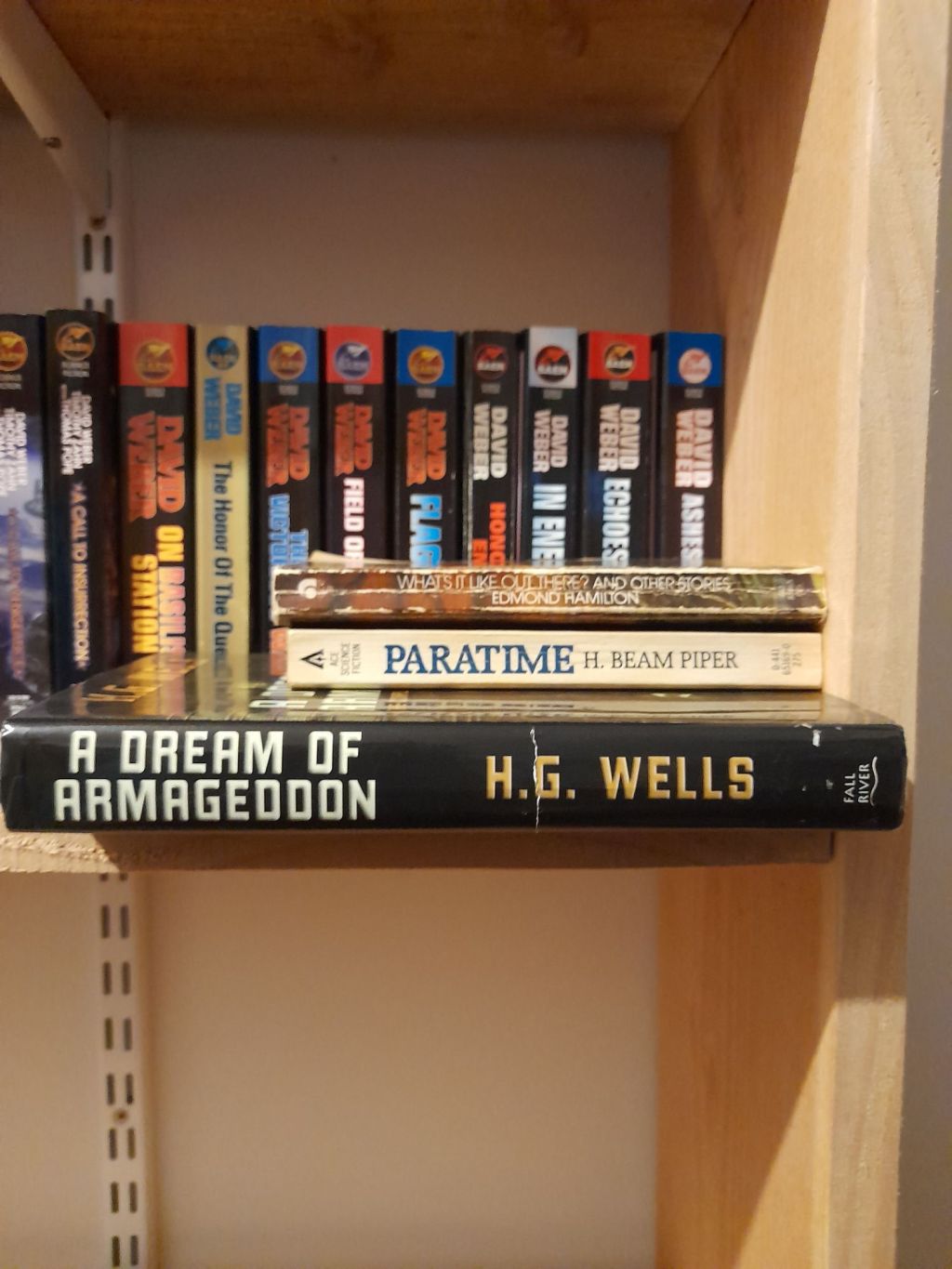
While I was travelling around America last month, I bought a lot of books. That probably doesn’t come as much of a surprise. It also won’t shock you to know that I didn’t get a whole lot of reading done while I was overseas. It’s very hard to stay focused on a novel when you’re reading in snatches between road trips, romantic evenings, and general sightseeing. Luckily, there are books designed to be read in snatches. Be they single author collections or ore general anthologies, books full of short stories are ideal for travelling. Whether you’re on an unfamiliar couch or lounging in an airport terminal, there’s always time to crack open an anthology. Short fiction collections comprised much of my October TBR, and spilled over into the start of November too. Here’s a rundown of some of my favourite collections and the stories you’ll find within.
Starships, ed. by Isaac Asimov, Martin H. Greenberg & Charles G. Waugh
One of an astonishing number of anthologies edited by some combination of Asimov and Greenberg, Starships lives up to its title by feature star-faring vessels in every story. There are a few weak stories, such as Anne McCaffrey’s ‘The Ship Who Sang,’ but it’s generally a strong anthology. Personal highlights include ‘The Oceans are Wide’ by M. Frank Robinson and ‘Far Centaurus’ by A. E. van Vogt. The latter is easily the author’s best short fiction, while the former is a novella-length tale that shows the perils of a generation ship nearing the end of its voyage.
Vacuum Diagrams, by Stephen Baxter
Here’s something you don’t see much anymore. A fix-up. A novel stitched together from short stories set in Baxter’s Xeelee universe. The book covers millions of years of that future history, with a framing narrative of two timeless beings in conversation. As a novel, it’s weak, but the individual stories are greater than the sum of their parts. Like a lot of Baxter’s work, this is SF so hard it hurts my brain to think about, occasionally branching off into mathematical fiction. It’s hard to pick out a favourite, but ‘Secret History’ and ‘Lieserl’ are perhaps the most significant in terms of the larger Xeelee universe, while ‘Pilot’ is perhaps the strongest on its own terms.
What’s It Like Out There? & Other Stories, by Edmond Hamilton
Having enjoyed many of Hamilton’s novels, I was excited to find this short fiction collection. It reminds me a lot of the works of Kuttner and Moore, with stories covering straight science fiction, fantasy, and a dash of horror here and there. ‘Dreamer’s Worlds’ is perhaps the most original story of the bunch, while ‘Castaway’ is a phenomenally interesting look at what might have influenced the work of Edgar Allen Poe. Not every story is a winner, but it’s kept my enthusiasm for Hamilton alive, and I’ll be keeping an eye out for more of his work next time I’m in the used bookshop.
Paratime, by H. Beam Piper
Piper is one of my favourite authors, and this is last major work that I haven’t read. Sadly, I have to say that I don’t enjoy Paratime as much as I do the Terro-Human Future History. The stories themselves are fine, but the universe they build is too broad and vague to be interesting. Keeping track of the various Levels of time is a chore, which is a shame because the only novel to come out of Paratime (Gunpowder God) is really, really good. In terms of this collection, I do have a certain fondness for ‘He Walked Around the Horses,’ which is based on a true historical mystery.
Needle in a Timestack, by Robert Silverberg
My first foray into Silverberg’s solo output did not disappoint. there are several versions of this collection, all with different contents, and I think I’m right in saying this audio version was published 2021. The titular story is a great opener, and showcases Silverberg’s fondness for time paradoxes. ‘Absolutely Inflexible,’ is an even better example. Outside of time travel, ‘Enter a Soldier. Later: Enter Another’ is a brilliant, not to mention prescient, look at generative artificial intelligence, while ‘The Pope of the Chimps’ is a thought-provoking look at the evolution of religion in early societies.
A Dream of Armageddon, by H. G. Wells
Despite being a big fan of Wells, I’ve never read any of his short fiction. This collection is labelled as containing his supernatural fiction, but much of it has the scientific edge you’d expect of the great writer. Unfortunately, I don’t think short fiction was Wells’ strong point, as none of these stories approach the level of his novels. ‘The Crystal Egg’ does offer an interesting look at Martian life, however, and ‘The Moth’ is a very strong piece of horror fiction. This is a collection worth looking at if you’re really into Wells’ or the history of short fiction, but as science fiction it pales in comparison to the later era of the pulp magazines.


 At Boundary's Edge