Teaser
Hadrian Marlowe has turned his back on the Empire, choosing a life of exile with his daughter Cassandra. Yet there is one thing that could tempt him back to duty: the opportunity to kill a god . . .
Review
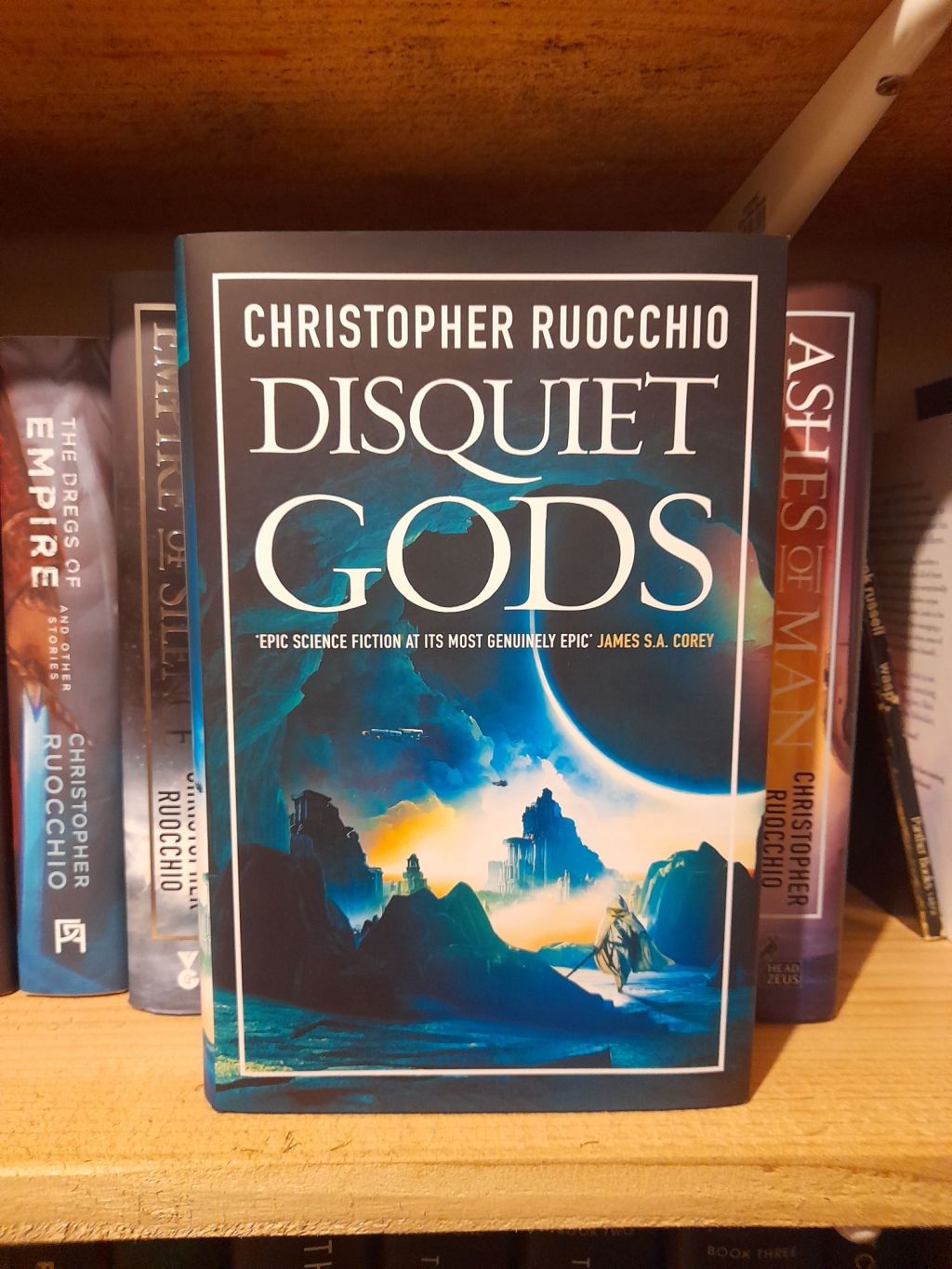
When Empire of Silence came out in 2018, it felt like a book tailored to my exact tastes in science fiction. It was so good, I started a blog to talk about books. Having now arrived at the penultimate volume of this epic series, two things have become clear. First, the quality of writing and the level of storytelling have grown in strength since those early days. Second, the underlying philosophy of the series has become a dominant feature. It’s the latter fact that leaves me in something of a quandary. Not only over this book, but over the series as a whole.
As with previous books, there are several distinct arcs within Disquiet Gods. The first brings Hadrian back into the fray in order to investigate the death of a scientific expedition. This section is possibly the closest this series will ever come to Hard SF, and proves to be a satisfying scientific horror mystery. As with a lot of high-concept storytelling, a lot of it went over my head, but it all felt logical. Equally satisfying is the final third of the novel, which is an all-out action extravaganza that ties together many dangling thread from earlier novels. Old favourite characters make unexpected reappearances, and everything is set up for the final book. If there is any weakness to these sections, it’s the way they fold in some of the short fiction Ruocchio has written, which does unfortunately centre the universe on Hadrian’s adventures rather than expanding the setting as short fiction should do.
These are mere quibbles, however. The larger stumbling point is in the middle act, which compresses three mini-arcs into not enough space. if any book in this series ought to have been split in two, it is this one. This middle act features one of my favourite chapters, which showcases the full breadth of humanity discussing the Cielcin issue. Yet only a few chapters later, that plotline is abandoned (or at least put on hold until the next book) so that Hadrian can experience a miracle.
Religion has always been a theme of this series. Sometime sit works very well. The Lesser Devil‘s use of Catholics was brilliant, highlighting that faith can coexist with a world beyond Earth. The Sollan Empire’s Chantry may be an artificial construct, but there is room for true piety as well. These explorations of faith are interesting, and rarely explored in science fiction. Alas, the same can not be said for Hadrian’s experiences in the main series. Where once we had tantalising glimpses of a lost alien civilisation, now we have a monotheistic creator deity. Where once Hadrian was a controversial self-appointed saviour, now he is an increasingly messianic figure on a divine mission from God.
I don’t mean to knock religion. Though I’m not a believer myself, I both respect and am fascinated by those who do ascribe to the existence of a higher power. Literal deities, however, are not what I want to see in science fiction. As the series leans further into these religious themes, it feels less like a science fiction epic, and more like a Christian fantasy. That’s fine, but it’s not at all what I was led to expect after earlier books. Again, the prose and story are phenomenal, and can carry me over the hurdle of these philosophical challenges. It does, however, leave me concerned for what lies ahead.
When this series started, it began with a question. Was eradicating an entire species justified in order to save the Sollan Empire? That is a powerful question, and one ripe for unpicking. Introducing a literal God – especially one in an increasingly explicit Christian mode – strips that question of nuance. If a man takes an action, then we can question his morality. If we have proof that God told him to do it, then the issue is pared back to black and white. If God appears before you, proves his divinity, and tells you to do something, then it is the right thing to do. And as the threat grows from the collapse of an Empire to the destruction of all creation, then it is an even simpler issue. To avert oblivion, all acts are good. This is an issue that has built up over the past few books in the series, and I expect it to rear its ugly head next time around.
Ultimately feel I’ve made peace with this series. Taken as a work of fiction, it’s thrilling, though-provoking, and I absolutely love it. But that love does require me to turn a blind eye to some its more troubling aspects. Shadows Upon Time will hopefully release next year, so let’s see how it all wraps up before rendering a final judgement.
Book Stats
- The Sun Eater (#6)
- Published by Head of Zeus
- First Published in 2024
- 679 Pages


 At Boundary's Edge