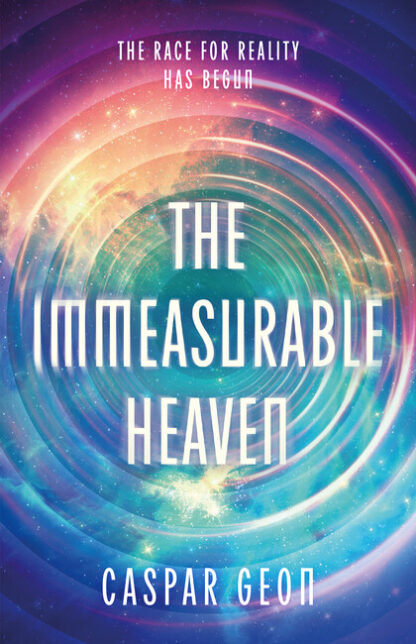
Today on the blog, I am thrilled to bring you my first author interview of the year, with Caspar Geon being kind enough to stop by and answer a few questions about his upcoming book The Immeasurable Heaven. Without further ado, here we go:
For those who don’t already know you, please introduce yourself.
Hello, and thanks for having me, Alex. I’m Caspar Geon, author of strange science fiction. For some reason I write a lot about the distant future or the distant past (I have a 147th century space opera trilogy called the Amaranthine Spectrum out under my other name, Tom Toner, and I’ve also written a novella called the Beasts of Lake Oph, set in 250 million years’ time on the supercontinent of Pangea Ultima). My latest novel, the Immeasurable Heaven, trumps both of them, taking place about 3 billion years ago in a distant galaxy (my agent’s at the end of his tether). I also like to sketch and paint in my spare time, which is very good for the blood pressure, though I probably spoil that by eating crisps while I do it.
Your new book The Immeasurable Heaven comes out on the 15th of July. What can you tell us about it?
The worldbuilding for this was much more complex than anything I’ve ever written, and the book took about five years all in all to finish. It features a completely inhuman cast of characters living in a long-settled galaxy called Yokkun’s Depth, where machine gods inhabiting the stars have outlawed all forms of violence. As such, the locals have to amuse themselves in other ways, like vanishing into lower realities or playing huge interdimensional multiplayer games. I hope readers have as much fun reading it as I did writing it.
Science Fiction is a broad genre. What is it that appeals to you?
I think what I love most about science fiction is that it can change the way you see the world around you. As a teenager growing up on the Somerset Levels I sometimes felt quite depressed (especially in winter, when the world seemed very gloomy and drab), but reading science fiction lifted me out of that. It not only expanded my imagination but also taught me to see the magic in everyday life. Science fiction is also (to paraphrase Iain Banks) the largest canvas you can paint on, the most extreme and extraordinary end of literature’s spectrum, where anything can happen. I’ve tried writing other things and they always end up being SF in some form, whether I like it or not, so I must just be completely obsessed.
The Immeasurable Heaven features an entirely alien cast. What prompted you to write a story with no human characters?
My previous book, the Tropic of Eternity (book three in the Amaranthine trilogy) started to delve into this sort of territory, and made me realise how much I wanted to explore the more cosmic and inhuman end of SF simply because I enjoyed writing it so much. I was also having trouble finding more of this in the bookshops, so I wrote the sort of thing I wanted to see on the shelf. There’s such an ungraspable expanse out there where all sorts of wonderful things could be happening, and I had to get out there and explore it. Human characters weren’t an option.
Given that much of science fiction extrapolates from the present day, how much of a challenge was it to invent an entire galaxy from scratch?
You have to build everything from scratch, which takes a very long time and means you’re always stopping the actual writing to go back to the notebook and puzzle out how things look/work, and why. I’ve compared it in a previous interview to that scene at the end of the Wrong Trousers where Gromit’s zooming along on the little model train in his kitchen, desperately laying down track in front of him. The notebook work is the trackway, and has to be there (I find) to make sure that what you end up writing is actually of good quality. Some people might find that an absolutely horrible way to write, always stuttering along, but I love it. Worldbuilding is one of my favourite things to do, and once you’re in draft three or four the story really starts to flow, enriched by so much preparatory work (this also benefits the character development enormously, which I always find grows in layers over repeat drafts). I’m considering a future book set in one of the other galaxies in the ring of eight, which will have to be an utterly different worldbuilding job – I know it’ll be years of work, but I’m really looking forward to it.
You mentioned writing previous books under another name. Does this allow you to change your style, or are there common themes that you keep coming back to?
My style has changed naturally over time, I think, but Caspar exists to push the boundaries of what I can write and what I’m allowed to traditionally publish, rather than as a separate stylistic entity. I have a couple of as-yet unpublished contemporary horror books finished under another name, and in that mode I actually do write a little differently, which is refreshing after finishing a big space opera. You can actually write about someone having a cup of coffee or listening to a recognisable song on radio, it’s great. Themes I seem to keep returning to are mortality and deep time, both of which have bothered/fascinated me for as long as I can remember. You often entertain your own anxieties as a writer, you try to spook yourself. With this book I also thought a lot about the different ways in which reality could be experienced (part of the reason for having a large cast of alien mindsets), and whether there’s ever a correct answer (mild spoiler for the end, there is).
Next up is a little game I like to call d20 Questions. I roll dice, and we see which random questions you end up with.
Q9/20: Who is an author you wish more people had heard of?
Jack Vance, a grand master of science fiction who doesn’t seem very widely read these days. I’m always recommending him to people. His imagination continues to surprise me, and every page is a feast of wonderful ideas and dialogue.
Q11/20: What is the next science fiction book you’re planning to read?
Next up is the Colour of Distance, by Amy Thomson – I’ve heard good things, looking forward to it.
Q19/20: What is the best screen adaptation of a science fiction book?
I think Jurassic Park outdid its source material. I was very young when I saw it in the cinema in 1993, and it’s still the most magical film experience I’ve ever had. Bonus points go to Fantastic Planet, based on a much earlier French novel, which is brilliantly weird.
Finally, where is the best place for people to find updates on your work?
You can get updates on my work by finding me on Instagram and Bluesky, or following my publisher Solaris there too. I rarely use Twitter nowadays. I also have a terrible bodged-together website with a missing newsletter button (because my newsletter doesn’t exist yet).
Caspar Geon’s new novel The Immeasurable Heaven will be published on the 15th of July by Solaris Books.

 At Boundary's Edge