Teaser
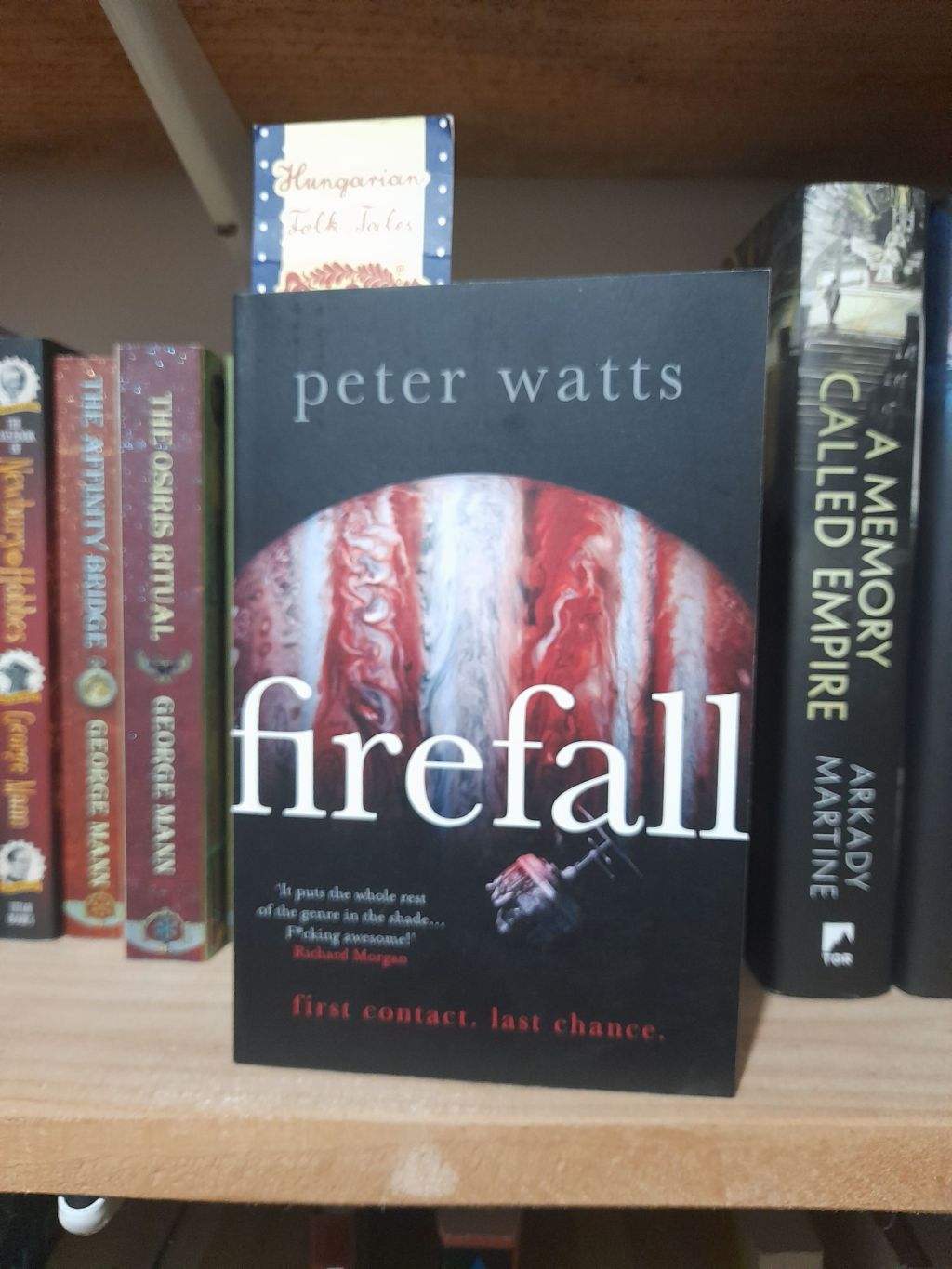
Aliens have found us. In the late twenty-first century, their remote probes take a snapshot of Earth. Humanity’s response is to send two ships into space in search of answers, but before we can hope to understand alien life, we must first examine the nature of our own existence . . .
Review
I want to make one thing perfectly clear. As a general rule of thumb, I am happy to take scientists at their word. They’re the ones who have dedicated careers and entire lives to studying the world, after all. Who am I to question them? I’m also the kind of nerd who gets inordinately excited when I see a science fiction book written by a bonafide scientist. Peter Watts is a former Marine Biologist, so I expected some good aliens. Some real thinky stuff.
I got vampires.
Now, in the extra material at the back of this book is a link to an article that proposes vampires may once have existed. I still can’t quite tell if this is supposed to be taken seriously or not, but if you’re a scientist and you expect me to believe that proto-humans had to deal with bloodsucking hominids with an allergic reaction to geometry (hence the crucifix aversion) then I’m afraid I have to say that you’re talking an absolute load of cobblers. Nevertheless, that is an assumption baked into these very, very hard SF books, so I learned to let go an just roll with it.
Firefall contains both Blindsight and its sequel Echopraxia, and was actually published before the latter’s solo release. Blindsight is by far the superior book, in part because it largely delivered what I had been led to expect from hearing other reviewers talking about it. Take Stephen Baxter’s love of science, slather it in existential nihilism, and you’ve got Blindsight. The aliens are indeed cool, and more realistically drawn than any other I’ve come across. The impossibility of meaningful communication between two very different species plays a key role. It is a truly phenomenal first contact story.
Echopraxia, in contrast, is an absolute mess of a novel. It’s not quite a sequel, but takes place concurrently with the other book, flowing a different set of characters who have tangential links to those in Blindsight. The problem is that I honestly don’t know if I can tell you what the book is about. there are some characters, they go to space, they face unimaginable horror.
The faults common to both books in this omnibus are twofold. The first is that the characters are almost universally bland. Blindsight‘s Siri Keeton has a unique perspective that was strangely, and at times horrifyingly relatable, but everyone else across both books is just, well, there. People turn up, do their jobs, and then fade away as the narrative demands. If you’re looking for character-driven fiction, look elsewhere.
This perhaps stems from Watts’ overall philosophy in these novels. As a trained biologist, he is perhaps seeking a biological answer to every problem, with no time for pesky things like cultural development. You see, and the afterwords make this clear, Watts doesn’t believe in free will. Humanity’s biological determinism is the throughline for this entire affair. We are not in control of our own bodies. We are just a parasite along for the ride. If there even is a we. This leads to some great horror scenes in Blindsight as aliens intrude on human minds, but the bleakly nighilistic point is hammered home page after page, book after book. Sure, Watts has some evidence to back up his case, but to that I have to reactions. One, I am not reading a hundred essays in order to understand your novel. Two, at no point is an alternative considered. There’s a philopsophiocal and scientific richness to Firefall that few other books can come close to. The problem is that these arguments would be better delkivered viua a speech or essay. As a work of fiction, it all starts to fall apart once the focus pulls away from the story. And really, If there’s no free will, and people don’t matter in the slightest, why on Earth should anyone stop and pay attention to your characters and their struggles?
Blindsight is a fascinating first contact story that at times went well over my head, but generally left me wanting more. Unfortunately, the more I got was Echopraxia, which is a barely coherent mesh of some fascinating ideas, and a story that falls apart on just about every level. It’s worth reading the first book, but only continue on if you’re a die-hard fan. No matter how cool you think ‘vampires in space’ sounds.
Blindsight
Echopraxia
Book Stats
- An omnibus of Blindsight and Echopraxia
- Published by Head of Zeus in 2014
- 710 Pages (Plus Afterwords and Author’s Notes)


