Teaser
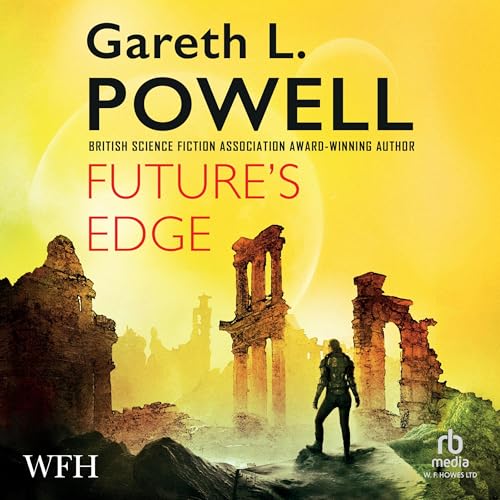
Earth has fallen. With a relentless enemy hunting all intelligent life to extinction, the only hope for humanity lies in fleeing as fast as possible. The only hope, that is, until Ursula Morrow is dragged into a last ditch bid to save the galaxy . . .
Review
Over the past decade or so, Gareth L. Powell has made a name for himself as one of the most reliably entertaining British authors of space opera. His Embers of War trilogy remains one of the best examples of the genre that takes a rag-tag crew, sticks them in a spaceship, and sends them off to cause chaos. Future’s Edge is his latest story in the same vein. It’s a standalone novel this time around, but one that will feel very familiar to anyone who’s read Powell’s work before. And I mean that for better and for worse.
On the positives, all of Powell’s hallmarks are in play here. It’s fast-paced and full of action. Listening to the audiobook, you can just close your eyes and be swept along with the adventure. It’s not a book that’s going to be too taking on your brain, but there are some interesting ideas hinted at. Inevitably, there’s also a sentient spaceship who steals the show.
This book sees Powell taking on the Fermi Paradox: Why are there no galaxy-spanning alien societies? His explanation is a familiar one: Because artificial constructs relentlessly destroy life that reaches a certain level of technological development. From Saberhagen’s Berserkers, through Reynolds’ Inhibitors, to Mass Effects Reapers, this is an idea that is so commonplace in science fiction that Powell doesn’t have to go to any great lengths to explain it. He has his own little twist when it comes to these constructs’ origins, and how they find their prey, but the overall idea is a well-worn one.
And that’s where we get to one of the problems here. Everything in Future’s Edge has been done before. We are now decades deep into science fiction feeding on its own ideas, so that’s not necessarily a failing of Powell’s. But that doesn’t change the fact that it’s all a bit old hat by now. Ten years ago, I’d have been all over this book like a Labrador with an open cookie jar, but in 2025, it feels more than a little tired. It doesn’t help that Powell expects his readership to be familiar with the ideas, so he doesn’t spend any real time delving into them. It’s okay to include an old idea as a side note, but if you’re going to centre your novel on something, I think that idea needs to be explored. That’s how you make new value out of old material.
That lightness of touch also applies to the overall style of the book. It is a very quick read, but that speed leaves it hazy around the edges. As I mentioned in my review of Gary Gibson’s Stealing Light, constant flashbacks irritate me, and there are multiple instances in Future’s Edge where the timeline shifted and I wasn’t sure when I was reading about during the changeover. This confusion was only worsened by the cast of characters being the same on both sides of the flashbacks. At the same time, this story is told through a broad cinematic lens, heavy on the action with occasional pauses for introspection. Description, however? That’s less detailed than I’d like. I have an image of all the characters, yes. But the aliens? The planetary vistas? The fight scenes? These were all much harder to visualise.
Don’t get me wrong. Future’s Edge is a fun book. I don’t at all regret the time I spent listening to it. But it left me wanting more. Not from a potential sequel, but because it ultimately felt too shallow, with the depths of its potential barely even touched upon.
Audio Stats
- A Standalone Novel
- Published 2025
- Runtime 9hrs 22mins

 At Boundary's Edge