
Teaser
The Arcology is a utopian state, based not in the physical world, but in information space. But when the Arcology disappears, it falls to a few scattered survivors in the physical world to save whatever remains . . .
Review
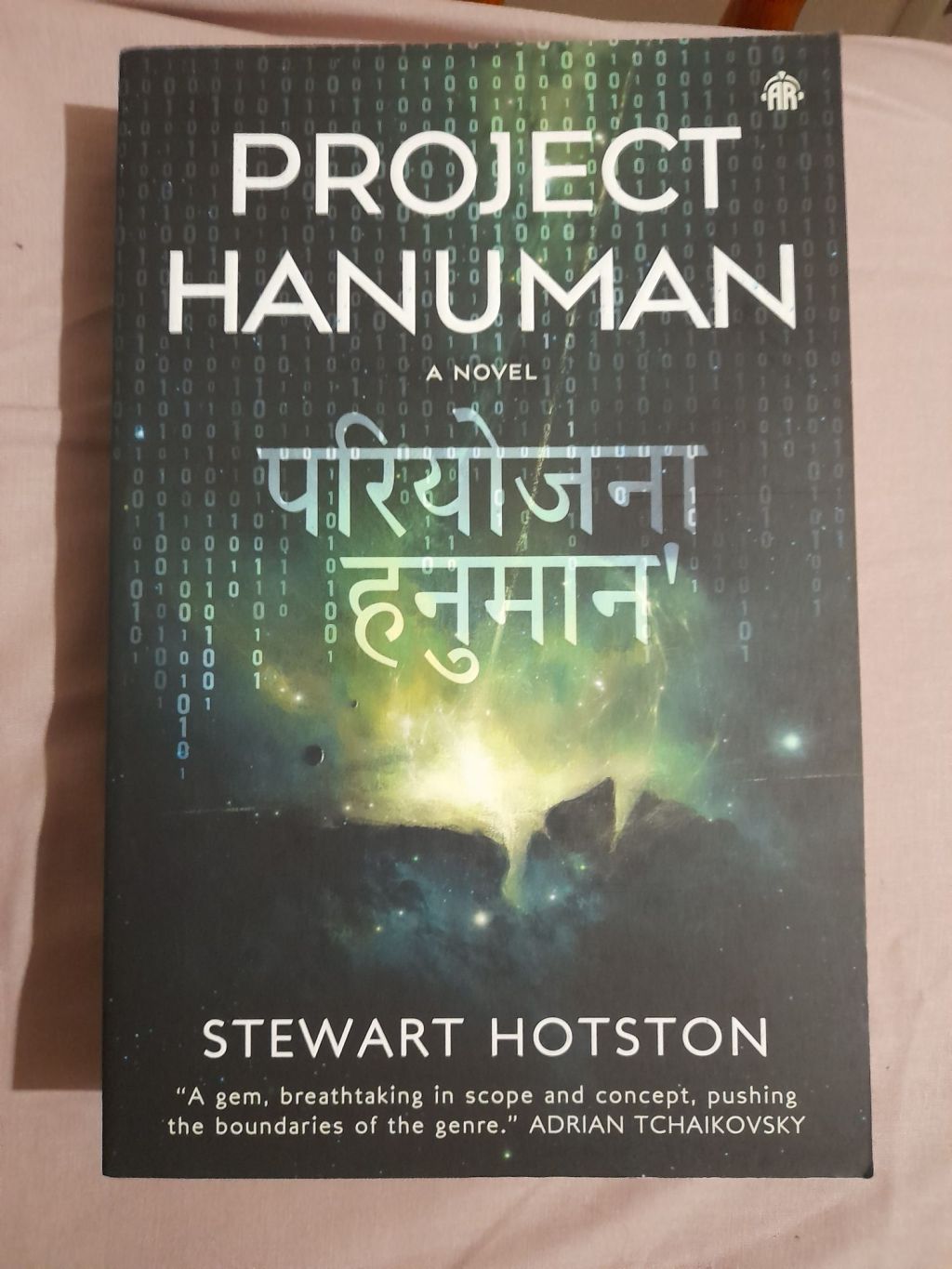
One of the high points of my recent trip to World FantasyCon in Brighton was attending the launch of Project Hanuman. It’s a brand new, standalone space opera that is heavily influenced by Indian mythology. Since both a friend and I picked up copies at the launch, we decided to make it our November buddy read. It was great to have a partner to bounce ideas off of, because Project Hanuman really is a book that makes you think.
The foundational idea behind the worldbuilding is an interpretation of quantum physics that I haven’t come across before. What if the universe is not made up of physical matter, but of information? Now, I am a layman who doesn’t really understand how this works. If a rock is actually just the idea of a rock, I can still pick it up and throw it, right? So how does an information-based universe make sense? The Arcology has a representation in the physical universe, but its inhabitants exist purely as information. Indeed, being rendered as physical beings is perceived as a tortuous punishment. It’s easy to see this as a virtual reality, but it’s not. Not quite, anyway. And it’s not just the Arcology. Faster-than-light travel also relies on translating a physical ship through information space. Naturally, this raises questions of if the ship remains constant or it the arrival is simply a duplicate of the departing vessel, but is addressed in a quick and tidy manner. Thankfully, Hotston doesn’t get lost in the weeds of the worldbuilding, but instead uses it as a springboard for a great story. One that, even if it lost me at times, was enjoyable throughout.
Where the Indian mythology comes into play is in the role of the (slightly inevitable) ship’s AI. This artificial intelligence is positively drowning in information space during the course of the novel. It’s through this machine that the book earns its title. Unfortunately, this does make it hard to talk about without giving the game away. What I will say is that the ship’s developing personality throughout the novel offers some of the best and most innovative approaches to the question of artificial identities that I’ve come across in recent years.
There is also the idea that the Arcology is based around religious principles. If you can live forever, how does that affect beliefs about reincarnation and karma? Can you even be human if you have lost the ability to die? Granted, it has been a very long time since I explored Indian mythology and Hinduism (thank you, GCSE RE lessons), but I loved the way Hotston played with these ideas. This is how you do religion in science fiction right. If you compare this another recent, openly-religious space opera (Christopher Ruocchio’s Sun Eater Saga), and you’ll find that this is a much more nuanced approach.
Even if you set aside the philosophical and religious elements, Project Hanuman is still a thrilling and engaging space opera. The influence of Iain M. Banks is clear, as it so often is in British SF, especially in the way that the Arcology categorises physical civilisations and, unlike Star Trek with its prime directive, openly influences their development. It also takes an idea I recently encountered in Perter Watts’ Blindsight, and makes it even more interesting, and written with far more flair.
People who read a lot of science fiction will obviously find a lot of familiar elements in here, but they’re all done brilliantly, and the original ideas make it even better. Project Hanuman is up there with my favourite books of the year, and I’d highly recommend it to all space opera fans.
Book Stats
- A Standalone Novel
- Published by Angry Robot
- Published in 2025
- 346 Pages


