Welcome back to another round of quick reviews. In the interests of full disclosure, not all of these books actually fit into the Vintage Science Fiction category. There’s a good eight decades of science fiction covered in this article, but as before these are books I can’t manage a full-sized review for. I am, after all, a busy man who reads far too many books.
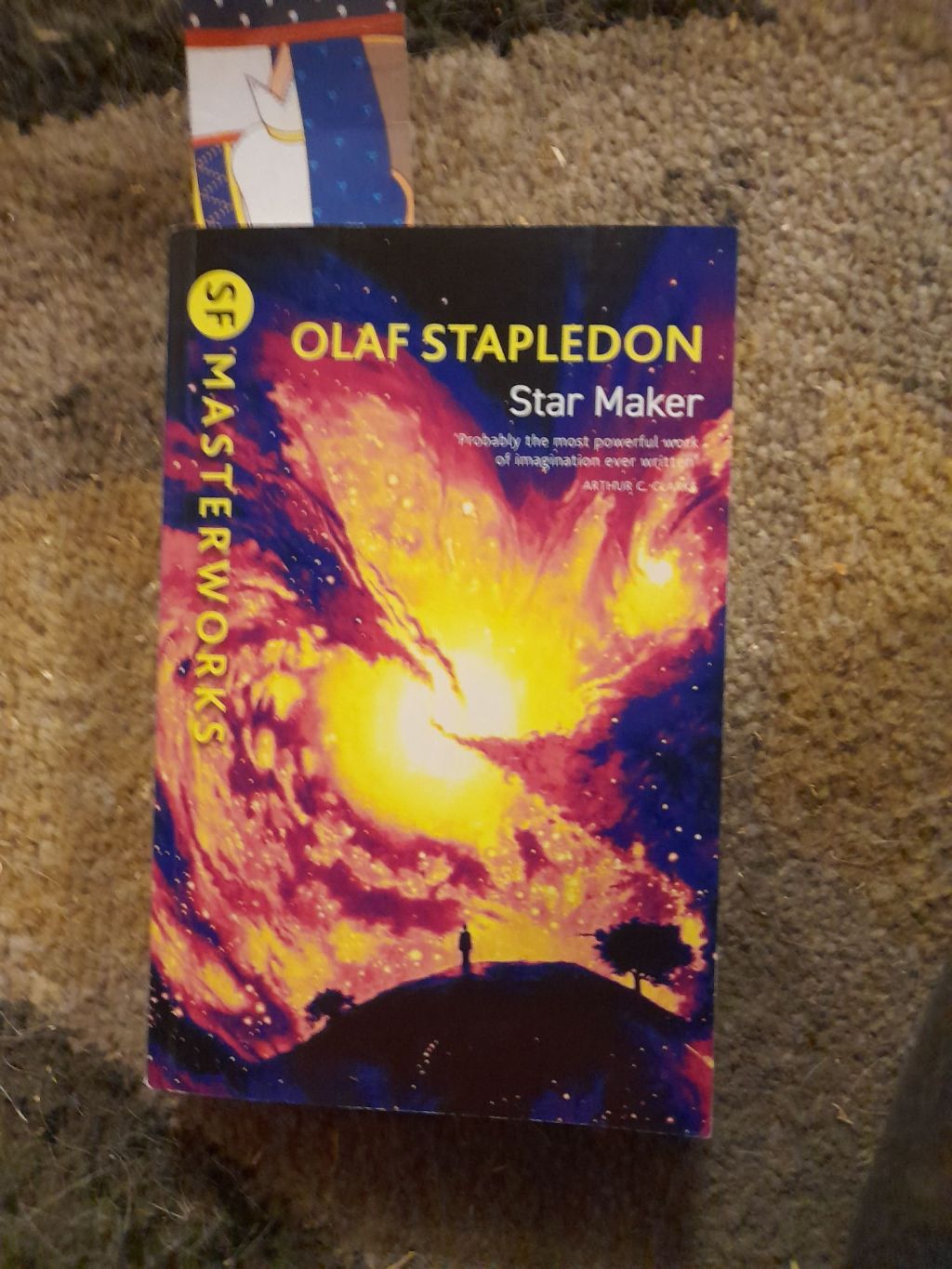
Star Maker, by Olaf Stapledon (1937)
Opening in contemporary England and ending with the death of the universe, Star Maker is absolutely unparalleled when it comes to scale. Stapledon takes a cruise around the galaxy, stopping by on various planets and chronicling their histories. But with this scale comes compromise. There is the barest hint of a narrative here. There may as well be no characters. This is idea-driven SF taken to its ultimate extent. Stapledon himself was more a philosopher than a novelist, and that is on show here. The prose is like that of an essayist, and all the grand ideas can’t quite outweigh the absolute dryness of this book.
Time and Again, by Clifford D. Simak (1951)
My second Simak is even better than Way Station. There’s an odd gentleness to Simak’s writing that makes even a story of duelling androids and time-travelling assassins feel incredibly comforting. In places, the plot does become so tangle in paradoxes that it gets tricky to follow, but it all comes together in the end. There are enough hints at larger worldbuilding to support a dozen novels, but Time and Again never feels overly full, a tightrope that is not easy to pull off. I look forward to reading more Simak in the future.
Childhood’s End, by Arthur C. Clarke (1953)
I’m not a huge fan of psionic powers, and the scene at a séance is ever so slightly silly, but this is still one of the best books about telepathy out there. It’s also a fascinating look at Earth existing under a largely benevolent occupation. Although at time it feels like a short story that goes on for slightly too long, Childhood’s End is nevertheless a haunting and thought-provoking look at humanity’s place in the cosmos. It won’t take you long to read, and is definitely worth your time.
I Am Legend, by Richard Matheson (1954)
Is this science fiction? Maybe. Is it horror? Definitely. I Am Legend asks the very important question: What if vampires took over the world? Spoiler alert: It ends badly for just about every one. This is a bleak and very lonely book that follows the last living human in the world, raising questions about the point of going on, man’s place in the food chain, and whether society can ever come back from such a total collapse.
Candy Man, by Vincent King (1971)
Remember how I don’t like dystopias? Here’s another piece of evidence for my case. The world is typically grim and dour, with humankind little better than sheep shuffling about their lives. There are some interesting suggestions about the point of the system that has led to this state, but it’s mostly lost in a bizarre, dream-like style that doesn’t name any characters, offers no clue as to what anything means, and generally got on my nerves. Not one I’d recommend, but you do you.
The Dreaming Void, by Peter F. Hamilton (2007)
One of two modern audiobooks I’ve listened to this month, I treated this as a last chance saloon for Hamilton. It turns out that his style is much easier for me to handle as an audiobook than if I were trying to wade through seven hundred pages of text. Everything you’d expect from Hamilton is here. Luxurious worldbuilding, grand cosmic ideas, bizarre sex scenes, and more plot arcs than the book can safely contain. This first boom in the series is narrated by Toby Longworth, and the switch to John Lee for the others has me interested enough to keep going.
The Soldier, by Neal Asher (2018)
My other last chance saloon read went even better. I have to than BookTuber Crowley’s Bookshop for recommending this as a good way to get into Asher. Even if it’s chock-full of references to his other Polity novels, The Soldier is easily the most accessible of his books that I’ve come across. It’s just as dark and nasty as his other work, but it’s also better paced, a little less cynical, and perhaps even a little more fun. It’s also a nice change to read about a transhuman state that isn’t a utopian paradise. And if you needed any further recommendation, know that I’ve already started the sequel.


 At Boundary's Edge