Teaser
Something is is destroying the solar system. Yet even as planets are turned to dust by powers unknown, economics, politics, and other social phenomena still have a role to play. Especially when the future of humanity falls into the hands of one small spaceship and its crew . . .
Review
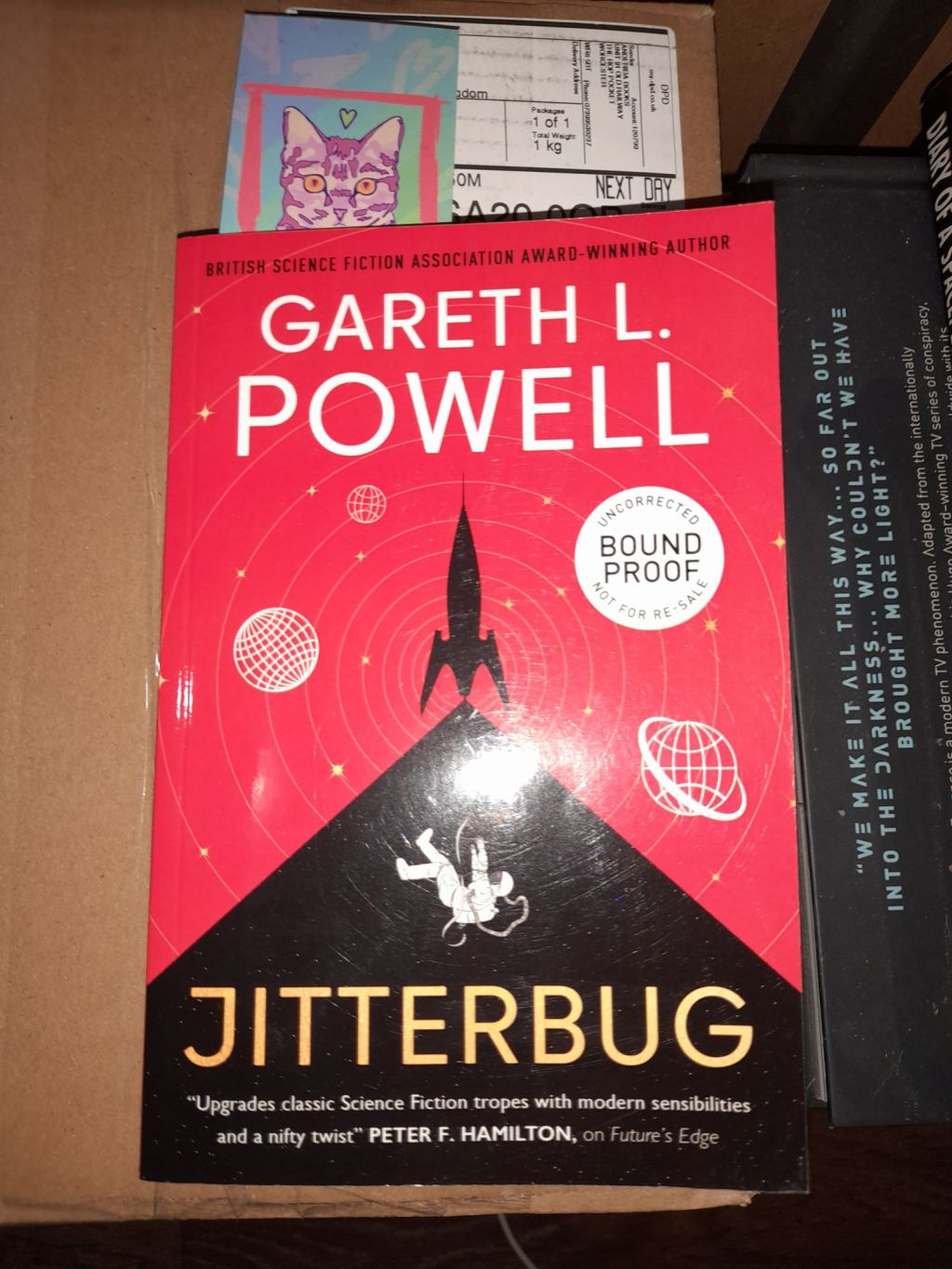
In a career spanning the best part of two decades, Gareth L. Powell has made something of a name for himself, especially when it comes to space opera. His Embers of War trilogy is a series that I still hold up as one of the best British examples of the genre. In the years since that series was complete, Powell has carved up a comfortable niche for his space operas, with a particular flair for small spaceships and tight-knit crews. The two Continuance novels, Future’s Edge, and now Jitterbug all follow in that tradition. Some of those novels have fared better than others in my estimation, but when Jitterbug was announced I had high hopes that it could capture the magic of Powell’s earlier trilogy.
Jitterbug follows on from previous novels not only in style, but also thematically. It’s the not-too-distant future, and the solar system is under threat by immensely powerful and incredibly mysterious aliens. Powell’s fans will be pleased, while readers of series like James S A Corey’s The Expanse will also find a lot that appeals. The book is deeply concerned with the end of the world, and the fact that we mere mortals can’t really do a whole lot about it. The best we can do is learn to cope with our ever-changing stellar environment.
As is Powell’s frequent style, we follow a group of spacefarers through multiple first-person perspectives, handily divided by chapters bearing their names. And yes, one of these characters is a spaceship’s AI, who adopts the appearance (and mannerisms) of a parrot. Because why not? As a result, there’s a lot of head-hopping, and the narrative never sits in one place for too long. It’s a fast and frantic adventure that offers up a whole load of fun.
That fun does come at a cost, however. Powell’s light touch is a hallmark of his space operas. He’s not the sort to get bogged down in deep philosophising or internal monologues. In Jitterbug, this leads to the characters feeling oddly hollow. There’s a sense that they’re all just going through the motions, existing only to serve as archetypes for the narrative.
My bigger issue, however, is the ending. I really enjoyed the build-up to humanity’s first contact with an alien artefact. The action is well-executed, the banter witty, and the villains suitably scenery-chewing. Then comes a twist, and it comes out of nowhere. Yes, Powell ties it back to the prologue (which I found so abrupt as to be unintentionally hilarious the first time around), but the final fifty-odd pages of the book feel like they’ve wandered in from another book. Or a sequel that’s been squeezed into a standalone at the last moment. It’s a sudden gear change that may as well be a full reset of the book, and does the overall story no favours.
So yes, this is definitely the weakest of Powell’s space operas to date, but even if the ending is a bit of a dud, I still had fun getting there. Maybe other readers won’t have the same issues as me, who’s to say? There’s a fun space opera jaunt in here, but for me those usually clear waters of muddied by the let-down of a finale.
Book Stats
- A Standalone Novel
- Published 03/03/2026 by Titan Books
My thanks go to the publisher for providing an advance copy in exchange for an honest review.

 At Boundary's Edge