Teaser
The year is 1952, and Washington DC has been destroyed by a meteor. With dust clouds threatening the future of humanity, there is only one way to go. Up, up, and away . . .
Review
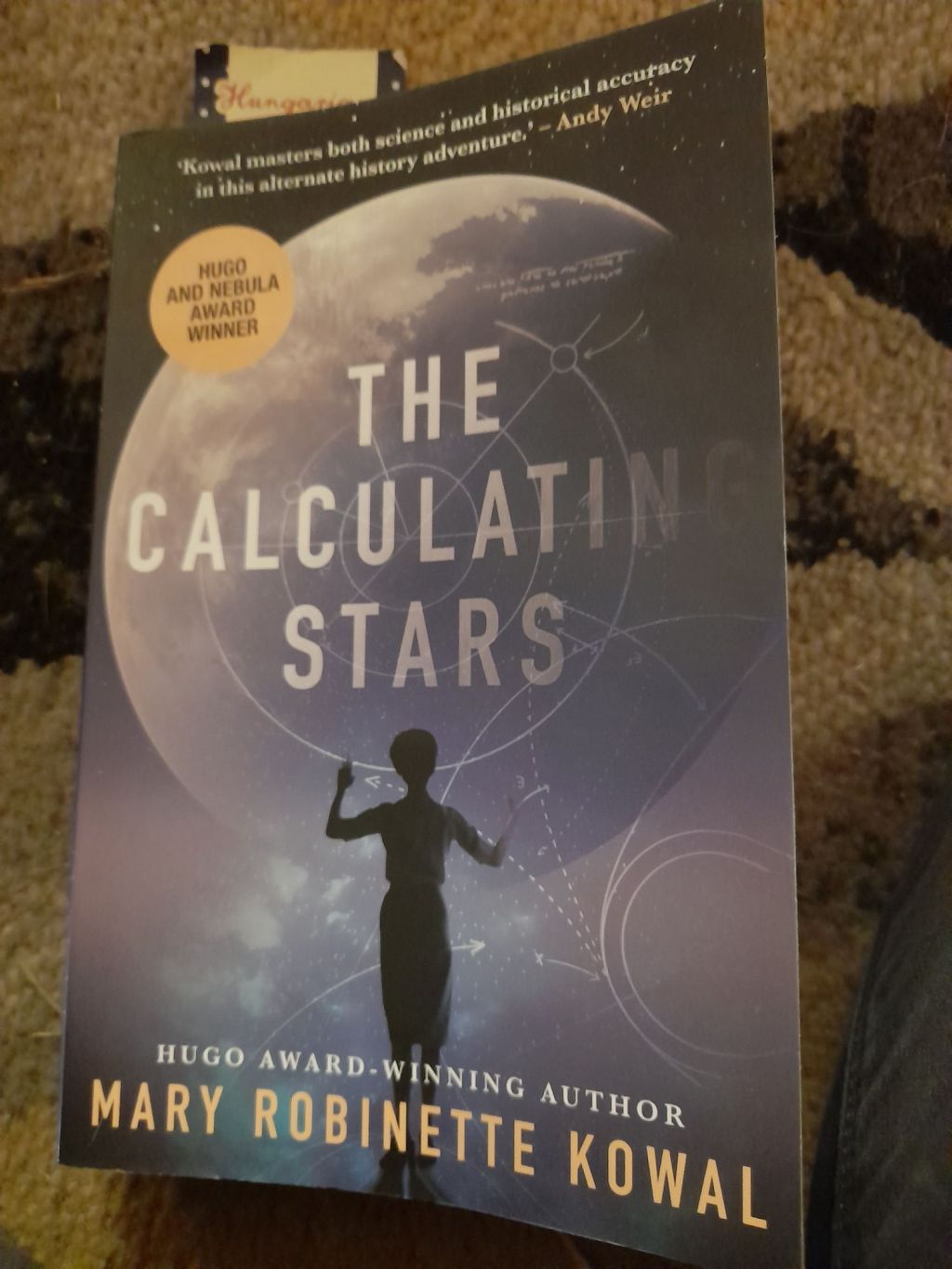
A fun fact about me is that I adore the space race. The period between Sputnik and the end of the Apollo missions has always held an interest for me, and regardless of the individuals involved, present-day spaceflight endeavours still gets me excited. Of course, this period is a busy sandbox for writers of alternative history. AppleTV’s For All Mankind is probably the best version of the story I’ve come across in recent years. If you haven’t seen it, I cannot recommend it highly enough. Mary Robinette Kowal’s The Calculating Stars won the Hugo Award in 2019, so it was only a matter of time before I got round to reading it. My initial excitement had been tempered by some less than glowing reviews from people I trust, but really? An alternate history space race? I was never going to stay away for long.
To address the criticisms. Yes, this is a very American novel. The book opens with the entire US government being wiped out of existence, yet somehow the US is still at the forefront of the new space race The book is rich with the unfair treatment of women, race relations, and the civil rights movements of the period, but with everyone pulling together, it’s a very rosy imagine of the United States that we end up getting. This didn’t particularly bother me, because we can all do with a bit of optimism every now and then, and as the book progresses, it does begin to acknowledge that perhaps the US isn’t as ideally placed to lead the space race as it claims to be. The other criticism I have of the book is in the marriage of Elma and Nathaniel. They are cloyingly lovey-dovey, and if I never have to read another rocketship innuendo before a fade-to-black, it will still be too soon. Again, it’s nice to see people getting along, but it was a touch overdone.
Having said all that, these minor quibbles pale in comparison to much I adored the rest of the novel. It’s set in the fifties, so most of the major players I know from the real space race don’t feature. Von Braun makes a brief appearance, and there are a handful of other real-life individuals scattered through the novel, but most of it is running on pure imagination. This complete rewriting of history allows for new first people in space, an earlier entry into space for women (the key narrative arc of the book), and genuine suspense when things inevitably go wrong.
I think people’s problems with The Calculating Stars stem from the same simple reason I enjoyed it so much. This is a nice book. It’s not cosy, I wouldn’t say. There’s racism, sexism, and the world has an expiry date in the near future. But it’s full of good people trying their best and being rewarded for their efforts. It probably helps if you grew up as obsessed with all thing outer space as I did, but there’s a charming naivety to the book. Scientists give one briefing about climate change, and are immediately believed. They apply for jobs, and they get them. On a fundamental level, this is a book of pure wish fulfilment. Wouldn’t it be nice if everything in our world were as simple as Kowal makes them out to be? On another day these flaws would have bothered me a lot more. I might even have picked the book apart. But I won’t. The Calculating Stars has put me in a good mood, and made me optimistic about space travel. For that, I have little choice but to say thank you.
Book Stats
- The Lady Astronaut #1
- Published 2018
- 497 Pages


 At Boundary's Edge