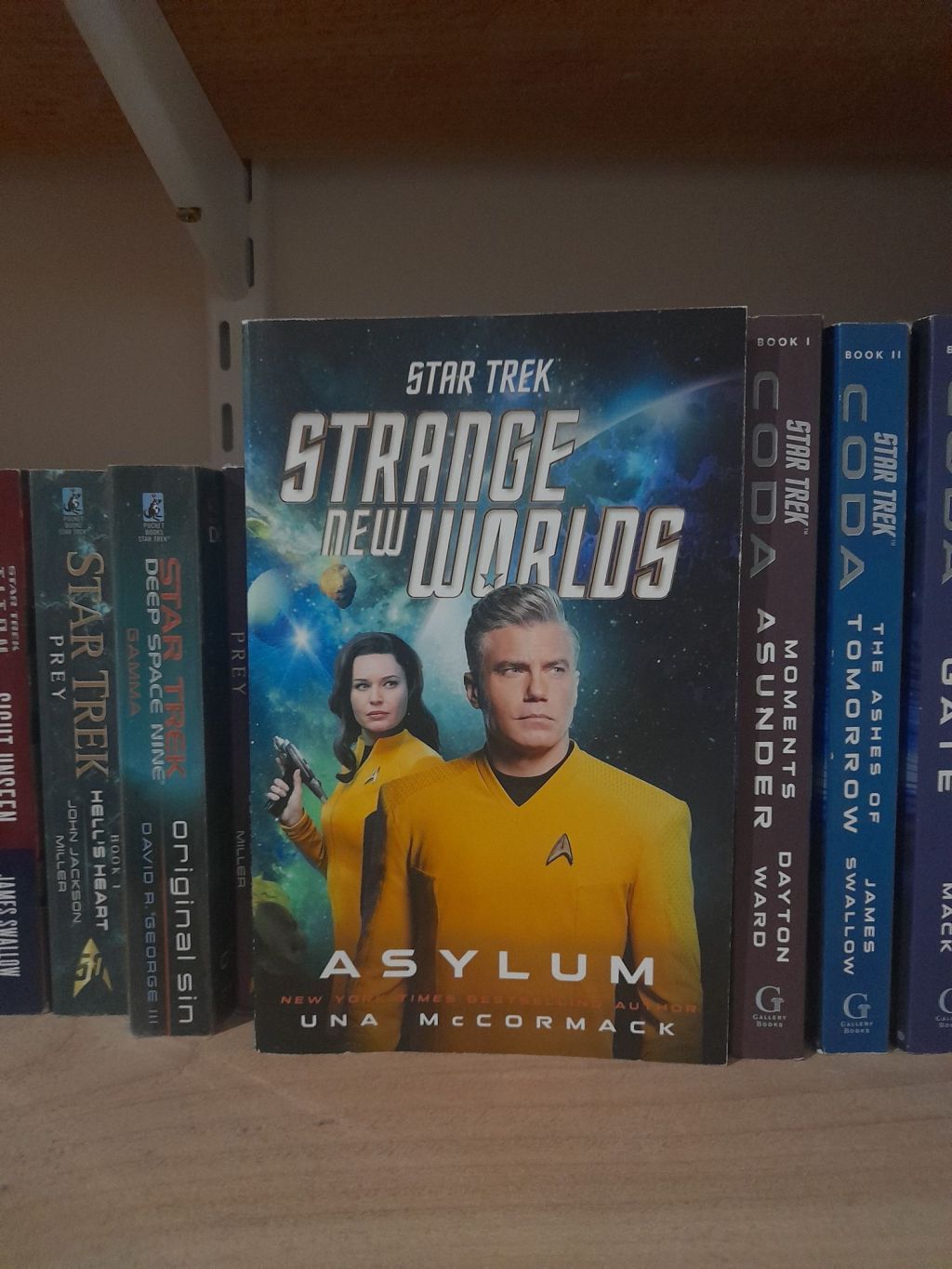
Teaser
When the Enterprise crew are tasked with safeguarding negotiations to bring a new world into the Federation, it dredges up old memories of Pike and Una’s Academy days . . .
Review
I’ve read hundred of Star Trek novels at this point, but there’s one variety I’ve tended to avoid: the ones written while the series is airing, and set between episodes. Broadly speaking, these books are the bedrock of the Trek literary canon, and function as extra episodes. However, because they are extraneous to the TV series, there’s a certain tension that is lacking. For example, you know a major character won’t be killed off, because they have to be on screen next week. The bigger issue is that the ones written early in a series’ run tend to be based on incomplete ideas for the show. thus we have Bill Riker and Doc Zimmerman instead of William Riker and the Doctor. Small niggles, perhaps, but niggles nonetheless.
In the modern world of Trek literature, the publication schedule is a lot more relaxed than it once was. However, the shows are increasingly serialised, leaving little room for extra adventures. The Picard novels I have read so far have all been prequels, and all the better for that, whereas the Discovery novels have had a harder time writing themselves around the events seen on screen. Strange New Worlds is much more episodic. so it’s easier to fit these standalone novels into the larger narrative. In spite of my general reluctance to approach these books, the combination of Strange New Worlds and Una McCormack proved impossible to resist.
The two halves of tie-in fiction are, of course: Does it tell a good story? And does it fit neatly with the larger franchise?
On the first point, it’s a resounding yes. Generally I complain about split timelines in books, but I don’t think there was any other way this story could be told. Some of the splits in where present day and flashback stop and start do feel arbitrary, but the gentle pacing of the book means it never becomes too much of an issue. And yes, I am using the word gentle to describe a book about high-stakes politics and terrorism.
In the present day, we have Pike and friends taking part in negotiations with a feline alien race (who are very well-developed from a cultural standpoint, putting approximately a hundred other Trek aliens to shame in how well-realised their culture is by McCormack. There aren’t many surprises here, but the original characters all have sound motivations and the mystery of who wants to disrupt negotiations is a compelling one.
In the past, we go back to Una Chin-Riley’s days at the Academy, and her first meeting with a young Pike. Not only does this earlier stage of life explain away any character inconsistencies, it also serves to show how Una covered her Illyrian origins while at the Academy. Of course, there is a link to the present-day, as Una works with a family of those very same feline aliens who are seeking asylum in the Federation. Plot-wise, it’s all very well executed.
But does it feel like an episode of the show? Well, the flashbacks would obviously be harder to realise on the show, but Una and Pike do genuinely feel like younger versions of their familiar selves. It’s a little weird to see Una referred to as Una or Chin-Riley rather than Number One, but it never took me out of the story. La’An gets a secondary role as head of security for the negotiations and I have no complaints there. Neither M’Benga nor Chapel appear, and the rest of the regular crew are largely relegated to a single scene, but all are captured well. Not bad at all for what is largely an Una Chin-Riley character piece. However, the starring role must surely go to Pelia. Carol Kane’s performance is utterly unique, but McCormack captures her energy perfectly. I have no notes of criticism at all.
Asylum is a perfect literary introduction to Strange New Worlds, and I look forward to many more extra adventures from both the Enterprise crew and Una McCormack.
Book Stats
- Set during Strange New World’s 2nd Season
- First Published in 2024
- 304 Pages